Responses API Image Input for Vision Models on AI-901
Short answer
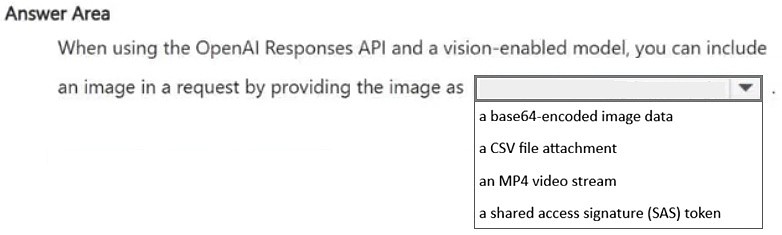
Complete the sentence with a base64-encoded image data string. The Responses API accepts images either inline as base64-encoded data or via a public image URL — not as CSV, MP4, or an SAS token.
Question
Select the answer that correctly completes the sentence.
Key Takeaways
The test checks whether you know the only two accepted image input formats for the Responses API — inline base64-encoded data or a URL — and the trap is picking a file-format or credential term (CSV, MP4, SAS token) that has nothing to do with image transport.
This AI-901 hotspot asks how the Responses API accepts an image when calling a vision-enabled model such as a GPT-4o-class model in Azure AI Foundry/OpenAI. The sentence is correctly completed with a base64-encoded image data string, because the API supports exactly two image input formats: inline base64-encoded data or a public image URL.
Common mistake: Choosing an SAS token, a CSV file, or an MP4 video, because these are common items seen around AI workloads. None of them deliver pixel data to the model: an SAS token is only a storage-access credential, and CSV/MP4 are unrelated file formats rather than image payload formats.
Expert Analysis
Why the Answer Is Correct
When a vision-enabled model is called through the Responses API, the image content must be delivered inside the request payload, and the two supported ways to do that are a base64-encoded image data string embedded inline or a URL pointing to a publicly reachable image. Base64 encoding converts the raw bytes of a JPG or PNG into a text-safe character stream that can travel in a JSON payload without multipart handling, which is exactly what a REST-based Responses call requires. Therefore the blank must be completed with base64-encoded image data, since the alternative valid format (a URL) is not offered as a choice in this hotspot.
Why Other Candidate Answers Are Wrong
A CSV file is a delimited text format for tabular data and carries no image pixels, so passing it would give the model nothing visual to analyze. An MP4 is a compressed video container, and although some multimodal endpoints accept video, the Responses API image slot described here is specifically about image input, not video ingestion. An SAS token is merely a time-limited authorization string for Azure Blob or container access; it may accompany a URL, but it is not itself a way of passing image content to the model, so it does not complete the sentence.
Community Comment Notes
Commenters converge on the same verdict, with derafazu noting the answer
Official Reference
https://learn.microsoft.com/azure/ai-services/openai/how-to/gpt-with-vision
This link opens the official vendor documentation in a new tab.
Exam Strategy
When a hotspot asks how an API receives multimodal content, think in terms of transport formats (inline encoded bytes versus URL references), not file extensions or credentials. Eliminate any candidate that is an authorization artifact or an unrelated media container before selecting the encoded-data option.
Frequently Asked Questions
What image formats does the Responses API accept when calling a vision-enabled model?
Why is an SAS token not the correct completion for the image-passing sentence?
Discussion 3 contributions
Compiled from public community threads and reader submissions, lightly edited for clarity. Handles and vote tallies are shown as recorded, and comments reflect the views of individual contributors.
From public community threads 3
-
derafazu 👍 2The answer is correct by elimination — CSV, MP4, and SAS tokens have nothing to do with how the Responses API handles images. But it's worth noting the API actually supports two ways to pass an image to a vision-enabled model: either a base64-encoded string or a public image URL
-
Mary_Matic 👍 1Correct Answer is a base64-encoded image data. Becouse a base64-encoded image data: When working with vision-enabled models via API (such as OpenAI/Azure OpenAI), images can be passed directly as base64-encoded data strings within the payload or via image URLs.
-
Veenala 👍 1Answer is base64-encoded image data, the other accepted version being URL which isn't given here.
Reader comments & corrections
No reader corrections yet — spotted an error or have a note? Share it below.
Related Analysis
Practice All AI-901 Questions
Access 105 questions with complete answers and detailed explanations.
View Full AI-901 Practice Test →