Do Overall Accuracy and Group Comparisons Reveal AI Bias?
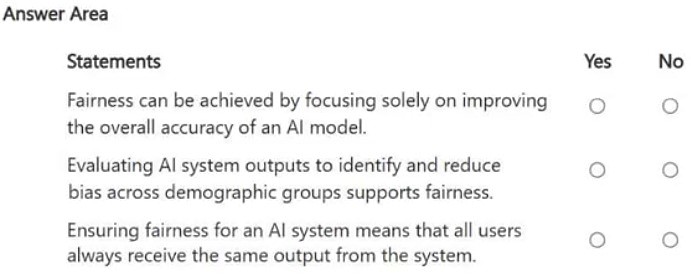
HOTSPOT
For each of the following statements, select Yes if the statement is true. Otherwise, select No.
NOTE: Each correct selection is worth one point.
Community Insight
The item tests whether you understand that fairness requires subgroup-level measurement, and the common trap is assuming that a strong aggregate accuracy number means the model treats all groups equitably.
This AI-901 hotspot tests the responsible-AI fairness principle that a single aggregate metric, such as overall accuracy, cannot prove a model is unbiased. The page establishes which fairness statements are true: a high aggregate accuracy score does not guarantee fairness, while explicitly comparing model outputs across demographic subgroups is the standard way to detect hidden disparities.
The most common wrong approach is selecting Yes for the claim that high overall accuracy indicates an unbiased model. Aggregate metrics average errors across the whole dataset, so poor performance on a small, underrepresented group can be mathematically invisible in the total score.
Community Discussion (1 comments)
Comments & Corrections
No comments yet — spotted an error or have a note? Share it below.
Expert Analysis
Why the Answer Is Correct
Microsoft's responsible AI guidance lists fairness as a principle measured with disaggregated metrics, not headline accuracy. Overall accuracy is computed across the entire evaluation set, so a model that fails badly on a small demographic group can still post an excellent aggregate score. Detecting that disparity requires slicing the data and comparing error rates, prediction distributions, and outcome metrics across defined groups — exactly what the second statement describes as a proactive mitigation practice. That is why the aggregate-accuracy claim is false and the subgroup-comparison claim is true.Why Other Candidate Answers Are Wrong
Marking the accuracy statement as true confuses aggregate performance with equitable performance; accuracy says nothing about how errors are distributed across groups. Equally, marking the subgroup-comparison statement as No ignores the core of the fairness measure phase, where evaluators compare performance across sensitive attributes precisely to surface disparities. A third error is believing fairness can be established once at deployment; fairness evaluation is iterative and must be repeated whenever data, thresholds, or deployment context change.Community Comment Notes
The single community comment frames the logic well, noting that "High overall accuracy can often hide significant biases against smaller, underrepresented demographic groups." The commenter also argues that "Proactively evaluating and comparing outputs across different demographics helps engineers identify disparities," which supports the Yes selection for the subgroup-comparison statement. The parenthetical guesses attached to that comment are inconsistent with its own reasoning, so follow the reasoning rather than the label.Official Reference
Exam Strategy
Read each hotspot statement as an absolute claim: wording like "indicates the model is fair" or "guarantees no bias" is almost always No. Favor statements describing subgroup slicing, metric comparison across demographics, and iterative evaluation — those reflect Microsoft's documented fairness workflow.
Frequently Asked Questions
Why doesn't high overall accuracy mean an AI model is fair?
Overall accuracy is an aggregate across the whole dataset, so poor performance on a small underrepresented group is diluted. Fairness must be measured per subgroup, not on the total score.
How do you detect bias in an AI model's outputs?
Slice evaluation data by sensitive attributes such as demographic groups, then compare error rates and outcome metrics across those slices to reveal disparities, per Microsoft's fairness measure guidance.
Related Analysis
Practice All AI-901 Questions
Access 105 questions with complete answers and detailed explanations.
View Full AI-901 Practice Test →