Identify Speech-to-Text Workloads in Azure AI
HOTSPOT
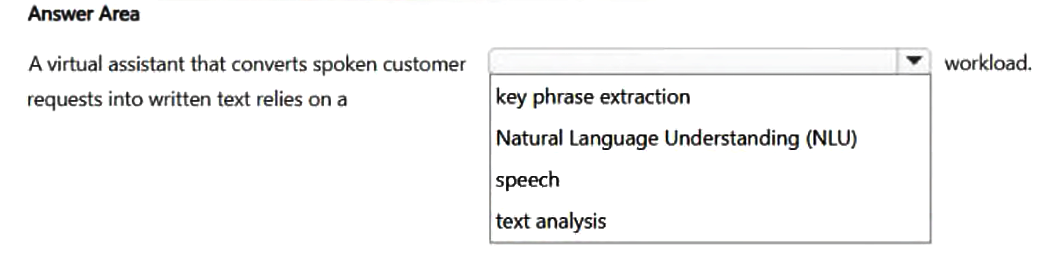
Select the answer that correctly completes the sentence.
Community Insight
The core trap is confusing input modalities; learners must recognize that processing an audio signal requires a speech workload, whereas other options only process existing text.
This question tests the ability to distinguish between AI workloads, specifically identifying speech recognition as the correct solution for converting audio to text. It establishes that speech workloads are distinct from text-based analysis tools like NLU or key phrase extraction.
Learners often select Natural Language Understanding (NLU) because it involves 'understanding' language, failing to realize that NLU requires text input, not raw audio.
Community Discussion (3 comments)
Comments & Corrections
No comments yet — spotted an error or have a note? Share it below.
Expert Analysis
Why the Answer Is Correct
The scenario describes converting spoken customer requests into written text, which is the definition of speech recognition. In Azure AI and general AI terminology, this is classified as a Speech workload (often referred to as speech-to-text). This workload takes an audio signal as input and outputs text.Why Other Candidate Answers Are Wrong
Other options like Key Phrase Extraction and Natural Language Understanding (NLU) operate on text data, not audio. Key phrase extraction identifies important terms within a document, while NLU interprets intent and entities from already-transcribed text. Since the input here is audio, these text-only workloads cannot be applied directly without prior transcription.Community Comment Notes
Community consensus strongly supports 'Speech' as the answer. As user mk2501 noted, "The task described is speech recognition: converting an audio signal into text." Another commenter, Sr18, confirmed it was a "no brainer question" pointing to Speech. Jedi_Jeremy further clarified that speech workloads are designed to recognize spoken language, distinguishing it from text-based interpretations.Exam Strategy
When analyzing AI workload scenarios, always identify the input modality first. If the input is audio/video, look for Speech or Computer Vision workloads. If the input is text, look for Language, Text Analytics, or Generative AI workloads.
Frequently Asked Questions
What is the difference between Speech and Natural Language Understanding workloads?
Speech workloads convert audio to text (transcription), while NLU workloads analyze existing text to understand intent, entities, and sentiment.
Can I use Key Phrase Extraction on audio files directly?
No. Key phrase extraction analyzes text documents to find significant terms. You must first transcribe the audio using a Speech workload before applying text-based analytics.
Related Analysis
Practice All AI-901 Questions
Access 105 questions with complete answers and detailed explanations.
View Full AI-901 Practice Test →