Azure OpenAI Tool Use Modes: Required vs None vs Auto
Short answer
1. No; 2. Yes; 3. Yes
Question
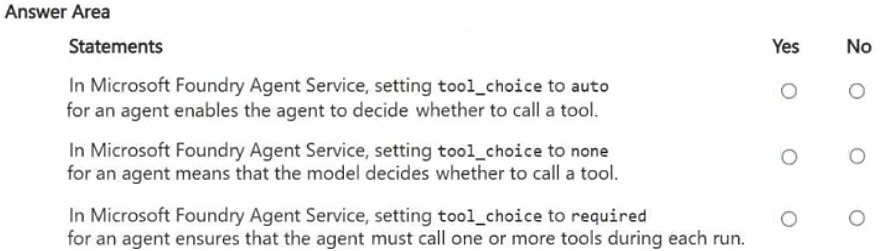
For each of the following statements, select Yes if the statement is true. Otherwise, select No.
NOTE: Each correct selection is worth one point.
Key Takeaways
The trap lies in confusing 'required' (mandatory tool call) with 'auto' (model's choice). 'Required' forces a tool call, eliminating direct answers.
Determines the truthfulness of statements regarding Azure OpenAI tool use configurations: required, none, and auto. The correct selections are No, Yes, and Yes respectively.
Common mistake: Learners often mark the first statement as 'Yes', mistakenly believing 'required' means the model has the option to choose. In reality, 'required' removes that option, forcing a tool invocation.
Expert Analysis
This question tests the understanding of Tool Use configurations in Microsoft Azure OpenAI Service, specifically how the required and none settings affect model behavior. The correct evaluation relies on distinguishing between optional tool invocation and mandatory or prohibited tool usage.
For the first statement, the configuration is set to required. This setting mandates that the model must select at least one available tool to process the request. It cannot generate a direct text response if tools are available; it must call them. Therefore, the statement describing this as 'the model decides whether to call a tool or answer directly' is incorrect because the choice is not left to the model's discretion—it is forced.
For the second statement, the configuration is none. This explicitly prohibits the model from calling any tools. The model is restricted to generating direct responses based solely on its training data and the prompt context. Any attempt to invoke a tool is blocked. Thus, the statement claiming 'the model is not allowed to call tools, must answer directly' accurately reflects this constraint.
The third statement describes the default behavior or a different configuration (often auto). In auto mode, the model intelligently decides whether to use a tool or answer directly based on the user's intent. If the user asks a general knowledge question, it answers directly; if they need specific data via an API, it calls the tool. The statement 'the model decides whether to call a tool or answer directly' correctly identifies this autonomous decision-making capability.
Operational Consequence: Misconfiguring these settings can lead to application failures. Setting required when tools might be irrelevant causes errors or hallucinations. Setting none when dynamic data retrieval is needed breaks functionality. Understanding these modes ensures robust AI agent design.
Exam Strategy
When facing HOTSPOT questions about AI capabilities, map each keyword to its strict operational definition. For tool use, remember: 'required' = no direct answers allowed; 'none' = tools disabled; 'auto' = intelligent selection. Always check if the statement allows flexibility where the setting forbids it.
Frequently Asked Questions
What happens if I set tool_use to 'required' but the user asks a general question?
Can the model answer directly if 'required' is set?
Discussion 1 contributions
Compiled from public community threads and reader submissions, lightly edited for clarity. Handles and vote tallies are shown as recorded, and comments reflect the views of individual contributors.
From public community threads 1
-
GrandWizard_007 👍 11. Yes 2. No 3. Yes auto -> the model decides whether to call a tool or answer directly required -> the model must call one or more tools, cannot answer without them none -> the model is not allowed to call tools, must answer directly
Reader comments & corrections
No reader corrections yet — spotted an error or have a note? Share it below.
Related Analysis
Practice All AI-901 Questions
Access 105 questions with complete answers and detailed explanations.
View Full AI-901 Practice Test →