Microsoft Foundry SDK: HTTP Requests, Web Services, and Authentication
Short answer
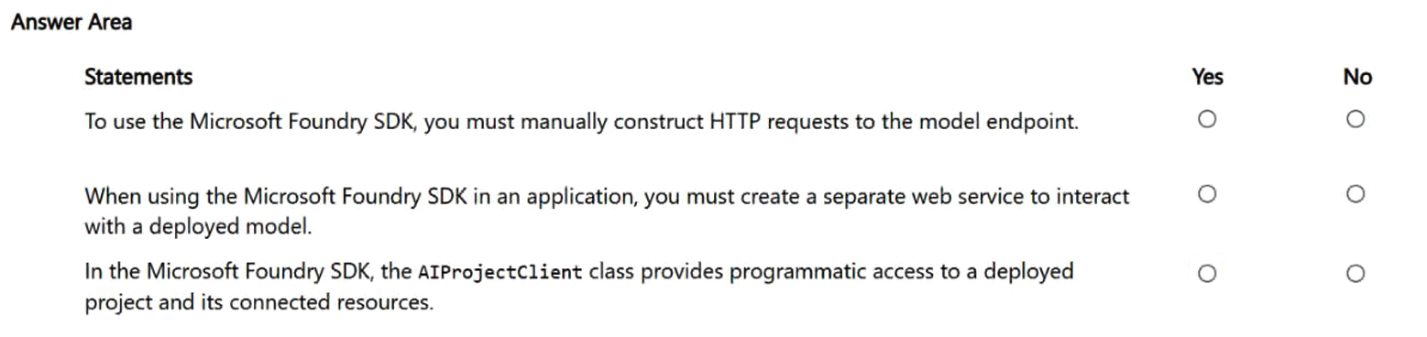
1. No, 2. No, 3. Yes. The SDK abstracts HTTP requests, connects directly to model endpoints without a separate web service, and includes built-in authentication handling.
Question
For each of the following statements, select Yes if the statement is true. Otherwise, select No.
NOTE: Each correct selection is worth one point.
Key Takeaways
The main trap is assuming manual low-level coding is required; the SDK abstracts HTTP, direct connection, and auth, making all but the third statement false.
Determine the truthfulness of statements about the Microsoft Foundry SDK's handling of HTTP requests, web services, and authentication for AI-901 certification.
Common mistake: Learners often select 'Yes' for the first two statements, mistakenly believing that integrating with AI models requires manual REST API construction and middleware creation, ignoring the SDK's abstraction.
Expert Analysis
Step-by-Step Evaluation of Microsoft Foundry SDK Capabilities
The scenario requires evaluating three statements regarding the Microsoft Foundry SDK. This SDK is designed to simplify interactions with Azure AI services and models, abstracting away low-level implementation details.
Statement 1: "You must manually construct HTTP requests to call an AI model."
This statement is False (No). The primary purpose of the Microsoft Foundry SDK (and Azure AI SDKs generally) is to provide a high-level programming interface. It handles authentication, serialization, deserialization, and network communication automatically. Developers interact with method calls (e.g., client.complete), not raw HTTP POST requests. Manually constructing HTTP requests contradicts the abstraction layer provided by the SDK.
Statement 2: "You must create a separate web service to connect to your deployed model." This statement is False (No). The SDK connects directly to the model endpoint exposed by the Foundry project or Azure resource (such as Azure OpenAI). There is no requirement to build an intermediate middleware or separate web service for standard integration. The SDK communicates directly with the cloud-based inference endpoint.
Statement 3: "The SDK provides built-in methods for handling authentication." This statement is True (Yes). The SDK integrates with Azure Identity libraries, allowing developers to use credentials like DefaultAzureCredential or API keys securely within the client configuration. This eliminates the need to hardcode secrets or manage token lifecycles manually in most scenarios.
Conclusion:
- Statement 1: No
- Statement 2: No
- Statement 3: Yes
Exam Strategy
When encountering questions about SDK capabilities, remember that SDKs are designed to reduce boilerplate code. If a statement suggests manual low-level work (like building HTTP requests or creating extra services), it is likely incorrect unless specific edge cases are mentioned. Focus on what the SDK abstracts away versus what remains developer responsibility.
Frequently Asked Questions
Does the Microsoft Foundry SDK require manual REST API calls?
Do I need to build a web service to use the Foundry SDK?
Discussion 1 contributions
Compiled from public community threads and reader submissions, lightly edited for clarity. Handles and vote tallies are shown as recorded, and comments reflect the views of individual contributors.
From public community threads 1
-
GrandWizard_007 👍 11. No - You do not have to manually construct HTTP requests when using the Microsoft Foundry SDK — the SDK provides built‑in methods that handle the HTTP calls, authentication, and routing to the correct model endpoint for you. 2. No - you do not have to create a separate web service; the Microsoft Foundry SDK can connect directly to your deployed model via the Foundry project endpoint. 3. Yes - the AIProjectClient class in the Microsoft Foundry SDK provides programmatic access to a deployed project and its connected resources.
Reader comments & corrections
No reader corrections yet — spotted an error or have a note? Share it below.
Related Analysis
Practice All AI-901 Questions
Access 105 questions with complete answers and detailed explanations.
View Full AI-901 Practice Test →