Mapping Tasks to Microsoft Responsible AI Principles
Short answer
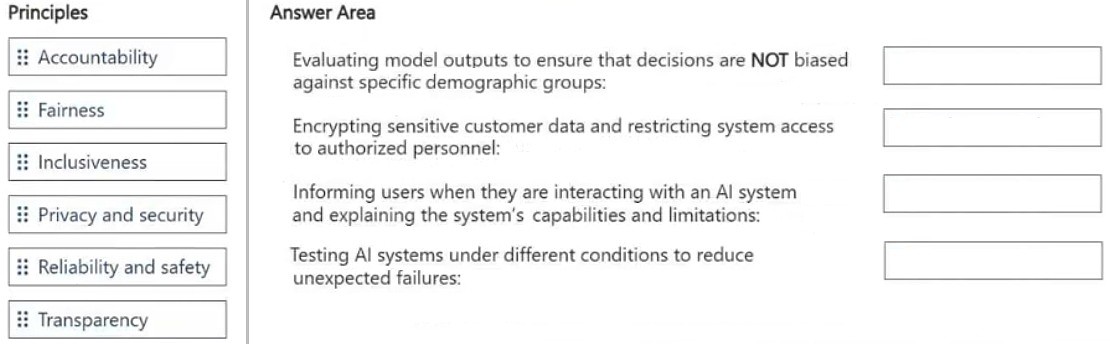
Map tasks to Microsoft Responsible AI principles: Bias mitigation maps to Fairness; explaining decisions maps to Transparency; error handling maps to Reliability and Safety; and data protection maps to Privacy and Security.
Question
You are reviewing best practices for using AI at your company.
Which Microsoft responsible AI principle is each task an example of? To answer, drag the appropriate principles to the correct tasks. Each task may be used once, more than once, or not at all. You may need to drag the split bar between panes or scroll to view content.
NOTE: Each correct match is worth one point.
Key Takeaways
The main trap is confusing Transparency (explainability) with Fairness (bias prevention); remember that fairness deals with equitable outcomes, while transparency deals with user understanding.
Learn how to match AI operational tasks to Microsoft's Responsible AI principles like Fairness, Transparency, and Reliability for the AI-901 exam.
Common mistake: Learners often misclassify 'documentation' as Fairness instead of Transparency, failing to recognize that transparency specifically covers making system behavior understandable to users.
Expert Analysis
The question requires mapping specific operational tasks to Microsoft's six principles of Responsible AI: Fairness, Reliability and Safety, Privacy and Security, Inclusiveness, Transparency, and Accountability. The core concept tested is the precise boundary between Fairness (preventing bias in outcomes) and Transparency (making systems understandable and traceable).
For example, a task involving "ensuring data sets are representative" or "mitigating algorithmic bias" falls squarely under Fairness, as it addresses equitable treatment. In contrast, a task such as "providing documentation on model limitations" or "explaining how decisions are made" belongs to Transparency, which focuses on user understanding and system explainability.
Another critical distinction is between Reliability and Safety and Privacy and Security. Tasks related to "testing for robustness," "handling errors gracefully," or "preventing unintended harm" align with Reliability and Safety. Meanwhile, tasks concerning "protecting personal data," "encryption," or "access controls" belong to Privacy and Security.
The comment provided lists the principles: "Fairness, Privacy and security, Transparency, Reliability and safety." This confirms the candidate must distinguish these four primary pillars based on the action described. For instance, if a task involves "auditing models for disparate impact," it is Fairness. If it involves "logging decision paths for auditability," it is Transparency.
To solve this, analyze the verb and object in each task:
- Does it address bias/equity? → Fairness.
- Does it address understanding/explanation? → Transparency.
- Does it address stability/error-handling? → Reliability and Safety.
- Does it address data protection/access? → Privacy and Security.
The correct answer depends entirely on matching the task description to the principle that governs that specific risk area.
Official Reference
https://www.microsoft.com/en-us/ai/responsible-ai
This link opens the official vendor documentation in a new tab.
Exam Strategy
When facing drag-and-drop principle questions, isolate the keyword in the task description first. Use elimination: if the task mentions 'bias,' 'disparate impact,' or 'representative data,' select Fairness. If it mentions 'explain,' 'log,' or 'document,' select Transparency. Always verify against the principle's definition rather than guessing.
Frequently Asked Questions
What is the difference between Fairness and Transparency in Microsoft's AI principles?
Which principle covers error handling and robustness?
Discussion 1 contributions
Compiled from public community threads and reader submissions, lightly edited for clarity. Handles and vote tallies are shown as recorded, and comments reflect the views of individual contributors.
From public community threads 1
-
imran78690 👍 1Fairness Privacy and security Transparency Reliability and safety
Reader comments & corrections
No reader corrections yet — spotted an error or have a note? Share it below.
Related Analysis
Practice All AI-901 Questions
Access 105 questions with complete answers and detailed explanations.
View Full AI-901 Practice Test →