Responsible AI Principles: Fairness vs Inclusiveness | AI-901
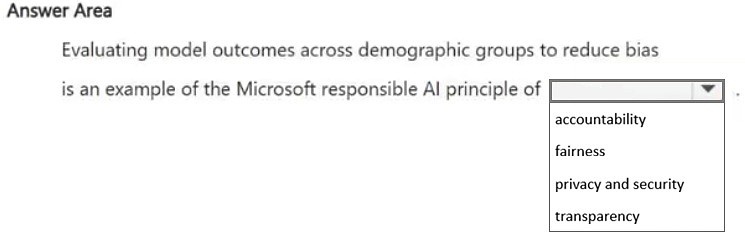
HOTSPOT
Select the answer that correctly completes the sentence.
Community Insight
The question tests your ability to identify which responsible AI principle applies to a scenario involving biased data or unfair outcomes, often confusing fairness with inclusiveness.
This study guide explains how to distinguish between the fairness and inclusiveness principles of Responsible AI, clarifying that fairness focuses on eliminating bias in model outputs.
Learners often select 'inclusiveness' because it sounds positive, but they fail to recognize that 'fairness' is the specific term for addressing bias and ensuring equitable treatment across different groups.
Community Discussion (1 comments)
Comments & Corrections
No comments yet — spotted an error or have a note? Share it below.
Expert Analysis
Why the Answer Is Correct
The correct answer is Fairness. In Microsoft's Responsible AI framework, the principle of Fairness specifically addresses the need to treat all people fairly and avoid affecting similarly situated people differently. It involves mitigating bias in training data and model outcomes to ensure equitable results for diverse user groups.Why Other Candidate Answers Are Wrong
Inclusiveness is a related concept but refers to ensuring that AI systems are accessible and usable by everyone, including people with disabilities. While important, it does not primarily address the elimination of statistical bias or unfair discrimination, which is the core definition of Fairness. Other principles like Reliability or Privacy do not fit this specific context of equity.Community Comment Notes
One commenter noted that 'the Answer by elimination is fairness but the wording... would suggest the answer is inclusiveness'. This highlights the common trap where candidates focus on the broad idea of helping everyone (inclusiveness) rather than the technical requirement of unbiased treatment (fairness). The key is recognizing that fairness deals with bias mitigation.Exam Strategy
When asked about bias, equity, or treating groups equally, always choose 'Fairness'. When asked about accessibility, usability for disabled users, or reaching underserved populations, consider 'Inclusiveness'. Memorize these distinctions to avoid confusion in hotspot questions.
Frequently Asked Questions
What is the difference between Fairness and Inclusiveness in AI?
Fairness focuses on eliminating bias and ensuring equitable outcomes for different groups. Inclusiveness focuses on making AI accessible and usable for everyone, including those with disabilities.
How does Microsoft define Fairness in its Responsible AI principles?
Microsoft defines Fairness as treating all people fairly and avoiding affecting similarly situated people differently, which includes mitigating bias in data and models.
Related Analysis
Practice All AI-901 Questions
Access 105 questions with complete answers and detailed explanations.
View Full AI-901 Practice Test →