Configuring the vPC System MAC Address for Separate vPC Domains in a DCI
Short answer
A 00:23:04:ee:be:14 on SW3
Question
Key Takeaways
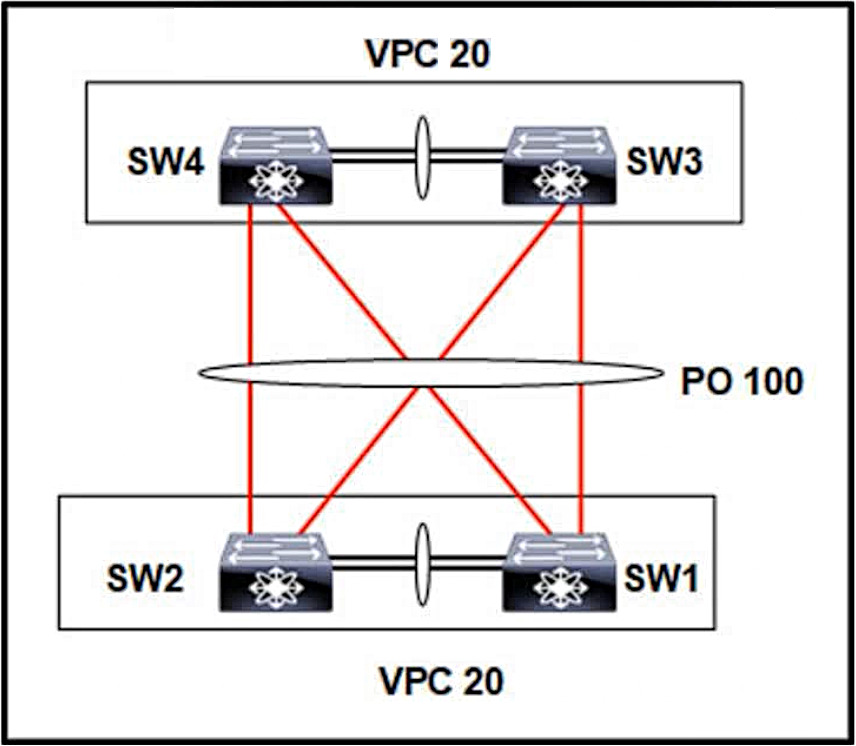
The vPC system MAC is domain-specific and must be unique per vPC domain. SW1 and SW2 (same domain) share the same system MAC (00:23:04:ee:be:20); SW3 (a different domain) must use a different value (e.g., 00:23:04:ee:be:14). SW2 must keep SW1's MAC to stay in the same domain.
Each vPC domain must have a unique system MAC address used for LACP and link-scope operations. In a dual-fabric DCI where SW1/SW2 form one domain and SW3 is a separate domain, SW3 must be configured with a different system MAC than SW1's 00:23:04:ee:be:20.
Common mistake: Setting SW2 to a new MAC (C/D) — SW2 is the peer of SW1 and must keep 00:23:04:ee:be:20. Or setting SW3 to the same MAC as SW1 (B) — that would collide two domains system MACs.
Expert Analysis
Why the Answer Is Correct
The vPC system MAC must be unique per vPC domain. SW1 and SW2 are one domain (both 00:23:04:ee:be:20). SW3 belongs to a different domain, so it requires a distinct system MAC — 00:23:04:ee:be:14 on SW3. This ensures LACP and peer-link operations do not collide across domains.
Why the Other Options Are Wrong
B. Sets SW3 to SW1's MAC, colliding two separate domains. C. Sets SW2 (peer of SW1) to a different MAC, breaking the SW1/SW2 domain pairing. D's 46:43:32:... is an unrelated MAC not derived from the fabric's allocated range.
Community Comment Notes
Community: "A is the only option that ensures the two vpc domains have different system MACs"; "the system MAC address must match for switches in the same vPC domain." Votes A 100.
Official Reference
This link opens the official vendor documentation in a new tab.
Community Votes
100% of anonymous learners picked answer A. Votes are pick records left by other test-takers — they are not the verified answer.
Discussion 4 contributions
Compiled from public community threads and reader submissions, lightly edited for clarity. Handles and vote tallies are shown as recorded, and comments reflect the views of individual contributors.
From public community threads 4
-
elper 👍 3 Answered AA is the only option that ensures the two vpc domains have different system MACs.
-
Rollizo 👍 1 Answered ASystem MAC Address Switch-Specific: Unique to Each Switch: Each switch in a vPC setup has its own unique system MAC address. This MAC address is specific to that individual switch and is used for internal operations, such as control plane communication and management. Internal Operations: The system MAC address is used by the switch for various internal processes, including maintaining the MAC address table and handling certain types of control plane traffic. Cannot be D because is complete different MAC address
-
bizzar7774 👍 1 Answered AA is correct. SW1 has a system MAC address of 00:23:04:ee:be:20. You need to configure the system MAC address for SW3 or SW2 in this vPC environment. The system MAC address must match for switches in the same vPC domain. ; C and D are not correct because SW2 mac should be the same as SW1 (00:23:04:ee:be:20): B is not correct because because mac address of SW3 must be different than mac address of SW1 or SW2 ; so the right answer is A because the mac address is different than the mac address of SW1 or SW2
-
crooks_1988 👍 1Answer should be C, in my opinion: VPC peer of sw1 is sw2 and they have to be the same vendor Each vPC domain has a unique MAC address that is used as a unique identifier for the specific vPC-related operation. Although the devices use the vPC system MAC addresses only for link-scope operations such as LACP
Reader comments & corrections
No reader corrections yet — spotted an error or have a note? Share it below.