NX-OS Scheduler Job VRF for TFTP Backup via the Global Routing Table
Short answer
A Use the default VRF for the scheduler job so the TFTP copy uses the global routing table.
Question
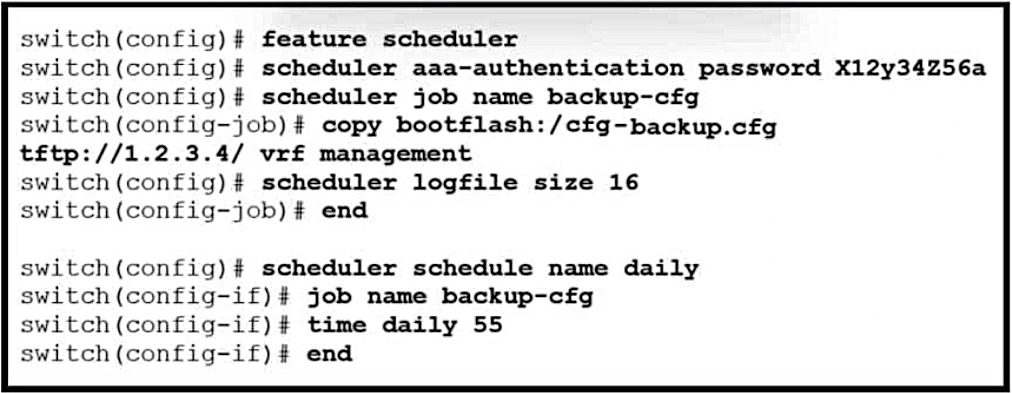
Key Takeaways
By default, file-copy operations in NX-OS (and scheduler jobs) use VRF management unless you explicitly set vrf default. If the TFTP server is in the global routing table (not the OOB management VRF), the scheduler job copy must use vrf default; otherwise the transfer fails because it looks in the management VRF.
NX-OS scheduler jobs execute CLI commands; when a copy command in the job targets a TFTP server reachable in the global routing table, you must specify vrf default (or omit VRF) so the copy uses the global table rather than the management VRF.
Common mistake: Assuming the start time (C) or authentication password (B) is missing. The exhibit already has 'time daily 55' defined and the job is authenticated by the logged-in user; the gap is the VRF — the copy needs vrf default to reach the global-table TFTP server.
Expert Analysis
Why the Answer Is Correct
The scheduler configuration is complete except for the VRF context of the TFTP copy. Because the TFTP server is reachable in the global routing table, the copy command inside the scheduler job must use vrf default (the default routing table), not VRF management. The start time ('time daily 55') and the job are already defined.
Why the Other Options Are Wrong
B. Scheduler authentication password is for AAA authentication of the scheduler user and is not the missing piece. C. Start time is already set ('time daily 55'). D. Job output size vs log file size is about log truncation, not connectivity to the TFTP server.
Community Comment Notes
Community: "A for sure, else the command tftp is executed in vrf management"; "global routing is not the same as management vrf." Votes A 100.
Official Reference
This link opens the official vendor documentation in a new tab.
Community Votes
100% of anonymous learners picked answer A. Votes are pick records left by other test-takers — they are not the verified answer.
Discussion 6 contributions
Compiled from public community threads and reader submissions, lightly edited for clarity. Handles and vote tallies are shown as recorded, and comments reflect the views of individual contributors.
From public community threads 6
-
crooks_1988 👍 2A. I would select C. is wrong, since the "time daily 55"already defined that: For the time daily 55 command, the scheduler assumes a start time every day at 22:55 hours
-
crooks_1988 👍 1B. is not because: switch(config) # scheduler aaa-authentication password [0 | 7] password Configures a password for the user who is currently logged in. - which is the case
-
Rollizo 👍 1 Answered AIt is A for sure, else the command tftp is execute in vrf management
-
udo2020 👍 1it is D because w/o this, the output will be truncated if its longer
-
asd248402 👍 1 Answered Aits a since the global routing is not the same as management vrf
Show 1 more comment
-
wickkkkkkkkkkkkkkkkkk 👍 1AAAAAAAAAAAAAAAAAAA is right.
Reader comments & corrections
No reader corrections yet — spotted an error or have a note? Share it below.