Activating a VSAN on a Virtual Fibre Channel (VFC) Interface in FCoE
Refer to the exhibit. An engineer configures FCoE in a newly installed data center. Which configuration must be applied to activate VSAN 100 on VFC 100? - 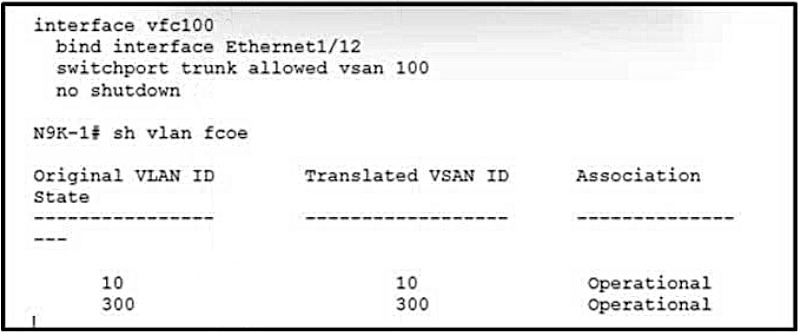
Community Votes
100% of anonymous learners picked answer A. Votes are pick records left by other test-takers — they are not the verified answer.
Community Insight
FCoE requires a dedicated VLAN that is mapped to a VSAN (the FCoE VLAN is the Ethernet transport for that VSAN). Without the fcoe vsan mapping, the VFC cannot carry the VSAN's Fibre Channel frames even if the VFC is bound and created.
To carry Fibre Channel traffic over Ethernet, you must bind a VFC interface to a physical Ethernet interface and map an FCoE VLAN to the VSAN. The missing step to 'activate VSAN 100 on VFC 100' is the VLAN-to-VSAN mapping (vlan <id> ; fcoe vsan 100).
Thinking you must allow VSAN 100 on interface eth1/12 (B) or configure a VLAN on VFC 100 (D). The exhibit shows the VFC already bound/created; what is missing is the FCoE VLAN to VSAN mapping that links the Ethernet segment to the Fibre Channel VSAN.
Community Discussion (3 comments)
Comments & Corrections
No comments yet — spotted an error or have a note? Share it below.
Expert Analysis
Why the Answer Is Correct
FCoE operation requires mapping an FCoE VLAN to the VSAN so the VFC interface can transport that VSAN's FC traffic:vlan 100 then fcoe vsan 100. This is the step that activates VSAN 100 on the VFC. (Typically you also bind the VFC to the Ethernet interface and add the VSAN to the VFC trunk, which the exhibit already shows.)Why the Other Options Are Wrong
B. Allowing VSAN on eth1/12 is a trunk-allow step, not the activation mapping. C.shutdown lan on VFC disables it. D. Configuring a VLAN on VFC is not how FCoE VSAN activation works — the mapping is done under the VLAN, not on the VFC.