Multicast Traffic Replication Across a vPC Peer Link
Apply switching protocols such as RSTP+, LACP and vPC
AnswerCorrect answer: C — The multicast traffic is replicated to the ports that joined a given multicast group and the peer link.
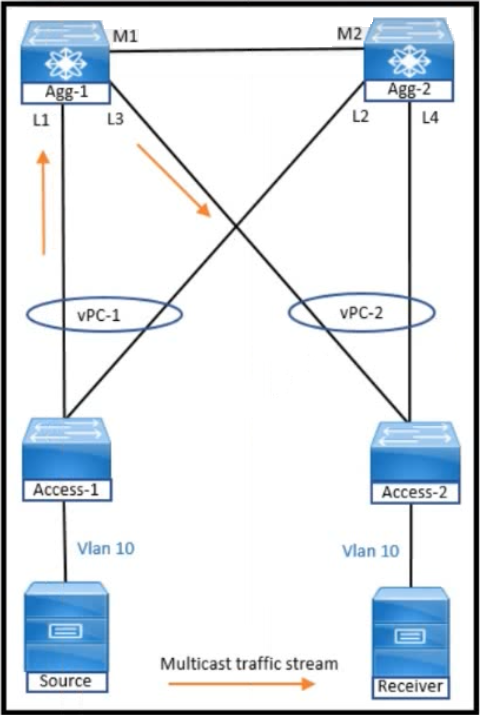
Refer to the exhibit. A source is sending a multicast traffic stream to the receiver. How is the multicast traffic expected to flow through the network when it reaches a vPC peer? -
The multicast traffic is not replicated to the ports that joined a multicast group (224.0.0.13) or the peer link.
The multicast traffic is replicated to the ports that joined a given multicast group and the peer link.
The multicast traffic is replicated to the ports that joined a given multicast group and the peer link. Correct Answer
The multicast traffic is not replicated to the ports that joined a multicast group (224.0.0.13) or the peer link.
Community Votes
C
100%
100% of anonymous learners picked answer C.
Votes are pick records left by other test-takers — they are not the verified answer.
Community Insight
vPC multicast uses the SVI/PIM and the peer-link as a multicast forwarding path. The active forwarding vPC peer device sends a copy out the vPC member port and a copy out the peer-link; the peer device forwards only to interested ports.
On a vPC pair, multicast (PIM) traffic from the source tree is forwarded out vPC member ports toward receivers and also copied across the vPC peer-link so the peer switch can serve its locally attached receivers; orphan ports with no interest drop it.
Believing multicast is NOT replicated to the peer-link. It is: the peer-link carries multicast to the peer so it can serve its own receivers; without that, receivers behind the secondary peer would starve.
Community Discussion (6 comments)
Eduardo7v👍 1
OPtion C confirmed by CHATGPT
msalamehi👍 2Selected: C
Agree C is correct 100%
asd248402👍 3Selected: C
Multicast data traffic flows down the source tree to active forwarding vPC peer device. vPC peer device 1 (7K1) sends a copy of the multicast traffic out of the vPC member port connected to access switch. One another copy is sent out of vPC peer-link. As there is no single-attached device (or orphan port) interested by this multicast traffic on the other side, vPC peer device 2 (7K2) will drop the multicast traffic
wickkkkkkkkkkkkkkkkkk👍 1
BBBBBBBBBBBBBBBBBBBBBBBBB
crooks_1988👍 1
Agree it is C
luisam👍 2
Answer A
Comments & Corrections
No comments yet — spotted an error or have a note? Share it below.
Log in to comment, report an error, or add a note about this question.
Expert Analysis
Why the Answer Is Correct
Multicast data flows down the source tree to the active forwarding vPC peer device. That device replicates the stream out the vPC member port connected to the access switch and out the vPC peer-link. The peer device, upon receiving it, forwards only to ports that joined the multicast group; it drops copies for ports with no interest.
Why the Other Options Are Wrong
A and D claim the traffic is NOT replicated to the peer-link or group ports, which contradicts vPC multicast forwarding behavior. B carries identical text to C in the exhibit; per community consensus C is the selected correct option describing replication to both group ports and the peer link.
Community Comment Notes
Community: "Multicast data traffic flows down the source tree to active forwarding vPC peer device. vPC peer device 1 sends a copy out the vPC member port... One copy is sent out of vPC peer-link." Votes C 100.