Interface Instability Caused by a Half-Duplex / Duplex Mismatch

Identify interface and cable issues (collisions, errors, mismatch duplex, and/or speed)
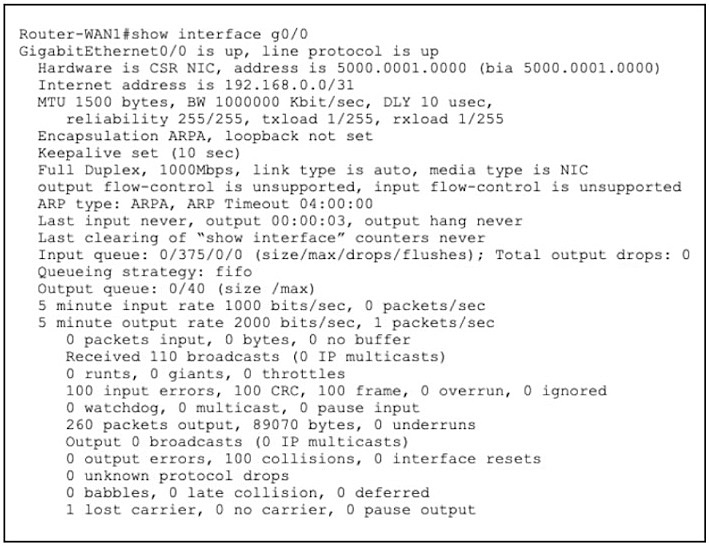
Answer Correct answer: B — The high 'collisions' counter points to a duplex mismatch (router is full-duplex, ISP side is half-duplex), discarding frames and causing unstable connectivity.

Refer to the exhibit. Router-WAN1 has a new connection via Gi0/0 to the ISP. Users running the web applications indicate that connectivity is unstable to the internet. What is causing the interface issue? - image
  1. The receive buffer is full due to a broadcast storm.
  2. Frames are discarded due to a half-duplex negotiation. Correct Answer
  3. Broadcast packets are rejected because ARP timeout is enabled.
  4. Small frames less than 64 bytes are rejected due to size.

Community Votes

B
67%
A
33%

67% of anonymous learners picked answer B. Votes are pick records left by other test-takers — they are not the verified answer.

Community Insight

Collisions = half-duplex behavior. On a full-duplex link you should see ~0 collisions; a large collision count means the peer is half-duplex — a duplex mismatch.

A rising 'collisions' counter on a link is a classic duplex-mismatch symptom: one side runs full-duplex while the peer is forced to half-duplex. The resulting collisions and CRC/input errors drop frames and make connectivity unstable, exactly the symptom reported.

Blaming a broadcast storm (option A): a storm would inflate broadcast packet counts, but the decisive symptom here is the collisions counter, which is a physical-layer/duplex issue, not a storm.

Community Discussion (4 comments)

sy0_061 👍 6 Selected: B
The collisions are worth looking at. It implies a duplex mismatch. Although the router is full-duplex, the other side might be manually configured for a half-duplex. This causes high number of collisions. Just FYI, broadcast storm is when when we see broadcast packet numbers above 3000. There is a 30% formula but I can't recall it.
bezkin 👍 3
Answer is B, but don't take my word for it, go learn something Collisions are a strong indicator of half-duplex environment or duplex mismatch Collisions will cause CRC errors and data corruption - another symptom of physical problem (such as duplex mismatch) Frame errors - also a physical layer (duplex mismatch) symptom Input errors - ALSO a physical issue indicator. correlates with duplex mismatch
Shaifalimittal02 👍 3 Selected: A
The correct answer is A. The receive buffer is full due to a broadcast storm. Here's why: In the output of the show interface command, we see 100 input errors and 260 input packets, which indicates that there may be an issue related to receiving data on the interface. Additionally, there are 110 broadcasts and 100 collisions, which suggests that there is likely a broadcast storm or excessive broadcast traffic, overwhelming the receive buffer. Explanation of incorrect options: B (Half-duplex): The interface is operating in Full Duplex, so half-duplex negotiation is not the issue. C (ARP timeout): ARP type and timeout configuration would not reject broadcast packets. D (Small frames): There is no indication that small frames are being rejected based on size.
exiledwl 👍 2
Correct

Comments & Corrections

No comments yet — spotted an error or have a note? Share it below.

Log in to comment, report an error, or add a note about this question.

Submitted for moderation before publishing. Keep it helpful and respectful.

Expert Analysis

Why the Answer Is Correct

B is correct. The interface shows 100 collisions alongside input errors, which is the signature of a duplex mismatch — the router is full-duplex while the ISP-side port is configured half-duplex. Half-duplex ends experience collisions, drop frames, and produce the unstable connectivity users report.

Why the Other Options Are Wrong

A is wrong: a broadcast storm raises broadcast counts, not the collisions counter. C is wrong: ARP timeout does not reject broadcasts. D is wrong: runt/rejected small frames are not what the collision count indicates.

Community Comment Notes

The vote is B (67) vs A (33). The top comment flags the collisions counter as the key duplex-mismatch indicator; a minority argues broadcast storm, but collisions are the decisive evidence.

Official Reference

Related Analysis

Practice All 200-301 Questions

Access 220 questions with complete answers and detailed explanations.

View Full 200-301 Practice Test →

← Back to 200-301 Study Guide