How a Switch Handles an ARP Request for an Unknown Destination
Refer to the exhibit. PC1 tries to ping PC3 for the first time and sends out an ARP to S1. Which action is taken by S1? - 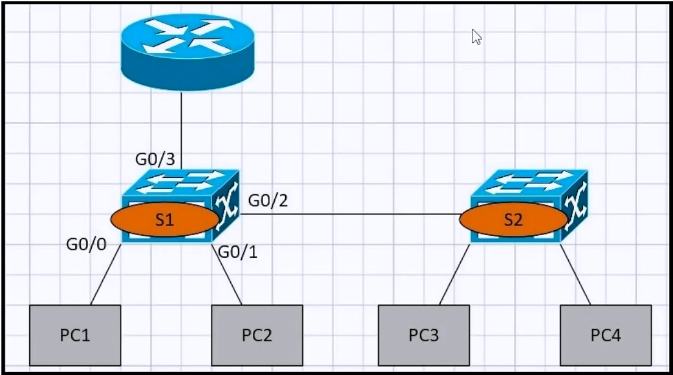
Community Votes
75% of anonymous learners picked answer A. Votes are pick records left by other test-takers — they are not the verified answer.
Community Insight
ARP is a Layer 2 broadcast frame to the switch, not a Layer 3 routed packet — the switch floods it; it does not selectively forward it toward a gateway.
An ARP request uses destination MAC ffff.ffff.ffff, a Layer 2 broadcast. A switch cannot route it; it floods broadcasts within the VLAN out all ports except the ingress port. The "first time" detail means S1 has no MAC entry for PC3 yet, reinforcing the flood.
Assuming the switch forwards the ARP only to G0/2 or G0/3 (C/D) or drops it (B). A switch floods unknown/broadcast frames; it does not decide the path from the IP address.
Community Discussion (7 comments)
Comments & Corrections
No comments yet — spotted an error or have a note? Share it below.
Expert Analysis
Why the Answer Is Correct
A is correct. PC1's ARP request is a broadcast (destination MAC ffff.ffff.ffff). S1, having no entry for PC3 yet (this is the "first time"), floods the frame out every port in the VLAN except the receiving port G0/0. Flooding is the defined switch behavior for broadcast and unknown-unicast frames.Why the Other Options Are Wrong
B is wrong: a switch does not drop a valid broadcast. C and D are wrong: the switch does not forward a broadcast only to a specific access port based on the IP — broadcasts go to all ports in the VLAN except ingress. Some comments mistakenly treat ARP as Layer 3 routed to the gateway, but to the switch it is a Layer 2 broadcast frame.Community Comment Notes
The leading comment (75 votes for A) reasons that because PC1 sent an ARP, S1 must lack a PC3 entry, so it floods. A minority argues C, confusing ARP (Network layer) with switch forwarding, but the switch acts on the L2 broadcast.Official Reference
Related Analysis
Practice All 200-301 Questions
Access 220 questions with complete answers and detailed explanations.
View Full 200-301 Practice Test →