Building the EUI-64 Interface Identifier for Router R2
Refer to the exhibit. The IPv6 address for the LAN segment on router R2 must be configured using the EUI-64 format. When configured which ipv6 address is produced by the router? - 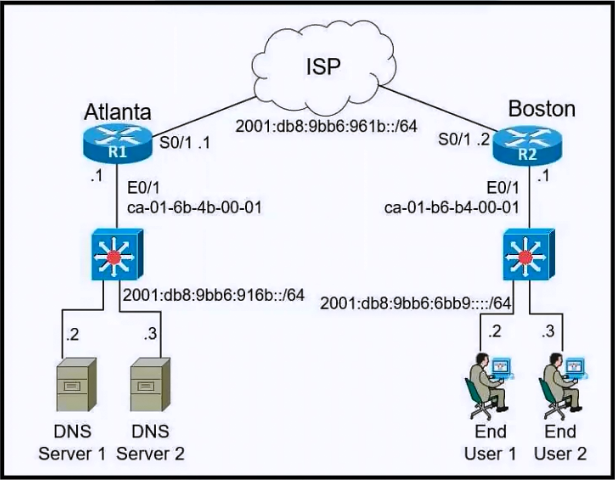
Community Votes
100% of anonymous learners picked answer D. Votes are pick records left by other test-takers — they are not the verified answer.
Community Insight
As with the other EUI-64 questions, the answer shows the inverted seventh bit (C8, not C0/C2) and the FFFE insertion; D is the only option consistent with that transformation.
EUI-64 builds the interface ID from the MAC: split at the OUI/host boundary, insert FFFE, and flip the seventh bit (U/L) of the first byte. For R2 the inverted first byte becomes C8, placing C801 in the third hextet, matching option D.
Picking an option whose first hextet lacks the C8 (inverted-bit) result. The 7th-bit flip is the step most often missed.
Community Discussion (9 comments)
Comments & Corrections
No comments yet — spotted an error or have a note? Share it below.
Expert Analysis
Why the Answer Is Correct
D is correct. EUI-64 on R2's MAC: the first byte CA (1100 1010) flips its seventh bit to 1100 1000 = C8, so the interface ID begins with C801, and the FFFE insertion produces the remainder shown in D (2001:db8:9bb6:6bb9:C801:B6FF:FEB8:1).Why the Other Options Are Wrong
A (C081) and B (C001) miss the seventh-bit inversion, so their first hextet is wrong. C does not follow the EUI-64 transformation of the exhibited MAC at all.Community Comment Notes
The vote is D (100). Commenters derive CA -> C8 by flipping the seventh bit, confirming C801 as the correct start and noting D is the only option that follows the EUI-64 rules.Official Reference
Related Analysis
Practice All 200-301 Questions
Access 220 questions with complete answers and detailed explanations.
View Full 200-301 Practice Test →