Equal-AD Routes Cause R1 to Load-Balance to 172.16.1.4/30
Refer to the exhibit. How does router R1 handle traffic to 172.16.1.4 /30 subnet? - 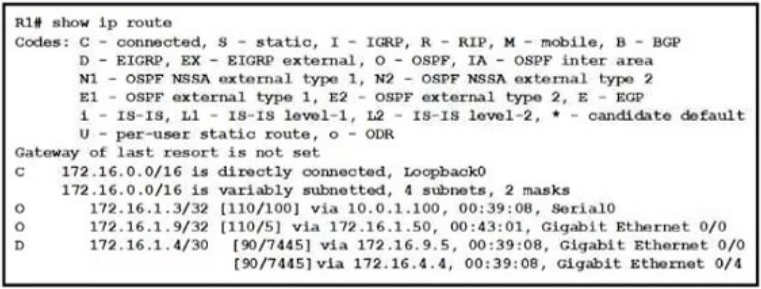
Community Votes
100% of anonymous learners picked answer D. Votes are pick records left by other test-takers — they are not the verified answer.
Community Insight
Equal AD + equal metric = multiple equal-cost paths in the routing table = per-flow load balancing. AD is the first tiebreaker in the forwarding decision.
When a router has two routes to the same destination with the same administrative distance (and, after AD, equal metrics), it installs both and load-balances traffic across them. Here R1 sees 172.16.9.5 and 172.16.4.4 as equal-AD next hops, so it splits traffic to 172.16.1.4/30.
Assuming one path is a 'backup': with identical AD there is no primary/backup relationship; both are active and share the traffic.
Community Discussion (3 comments)
Comments & Corrections
No comments yet — spotted an error or have a note? Share it below.
Expert Analysis
Why the Answer Is Correct
D is correct. R1 has two routes to 172.16.1.4/30 whose next hops (172.16.9.5 and 172.16.4.4) share the same administrative distance. Because AD is the first tiebreaker and it is equal, R1 keeps both routes and load-balances traffic across them.Why the Other Options Are Wrong
A and C pick only one of the two equal paths, ignoring the second. B names a next hop (10.0.1.100) that is not the equal-AD pair for this destination.Community Comment Notes
The vote is D (100). A commenter asks why it load-balances and the answer is the equal AD on both paths.Official Reference
Related Analysis
Practice All 200-301 Questions
Access 220 questions with complete answers and detailed explanations.
View Full 200-301 Practice Test →