Diagnosing Router Interface Output Drops as Oversubscription
Refer to the exhibit. What is the cause of poor performance on router R19? - 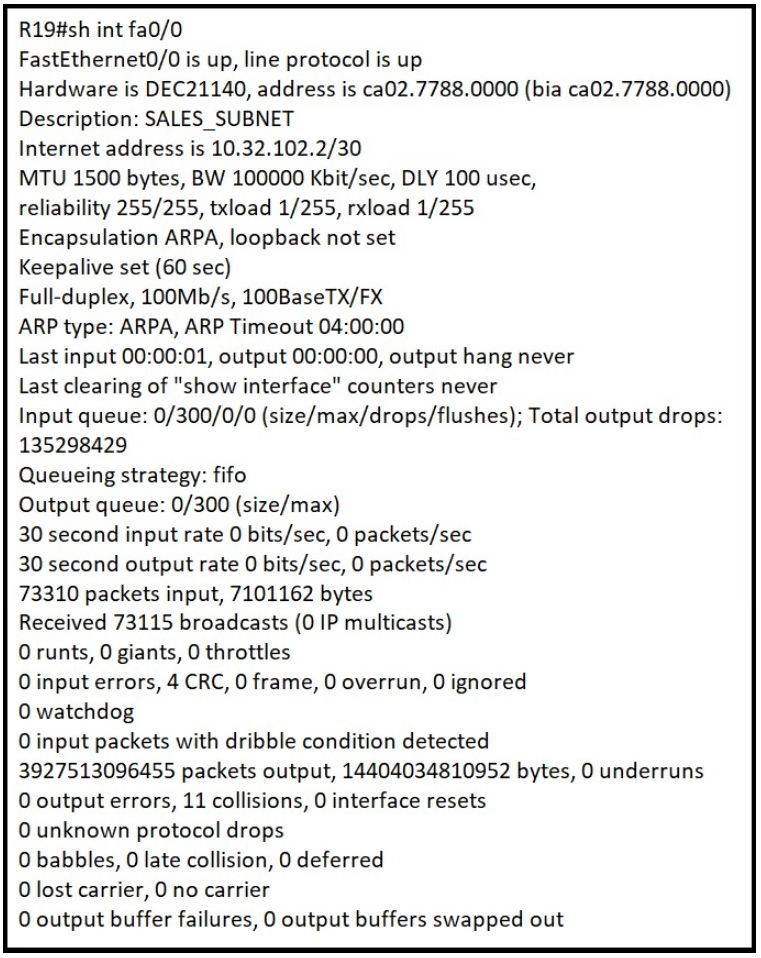
Community Votes
75% of anonymous learners picked answer C. Votes are pick records left by other test-takers — they are not the verified answer.
Community Insight
Output drops = egress congestion/oversubscription. CRC errors and speed/duplex mismatch show up as input/CRC errors, not as output drops.
In a 'show interface' output, a massive Total output drops count (here 135M) shows the egress interface is overloaded — more traffic offered than it can transmit. Collisions and CRC errors, if present, are minor by comparison. Speed/duplex mismatch typically shows as CRC/input errors, not output drops.
Picking D (speed/duplex mismatch): that causes CRC and input errors, not output drops. The dominant signal here is the enormous output-drop counter.
Community Discussion (4 comments)
Comments & Corrections
No comments yet — spotted an error or have a note? Share it below.
Expert Analysis
Why the Answer Is Correct
C is correct. The key indicator is 'Total output drops: 135298429' — vastly larger than the collision/CRC counts — which points to egress congestion because the interface cannot handle the offered traffic (port oversubscription).Why the Other Options Are Wrong
A (excessive collisions) and B (excessive CRC errors) are present but tiny next to the output-drop figure. D (speed/duplex mismatch) would manifest as CRC/input errors rather than output drops.Community Comment Notes
The vote is C (75) versus D (25). The leading comment highlights 'Total output drops: 135298429' as the signal of oversubscription, noting CRC/collision numbers are comparatively small.Official Reference
Related Analysis
Practice All 200-301 Questions
Access 220 questions with complete answers and detailed explanations.
View Full 200-301 Practice Test →