Teams DLP Protection Scope for Users, Groups, and Channels
Short answer
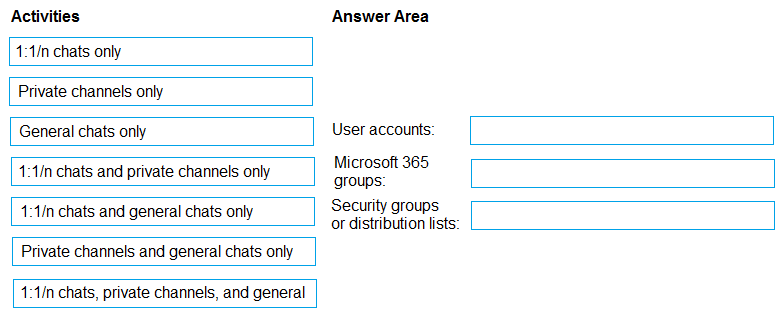
User accounts: 1:1/n chats only. Security groups or distribution lists: 1:1/n chats only. Microsoft 365 groups: 1:1/n chats plus standard (including General), private and shared channel messages.
Question
You have a Microsoft 365 E5 subscription.
You need to prevent the sharing of sensitive information in Microsoft Teams.
Which entities can you protect by applying a data loss prevention (DLP) policy to each resource?
To answer, drag the appropriate activities to the correct entity. Each activity may be used once, more than once, or not at all. You may need to drag the split bar between panes or scroll to view content.
NOTE: Each correct selection is worth one point.
Key Takeaways
The question tests whether you know Teams DLP channel coverage is owned by Microsoft 365 groups, not by individual user or security-group scoping.
Microsoft Teams DLP scoping gives user accounts and security or distribution groups 1:1/n chat coverage only, while Microsoft 365 group scope extends to standard, private and shared channel messages. This page maps each Teams entity to the DLP-protected surfaces.
Common mistake: Assuming any user or security group can protect Teams channel messages fails because those scopes reach only 1:1/n chats; channel sharing requires Microsoft 365 group scoping.
Expert Analysis
The deciding rule Teams DLP scoping follows the Teams object that owns the message, not the person who sent it. Individual user accounts and security or distribution groups can be used to evaluate direct and group chat traffic. Channel posts are different: a standard, private or shared channel is owned by the Microsoft 365 group that backs the team, so channel message coverage requires DLP policy scope to include that Microsoft 365 group. This is the documented scope-of-protection principle, not a popularity vote among practice answers.
Mapping the three entities
- User accounts: 1:1/n chats only.
- Security groups or distribution lists: 1:1/n chats only.
- Microsoft 365 groups: 1:1/n chats plus standard channel messages, including the General channel, private channel messages and shared channel messages.
If the goal is to prevent sensitive information sharing anywhere in Teams, scoping only user accounts or a security group leaves channel conversations unprotected. The Microsoft 365 group scope is the one that extends DLP into channel posts.
Why learners disagree Comments on this item show several different mappings, including claims that user accounts and security groups cover private channels or that Microsoft 365 groups cover only general chats. Those variants track an older or misread version of the Learn scope table; learners explicitly noted that the page was updated and that previously published answers changed. The reliable approach is to use the current scope table and the ownership principle behind it: chat surfaces are reachable through user and security scopes, while channel surfaces require the Microsoft 365 group.
Exam takeaway Memorize the asymmetry: chat-only for user accounts and security or distribution groups; chat plus standard, private and shared channels for Microsoft 365 groups. That single distinction answers the drag-drop and transfers to any SC-401 question about Teams DLP location scoping.
Official Reference
https://learn.microsoft.com/en-us/purview/dlp-microsoft-teams#scope-of-dlp-protection
This link opens the official vendor documentation in a new tab.
Exam Strategy
For Teams DLP drag-drop items, first identify whether the row is a chat surface or a channel surface. Map individual accounts and security or distribution groups only to chat coverage, then reserve Microsoft 365 group rows for standard, private and shared channel coverage. When a stem mentions preventing sharing in Teams broadly, choose the Microsoft 365 group scope because it is the only scope that reaches channel posts; do not let older archived Learn wording about private channels override the current scope table.
Frequently Asked Questions
Do security groups or distribution lists protect standard Teams channel messages with DLP?
Why do Microsoft 365 groups cover channel messages that user accounts do not?
Should I use an older mapping where user accounts cover private channels?
Discussion 9 contributions
Compiled from public community threads and reader submissions, lightly edited for clarity. Handles and vote tallies are shown as recorded, and comments reflect the views of individual contributors.
From public community threads 9
-
9ebaad0 👍 14They have since updated the MS Learn page Eltooth & Dicornyt refer to as of October 30th the site now reads: User Accounts: 1:1 Chats only Security & Distribution Groups: 1:1 Chats only M365 Groups: 1:1 chats, general channel messages & private channel messages. Checked on the wayback machine that it did previously say their answers before 10/30.
-
Dicornyt 👍 3User accounts: 1:1/n chats and private channels only Microsoft 365 groups: 1:1/n chats and general chats only Security groups or distribution lists: 1:1/n chats and private channels only https://learn.microsoft.com/en-us/purview/dlp-microsoft-teams
-
Jideakin 👍 2Individual user accounts = 1:1/n chats only Security groups/distribution group/non-mail-enabled security group = 1:1/n chats only Microsoft 365 groups = 1:1/n chats and Standard, private and shared channel messages https://learn.microsoft.com/en-us/purview/dlp-microsoft-teams?tabs=purview#scope-of-dlp-protection
-
Eltooth 👍 2User accounts: 1:1/n chats and private channels only Microsoft 365 groups: 1:1/n chats and general chats only Security groups or distribution lists: 1:1/n chats and private channels only https://learn.microsoft.com/en-us/purview/dlp-microsoft-teams#scope-of-dlp-protection
-
rvln7 👍 2user accounts: 1:1/n chats; Microsoft 365 groups: 1:1/n chats, Standard and shared channel messages, Private channel messages; Security groups/distribution group: 1:1/n chats; Scope of DLP protection: https://learn.microsoft.com/en-us/purview/dlp-microsoft-teams
Show 4 more comments
-
MultiCloudIronMan 👍 1User accounts: DLP can be applied to individual users to monitor and restrict sensitive data sharing in direct chats (1:1 or group chats). Microsoft 365 groups: These are tied to standard Teams channels (like General), where DLP can monitor shared content. Security groups/distribution lists: These can be used to scope policies for private channels, which are more restricted and require explicit membership.
-
Caezarlay 👍 1User accounts: Can protect 1:1/n chats and private channels, but not standard/shared channels. Microsoft 365 groups: Can protect all Teams modalities—1:1/n chats, standard/shared channels, and private channels. Security groups: Behave similarly to user accounts in DLP scope—no protection for standard/shared channels, but coverage for 1:1/n chats and private channels.
-
IndigorRabbit971 👍 1User accounts: 1:1/n chats only Microsoft 365 groups: 1:1/n chats, private channels, and general Security groups or distribution lists: 1:1/n chats, private channels, and general https://learn.microsoft.com/en-us/purview/dlp-microsoft-teams#scope-of-dlp-protection
-
MultiCloudIronMan 👍 1User accounts | 1:1/n chats, private channels, and general chats | | Microsoft 365 groups | Private channels and general chats only | | Security groups or distribution lists | 1:1/n chats only |
Reader comments & corrections
No reader corrections yet — spotted an error or have a note? Share it below.