Microsoft Purview Retention Policy Conflict Resolution
Short answer
A File1 will be deleted automatically after 10 years.
Question
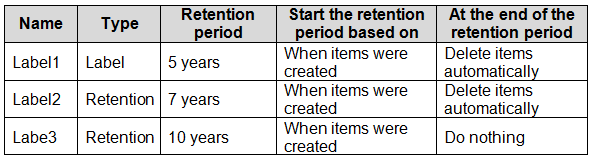
A file named File1 has all the policies applied.
How long will File1 be retained?
Key Takeaways
The core trap is confusing the longest retention duration with an automatic deletion schedule; the correct answer is determined by the maximum retention time, not the shortest delete action.
This question tests the Microsoft Purview retention principles of 'Retention wins over deletion' and 'Longest retention period takes precedence' to determine the final lifecycle of a file with conflicting policies.
Common mistake: Many learners incorrectly choose option B (5 years) or D (7 years), mistakenly believing that explicit labels override policies for deletion or that the shortest retention period applies.
Expert Analysis
Why the Answer Is Correct
According to Microsoft Purview documentation, when multiple retention settings apply to the same item, the principle of 'Retention always wins over deletion' dictates that all deletion actions are suspended until the longest retention period expires. Since Label 3 provides a 10-year retention with no deletion action, this becomes the governing rule. The deletion actions from the other policy and label are effectively ignored during this period.
Why the Other Options Are Wrong
Option A is incorrect because the 10-year setting is a retention hold, not a deletion trigger. Option B and D are incorrect because they rely on shorter durations which are superseded by the longer 10-year requirement. Option C is incorrect because while the file is retained for 10 years, it doesn't mean it stays forever without limit if another policy applies later, but in this static context, the specific answer is defined by the 10-year window.
Community Comment Notes
Community discussion highlights the confusion around 'explicit vs implicit'. User ironbeardyyc notes that labels are explicit, but as user kollyp2000 clarifies, retention still overrides deletion regardless of source: 'Retention wins over deletion... Label 3 retains for 10 years, so nothing can delete File1 before year 10.' This confirms that the 'longest retention' principle is the deciding factor.
Official Reference
This link opens the official vendor documentation in a new tab.
Exam Strategy
Always look for the longest retention period first when multiple policies conflict. Remember that 'Retention wins', meaning no deletion happens until the longest required retention period is complete.
Frequently Asked Questions
Does an explicit retention label always win?
What happens to deletion actions during a long retention?
Discussion 12 contributions
Compiled from public community threads and reader submissions, lightly edited for clarity. Handles and vote tallies are shown as recorded, and comments reflect the views of individual contributors.
From public community threads 12
-
5840b27 👍 18 Answered AMicrosoft retention handles retention and deletion separately. The longest retention wins so retained for 10 years. The delete action of the other retention policy and label is suspended during this time, but at the end of the 10-year retention period, the file will be deleted. https://learn.microsoft.com/en-us/purview/retention?tabs=table-overriden#the-principles-of-retention-or-what-takes-precedence
-
Eltooth 👍 11 Answered CLongest retention wins (10 years) and since no auto-delete is configured, file will be retained until manually deleted.
-
Caezarlay 👍 5 Answered CAccording to principle of retention, it will last for 10 years and it will not be deleted automatically.
-
Demonster 👍 4 Answered BThe answer is B - after 5 years because explicit wins over implicit for deletions https://learn.microsoft.com/en-us/purview/retention?tabs=table-overriden#the-principles-of-retention-or-what-takes-precedence A document is subject to two retention policies that have a delete action of five years and 10 years respectively, and also a retention label that has a delete action of seven years. The document is permanently deleted after seven years because the delete action from the retention label takes precedence.
-
ironbeardyyc 👍 2 Answered A"A retention label (however it was applied) provides explicit retention in comparison with retention policies, because the retention settings are applied to an individual item rather than implicitly assigned from a container. This means that a delete action from a retention label always takes precedence over a delete action from any retention policy. Example for this third principle (label): A document is subject to two retention policies that have a delete action of five years and 10 years respectively, and also a retention label that has a delete action of seven years. The document is permanently deleted after seven years because the delete action from the retention label takes precedence." https://learn.microsoft.com/en-us/purview/retention?tabs=table-overriden
Show 7 more comments
-
bill1982 👍 2 Answered AIt confusing question. table shows Type colum as label, retention, retention. if its counting label as policy then answer is A if its not counting label as policy then answer is C
-
MultiCloudIronMan 👍 2 Answered AFile1 will be deleted automatically after 10 years, because that is the longest retention period among the labels that include a delete action.
-
kollyp2000 👍 1 Answered AThe answer is A. File1 will be deleted automatically after 10 years. Why A, using the principles of retention in order Retention wins over deletion, and the longest retention period wins. Labe3 retains for 10 years, so nothing can delete File1 before year 10. Explicit wins over implicit for deletion. “A delete action from a retention label always takes precedence over a delete action from any retention policy.” Label1’s delete action is the one that counts. It’s suspended until the 10-year retention ends, then it runs. Learn has an almost identical example: “A document... is subject to both a retention policy and a retention label. The retention policy is configured to retain items... for 10 years after creation, while the retention label specifies a delete action after seven years... the document is retained for 10 years, which is the longest retention period. Because the retention label’s delete action takes precedence, the document is permanently deleted after 10 years.” Source: Learn about retention policies and retention labels, https://learn.microsoft.com/purview/retention#the-principles-of-retention-or-what-takes-precedence
-
JamesM9 👍 1 Answered C"Retention always wins over deletion. When multiple retention settings apply, the longest retention period takes precedence" Label 3 says "do nothing" after the retention period and there is no longer retention requirement. The earlier delete actions (5 and 7 years) have already been superseded and are not "queued up" to run later. After 10 years, the file remains in place because the winning retention setting is "retain for 10 years, then do nothing" It is not deleted after 10 years, because the label doesn't specify deletion at the end of the retention period.
-
Jarrome 👍 1label wins over retention, B.
-
PAPAKIA 👍 1 Answered CLongest retention wins
-
Pedro_Mlvda 👍 1 Answered C"preserve wins"
Reader comments & corrections
No reader corrections yet — spotted an error or have a note? Share it below.