How Do Purview Sensitivity Labels Inherit, Justify, and Persist?
HOTSPOT
You have a Microsoft 365 E5 tenant.
You have sensitivity labels as shown in the Sensitivity Labels exhibit. (Click the Sensitivity Labels tab.)
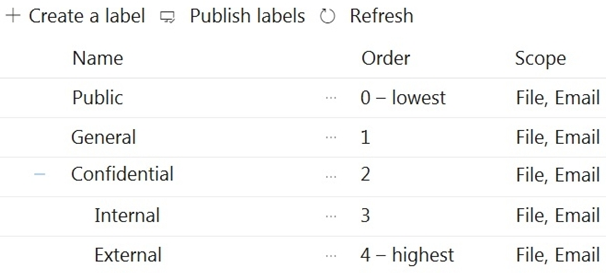 The Confidential/External sensitivity label is configured to encrypt files and emails when applied to content.
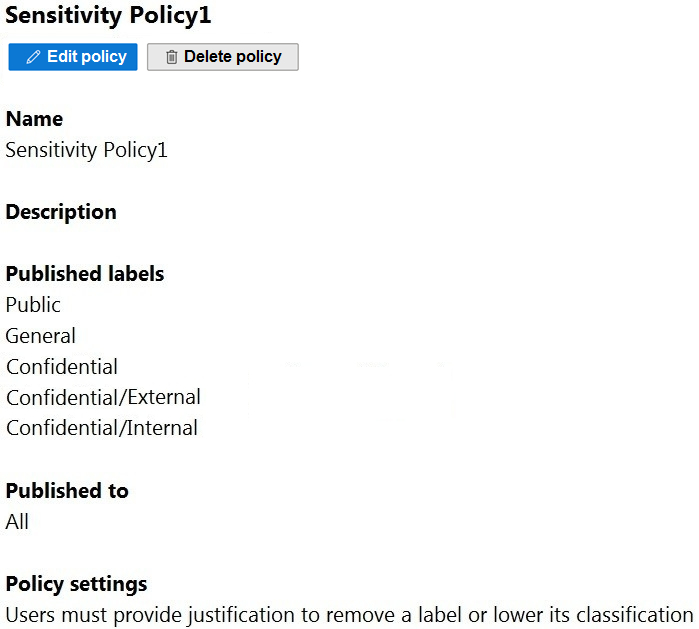
The sensitivity labels are published as shown in the Published exhibit. (Click the Published tab.)
The Confidential/External sensitivity label is configured to encrypt files and emails when applied to content.
The sensitivity labels are published as shown in the Published exhibit. (Click the Published tab.)
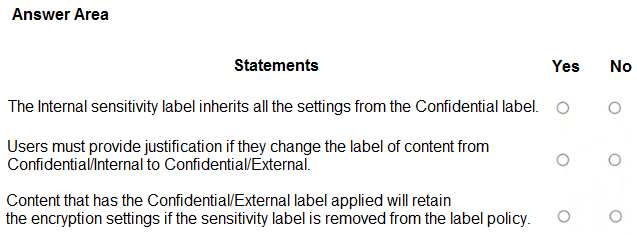
 For each of the following statements, select Yes if the statement is true. Otherwise, select No.
NOTE: Each correct selection is worth one point.
For each of the following statements, select Yes if the statement is true. Otherwise, select No.
NOTE: Each correct selection is worth one point.
Community Insight
SC-401 tests whether you know sublabels do not inherit parent label settings except color, justification is policy-driven rather than automatic, and an applied label travels with the content.
This SC-401 hotspot tests Microsoft Purview sensitivity label inheritance, justification requirements, and label persistence on files. The correct selections establish that Internal does not inherit Confidential/External settings, no automatic justification is required, and the applied label stays with the file.
Learners assume Internal automatically inherits encryption from its Confidential/External parent, or that moving to a higher-priority label always forces a justification prompt.
Community Discussion (8 comments)
Comments & Corrections
No comments yet — spotted an error or have a note? Share it below.
Expert Analysis
Why the Answer Is Correct
The hotspot sequence is No for the inheritance statement, No for the justification statement, and Yes for the persistence statement. Microsoft Purview sensitivity sublabels do not inherit the parent label’s protection settings; only the label color is inherited, so Internal cannot automatically receive Confidential/External encryption. A justification prompt is a policy configuration, not an inherent consequence of choosing a higher-priority label, and the published policy here does not impose that automatic requirement. Once a sensitivity label is applied, it remains attached to the file as the file moves or is downloaded, so the persistence statement is true.Why Other Candidate Answers Are Wrong
Choosing Yes for inheritance confuses label hierarchy with inherited protection; parent labels act as organizational containers, not templates that copy encryption, content marking, or auto-labeling settings. Choosing Yes for justification assumes label priority creates a mandatory audit prompt, but priority controls label ordering and policy behavior, not automatic justification for every label change. The all-No pattern also fails because it ignores that an applied label is stored with the file and does not disappear merely because the content location changes.Community Comment Notes
Multiple learners, including Eltooth, rvln7, and Amias2, align on “NO NO YES,” and kollyp2000 correctly cites that sublabels “don’t inherit any settings from the first tier label, except the label color.” Ender3 adds that “going from higher to lower priority does not require a justification,” which reinforces that priority alone does not create an automatic prompt. keambi0111 argued the opposite for a move to Confidential/External, but the consensus and exam doctrine favor No for that statement; the final Yes reflects that the label is already applied and stays with the file.Official Reference
Exam Strategy
Evaluate each hotspot statement independently instead of assuming label hierarchy behaves like Group Policy inheritance. For SC-401, separate three ideas: sublabels inherit only color, justification is a policy option, and an applied label persists with the file.
Frequently Asked Questions
Does the Internal sensitivity label inherit encryption settings from Confidential/External in Microsoft Purview?
No. Sublabels do not inherit parent label settings except label color, so encryption must be configured separately on Internal.
Does changing a file from Internal to Confidential/External always require a justification?
No. A justification prompt appears only when the label policy is configured to require it; label priority alone does not force a justification.