How Do AutoApply1 and Retention1 Apply to Microsoft 365 Group Resources?

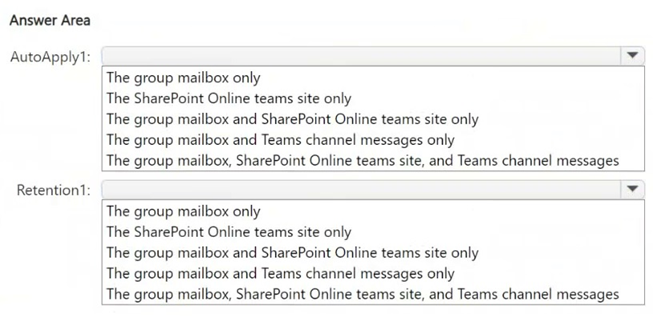
Answer AutoApply1 applies only to the SharePoint Online teams site. Retention1 applies to the group mailbox and the SharePoint Online teams site, not to Teams channel messages.

HOTSPOT You have a Microsoft 365 E5 subscription that contains two Microsoft 365 groups named Group1 and Group2. Both groups use the following resources: A group mailbox Microsoft Teams channel messages A Microsoft SharePoint Online teams site You create the objects shown in the following table. exhibit To which resources will AutoApply1 and Retention1 be applied? To answer, select the appropriate options in the answer area. NOTE: Each correct selection is worth one point. exhibit

Community Insight

The exam tests the different Microsoft 365 Groups location scope for retention labels versus retention policies; the trap is assuming the group's Teams channel messages are included automatically.

This SC-401 hotspot tests how Microsoft 365 Groups scopes differ between auto-applied retention labels and retention policies. It establishes that AutoApply1 reaches only the SharePoint teams site, while Retention1 covers the group mailbox and SharePoint teams site but not Teams channel messages.

The common mistake is treating a Microsoft 365 group as a single container that automatically includes Teams channel messages for both labels and policies; in Purview, Teams messages require the separate Teams channel messages location.

Community Discussion (14 comments)

kollyp2000 👍 1
Retention1 (retention policy applied to Group2) AutoApply1 (auto-apply retention label policy for Group1)
SSL2 👍 2
AutoApply1: The SharePoint Online teams site only Retention1: The group mailbox and SharePoint Online teams site only Microsoft says that for the Microsoft 365 Group mailboxes & sites location, retention labels include the SharePoint teams site only. That means an auto-apply retention label policy for Group1 does not apply to the group mailbox or Teams channel messages.
rvln7 👍 3
CORRECT: 1. SharePoint teams site only (Auto-apply= Retention Label) 2. Group mailbox and SharePoint teams site (retention policy) "To retain or delete content for a Microsoft 365 group (formerly Office 365 group), use the Microsoft 365 Group mailboxes & sites location. For retention policies, this location includes the group mailbox and SharePoint teams site. For retention labels, this location includes the SharePoint teams site only." https://learn.microsoft.com/en-us/purview/retention-settings#configuration-information-for-microsoft-365-group-mailboxes--sites
kanag1 👍 1
To retain or delete content for a Microsoft 365 group (formerly Office 365 group), use the Microsoft 365 Group mailboxes & sites location. For retention policies, this location includes the group mailbox and SharePoint teams site. For retention labels, this location includes the SharePoint teams site only. https://learn.microsoft.com/en-us/purview/retention-settings
MultiCloudIronMan 👍 1
AutoApply1 (Auto-apply retention label) Applies to: The SharePoint Online teams site only Reason: To-apply retention labels are designed to apply to individual items (documents, emails, etc.) based on conditions like metadata or content. Retention1 (Retention policy) Applies to: The group mailbox, SharePoint Online teams site, and Teams channel messages Reason: Retention policies apply at the container level.
Eltooth 👍 4
AutoApply1 → applies RLabel1 to Group1’s mailbox and SharePoint site only, not Teams messages. Retention1 → applies to Group2’s mailbox, SharePoint site, and Teams channel messages.
gabbinu 👍 3
AutoApply1: The group mailbox and SharePoint Online teams site only Retention1: The group mailbox, SharePoint Online teams site, and Teams channel messages Auto-labeling policies can only apply to Exchange mail (including group mailboxes) and SharePoint/OneDrive — not Teams messages. Retention policies can apply to all three locations: Group mailbox, SharePoint Online site and Teams channel messages
Jdr379 👍 12
AutoApply1: The group mailbox and SharePoint Online teams site only Retention1: The group mailbox, SharePoint Online teams site, and Teams channel messages 1. Auto-labeling policies for Microsoft 365 Groups apply to the group mailbox and SharePoint teams site, but not Teams channel messages directly 2. Retention policies for Microsoft 365 Groups have broader scope, covering the group mailbox, SharePoint teams site, and Teams channel messages 3. Teams chats or Teams channel messages that have their own retention policy locations are still included when the policy targets the Microsoft 365 Group directly https://learn.microsoft.com/en-us/purview/retention-settings
Jideakin 👍 1
To retain or delete content for a Microsoft 365 group, use the "Microsoft 365 Group mailboxes & sites" location. For retention policies, this location includes the group mailbox and SharePoint teams site. For retention labels, this location includes the SharePoint teams site only. That is quote from the same link you posted.
4d76265 👍 3
I think it should be: AutoApply1: The group mailbox and SharePoint Online teams site only Retention1: The group mailbox and SharePoint Online teams site only Auto-labelling policy cannot be applied to Teams chat and channel messages. You cannot mix Teams workloads with other 365 services for retention policies so there must be 1 policy for Exchange and SharePoint and another policy for Teams.
Katadaaa 👍 3
AutoApply1 : The group mailbox and SharePoint Online teams site only Retention1 : The group mailbox and SharePoint Online teams site only (need of two retention policies, one for mailbox/SPO and one for Teams)
Newb007 👍 1
Sorry so the first one MIGHT be just the Group Mailbox. I'm torn on this one.
DiegoWill 👍 3
The answer should be: The group mailbox and SharePoint Online teams site only The group mailbox, SharePoint Online teams site, and Teams channel messages Automatic retention label policies are not yet supported for Teams channel messages. It only applies to Exchange (mailbox) and SharePoint Online. Team channel messages only support files that are attached, not messages. https://learn.microsoft.com/en-us/purview/apply-retention-labels-automatically#auto-apply-labels-to-cloud-attachments
Newb007 👍 2
I think it might be "The group mailbox and SharePoint Online teams site only" for both. Why? You cannot apply a group to the SharePoint Sites location in the Auto Label policy. you can only apply the group to the exchange location. For the retention policy you cannot have one policy that covers both Team Channels Chats AND Group Mailbox/Team Sites. It won't let you toggle on both locations when creating. I just tested.

Comments & Corrections

No comments yet — spotted an error or have a note? Share it below.

Log in to comment, report an error, or add a note about this question.

Submitted for moderation before publishing. Keep it helpful and respectful.

Expert Analysis

Why the Answer Is Correct

AutoApply1 is an auto-apply retention label policy scoped to Group1, and Microsoft Purview's Microsoft 365 Groups location for retention labels includes only the SharePoint teams site; it does not extend to the group mailbox or Teams channel messages. Retention1 is a retention policy scoped to Group2, and the same Microsoft 365 Groups location for retention policies includes the group mailbox and the SharePoint teams site. Teams channel messages are a separate Purview location, so they are not automatically covered just because they belong to the group's team. Therefore the hotspot selections are SharePoint Online teams site only for AutoApply1, and group mailbox plus SharePoint Online teams site for Retention1. The answer should reflect no Teams channel messages for either object unless an explicit Teams location were selected.

Why Other Candidate Answers Are Wrong

The answer that adds Teams channel messages to Retention1 confuses a team's backing Microsoft 365 group with the separate Teams channel messages workload; group-scoped retention does not silently include that location. Answers that add the group mailbox to AutoApply1 override the documented label scope: "retention labels include the SharePoint teams site only" as SSL2 noted. Answers that add only the mailbox and site for both objects miss that the label policy's Microsoft 365 Groups scope is narrower than the retention policy's scope. The "cannot mix Teams and other workloads" argument is not the determining issue here; the selected location is what limits Retention1.

Community Comment Notes

Jdr379, Eltooth, and gabbinu expected Retention1 to cover Teams channel messages, but that assumption is not supported by the group location's scope. rvln7 and SSL2 focused on the key distinction, with SSL2 summarizing that "retention labels include the SharePoint teams site only" for the Microsoft 365 Groups location. Other commenters debated whether a policy can mix Teams and non-Teams locations; regardless of that debate, Retention1 is scoped to Group2's group location, so Teams channel messages require a separate Teams channel messages selection. Newb007's conclusion that both objects are limited to the group mailbox and SharePoint site is partly right for Retention1 but too broad for AutoApply1.

Official Reference

Exam Strategy

Map each object to its Purview workload location before answering: an auto-apply retention label scoped to a Microsoft 365 group touches only the SharePoint teams site, while a retention policy scoped to that group touches the group mailbox and SharePoint site. Do not add Teams channel messages unless the policy explicitly selects the Teams channel messages location.

Frequently Asked Questions

Does AutoApply1 apply to Group1's group mailbox?

No. For retention labels, the Microsoft 365 Groups location includes only the SharePoint teams site, so AutoApply1 does not cover the group mailbox or Teams channel messages.

Does Retention1 include Group2's Teams channel messages?

Not from the group location alone. A policy scoped to Microsoft 365 Groups covers the group mailbox and SharePoint teams site; Teams channel messages need the separate Teams location.

More SC-401 FAQ →

Related Analysis

← Back to SC-401 Study Guide