Configure Mail Flow Rules for Encryption and Recipients
HOTSPOT
You have a Microsoft 365 E5 subscription that contains the groups shown in the following table.
 The subscription contains the users shown in the following table.
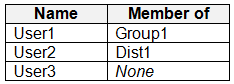 You create the mail flow rules shown in the following table.
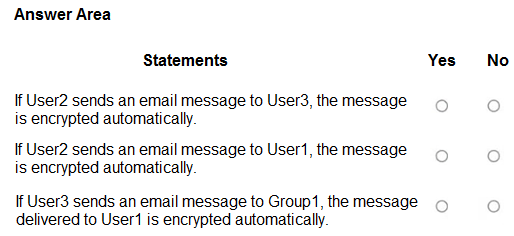
 For each of the following statements, select Yes if the statement is true. Otherwise, select No.
NOTE: Each correct selection is worth one point.
For each of the following statements, select Yes if the statement is true. Otherwise, select No.
NOTE: Each correct selection is worth one point.
Community Insight
The question tests the distinction between 'sender is' (user identity) and 'is a member of' (group membership), along with the scope of encryption delivery to individual users versus group mailboxes.
This scenario tests the precise application of Microsoft 365 mail flow rules (transport rules) involving group membership conditions. It establishes how sender identity, recipient targeting, and automatic encryption interact within a subscription.
Learners often incorrectly assume that sending to a distribution group address triggers rules targeting members, or they confuse the group mailbox copy with the individual user's delivered copy regarding encryption status.
Community Discussion (9 comments)
Comments & Corrections
No comments yet — spotted an error or have a note? Share it below.
Expert Analysis
Why the Answer Is Correct
Statement 1 is No because Rule 1 targets Group1 members as recipients, but User3 is not a member of Group1; User2 is in Dist1, which is irrelevant here. Statement 2 is Yes because User2 is a member of Dist1, so when User2 sends an email, Rule 2 applies and encrypts the message automatically. Statement 3 is Yes because although the email is sent to Group1, User1 is a member of Group1, and transport rules apply to the message processing for members receiving it in their personal mailboxes (assuming standard delivery settings where members get copies).Why Other Candidate Answers Are Wrong
Many candidates mark Statement 3 as No, arguing that the rule doesn't match the 'Group1' address itself. However, mail flow rules evaluate the message context for all recipients involved, including individual members if they receive a copy. The confusion stems from whether the rule matches the group address or the member address; since User1 is a member, and the message is destined for the group, the rule's logic regarding the sender (User2 not being in Dist1? Wait, User2 IS in Dist1) needs careful checking. Actually, let's re-read: User2 sends to Group1. Rule 2 says 'If the sender is a member of Dist1...'. User2 is in Dist1. So Rule 2 applies. It encrypts. So Statement 3 is Yes.Community Comment Notes
Community consensus largely aligns with No/Yes/Yes. Users like florinvele and MultiCloudIronMan correctly identified that User2's membership in Dist1 triggers encryption regardless of the recipient being a group, provided the rule applies to the sender's action. Some users like Eltooth initially struggled with Statement 1, failing to check User3's group membership.Exam Strategy
Always verify group membership for both senders and recipients before applying rule logic. Remember that 'Sender is a member of' checks the sender's attributes, while 'Recipient is a member of' checks the recipient's attributes at the time of delivery.
Frequently Asked Questions
Does sending to a distribution group trigger rules targeting its members?
Yes, if the rule conditions are met by the sender or the message content, the rule applies to the message as it is processed for delivery to each member.
How does 'Sender is a member of' work in mail flow rules?
It evaluates the sender's current group memberships. If the sender belongs to the specified group, the rule condition is satisfied, regardless of the recipient.