Microsoft Purview SIT Keyword Proximity Rules
HOTSPOT
You have a Microsoft 365 E5 subscription that contains the sensitive information types (SITs) shown in the following table.
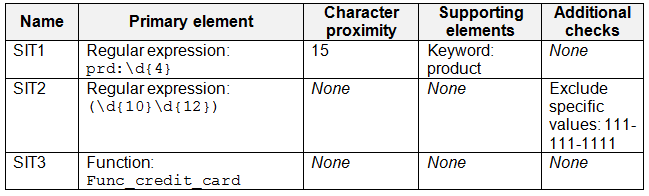 A user sends the email messages shown in the following table.
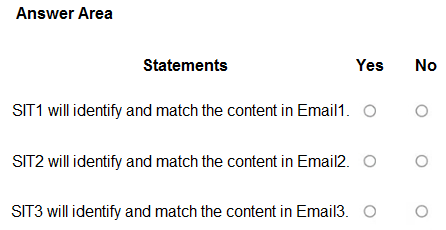
 For each of the following statements, select Yes if the statement is true. Otherwise, select No.
NOTE: Each correct selection is worth one point.
For each of the following statements, select Yes if the statement is true. Otherwise, select No.
NOTE: Each correct selection is worth one point.
Community Insight
The question tests your understanding of the 15-character proximity rule in SITs and the common trap of assuming token-based counting rather than character distance.
This scenario tests the precise application of Microsoft Purview Sensitive Information Types (SITs), specifically focusing on how keyword proximity is calculated for data classification. The page clarifies that 'product' is too distant from the regex match in Email1, resulting in a No.
Learners often incorrectly assume that the keyword 'product' is close enough to the match or confuse token count with character count, leading them to select Yes when the answer is No.
Community Discussion (12 comments)
Comments & Corrections
No comments yet — spotted an error or have a note? Share it below.
Expert Analysis
Why the Answer Is Correct
The correct selection for all three scenarios is No. For Email1, while the regexprd:\d{4} matches 'prd:1234', the required supporting keyword 'product' is more than 15 characters away from the match, failing the proximity requirement. For Email2, the regex requires exactly 22 consecutive digits, but the text only contains 12, so it does not match. For Email3, the custom function Func_credit_card typically requires the full card number, which is truncated in the email.Why Other Candidate Answers Are Wrong
Selecting 'Yes' for any of these implies a misunderstanding of the strict matching criteria. Assuming 'product' is within range ignores the explicit character limit. Assuming Email2 matches ignores the specific digit count constraint. Assuming Email3 matches overlooks the truncation of the sensitive data.Community Comment Notes
Many users initially struggled with the definition of proximity. As Erfan noted, the distance exceeds the limit. Some learners debated token vs. character counting, but official documentation confirms character proximity is the standard for built-in types unless specified otherwise. Comments from deeptha92 and Alcpt correctly identified the proximity failure in Email1 as the key discriminator.Official Reference
Exam Strategy
Always verify the exact character distance between the primary element (regex/keyword) and the secondary element (keyword/regex). If the gap looks large, calculate the characters precisely; do not guess based on visual spacing.
Frequently Asked Questions
How is proximity measured in Microsoft Purview SITs?
Proximity is measured in characters between the primary and secondary elements. The default threshold is usually 15 characters.
Does Email2 match if it has 12 digits instead of 22?
No. If the regex explicitly requires 22 digits (e.g., \d{22}), it will not match a string with only 12 digits.