Which Purview Classification Type Fits Employment, Offensive Language, and Medical Emails?
DRAG DROP
You have a Microsoft 365 E5 subscription.
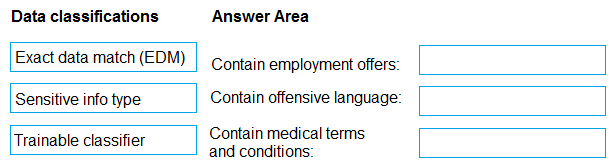
You need to label Microsoft Exchange Online emails that match the following conditions:
• Contain employment offers
• Contain offensive language
• Contain medical terms and conditions
The solution must minimize administrative effort.
Which type of data classification should you use for each condition? To answer, drag the appropriate data classification types to the correct conditions. Each data classification type may be used once, more than once, or not at all. You may need to drag the split bar between panes or scroll to view content.
NOTE: Each correct selection is worth one point.
Community Insight
The item tests whether you can separate semantic trainable-classifier use cases from a built-in sensitive information type; the trap is assuming all medical content requires a trainable classifier.
This SC-401 drag-and-drop item asks you to map Exchange Online email conditions—employment offers, offensive language, and medical terms—to Microsoft Purview classification types while minimizing administrative effort. The page establishes that trainable classifiers handle the first two semantic conditions and a built-in sensitive information type handles medical terms.
A common mistake is selecting trainable classifiers for all three conditions because they are machine-learning based, overlooking the built-in All Medical Terms And Conditions sensitive information type that directly matches the medical condition.
Community Discussion (11 comments)
Comments & Corrections
No comments yet — spotted an error or have a note? Share it below.
Expert Analysis
Why the Answer Is Correct
The first two conditions describe semantic, context-heavy email content. Microsoft Purview's trainable classifiers are built for unstructured text such as employment offers and offensive language, and the pre-trained Offensive Language classifier directly covers the second condition. For the third condition, Microsoft provides a built-in sensitive information type named All Medical Terms And Conditions, which is purpose-built to detect medical terminology without custom model training. That mapping—trainable classifier, trainable classifier, sensitive information type—minimizes administrative effort while matching each condition to the classification mechanism designed for it. The comments from gabbinu, choukou, and Eltooth consistently point to the same trainable/trainable/SIT split.Why Other Candidate Answers Are Wrong
Choosing a sensitive information type for employment offers or offensive language would force keyword lists or patterns onto semantic content that varies widely, producing weak matches and more tuning. Choosing a trainable classifier for medical terms and conditions ignores the existing All Medical Terms And Conditions SIT and would add unnecessary model training or configuration. The all-trainable answer proposed by TheWiz is understandable because classifiers are ML-based, but it is not the minimum-effort design once the built-in SIT is considered. Similarly, treating all three as SITs would miss the built-in Offensive Language trainable classifier and the unstructured nature of employment offers.Community Comment Notes
Several learners converged on the trainable/trainable/SIT mapping, with gabbinu explaining that employment offers are best caught by a classifier trained on examples and that medical T&Cs fit a SIT. RickySmith linked directly to Microsoft's trainable-classifier definitions and the All Medical Terms And Conditions SIT, which supports the official basis for the split. TheWiz initially argued "Trainable, Trainable, Trainable" to minimize effort, then revised after recalling the built-in medical SIT: "On further reflection, Trainable, Trainable, SIT." vixxx83 also noted that Microsoft has a built-in Offensive Language trainable classifier, reducing the need for custom training.Official Reference
Exam Strategy
For drag-and-drop classification items, ask whether the condition is semantic and unstructured (trainable classifier) or a predefined pattern/list (sensitive information type). Then check Microsoft's built-in classifier and SIT lists before proposing custom training, because built-ins minimize administrative effort.
Frequently Asked Questions
Why does 'medical terms and conditions' use a sensitive information type instead of a trainable classifier?
Microsoft provides a built-in SIT named All Medical Terms And Conditions, so no custom classifier training is needed; the SIT is the least-effort match.
Is there a pre-trained trainable classifier for offensive language in Exchange Online?
Yes. Microsoft Purview includes an Offensive Language trainable classifier that can be used in Exchange email labeling without custom training.