Northwind Traders semantic model: choosing Import storage mode for the Power BI tables
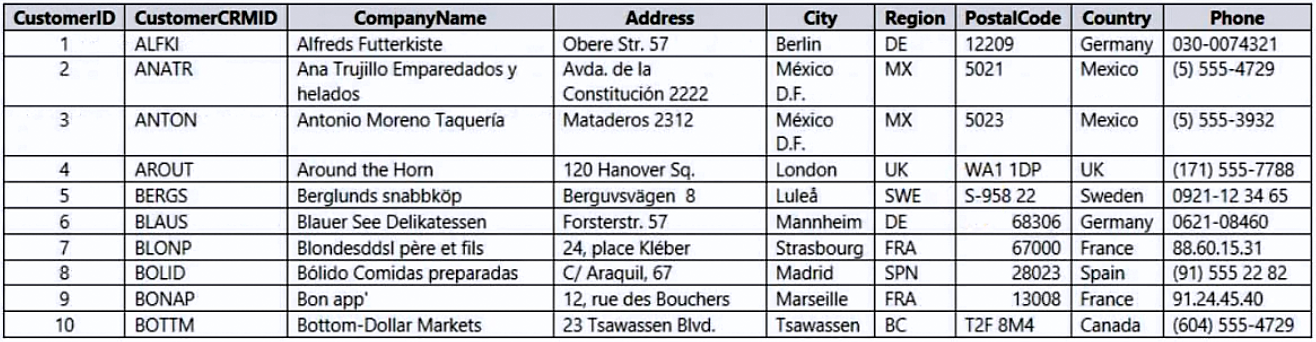
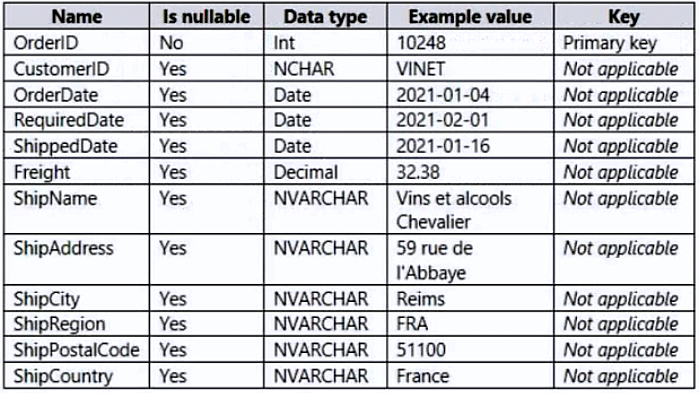
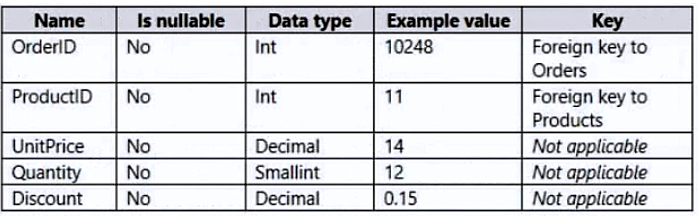
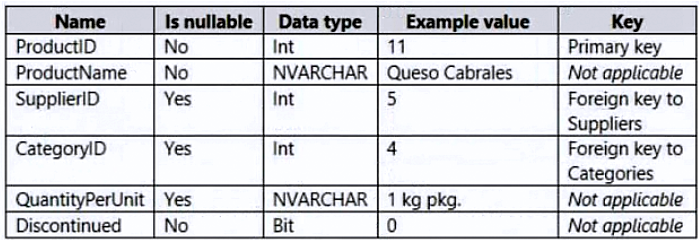
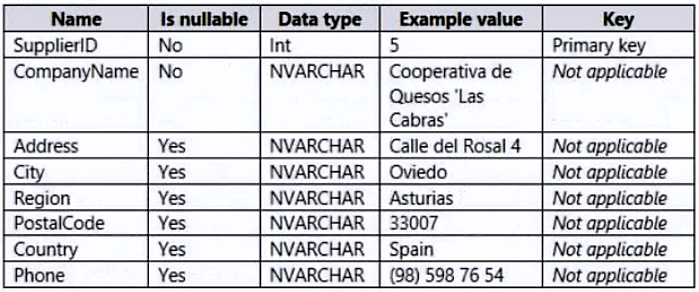
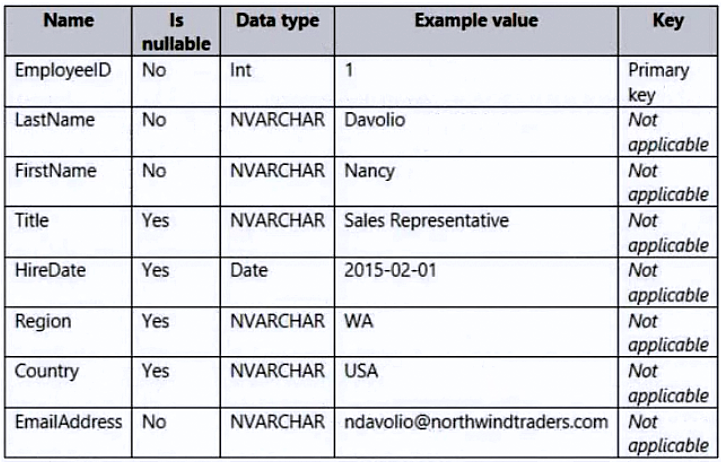
Case Study - This is a case study. Case studies are not timed separately. You can use as much exam time as you would like to complete each case. However, there may be additional case studies and sections on this exam. You must manage your time to ensure that you are able to complete all questions included on this exam in the time provided. To answer the questions included in a case study, you will need to reference information that is provided in the case study. Case studies might contain exhibits and other resources that provide more information about the scenario that is described in the case study. Each question is independent of the other questions in this case study. At the end of this case study, a review screen will appear. This screen allows you to review your answers and to make changes before you move to the next section of the exam. After you begin a new section, you cannot return to this section. To start the case study - To display the first question in this case study, click the Next button. Use the buttons in the left pane to explore the content of the case study before you answer the questions. Clicking these buttons displays information such as business requirements, existing environment and problem statements. If the case study has an All Information tab, note that the information displayed is identical to the information displayed on the subsequent tabs. When you are ready to answer a question, click the Question button to return to the question. General Overview - Northwind Traders is a specialty food import company. The company recently implemented Power BI to better understand its top customers, products, and suppliers. Business Issues - The sales department relies on the IT department to generate reports in Microsoft SQL Server Reporting Services (SSRS). The IT department takes too long to generate the reports and often misunderstands the report requirements. Existing Environment. Data Sources Northwind Traders uses the data sources shown in the following table. Source2 is exported daily from a third-party system and stored in Microsoft SharePoint Online. Existing Environment. Customer Worksheet Source2 contains a single worksheet named Customer Details. The first 11 rows of the worksheet are shown in the following table. All the fields in Source2 are mandatory. The Address column in Customer Details is the billing address, which can differ from the shipping address. Existing Environment. Azure SQL Database Source1 contains the following tables: • Orders • Products • Suppliers • Categories • Order Details • Sales Employees The Orders table contains the following columns. The Order Details table contains the following columns. The address in the Orders table is the shipping address, which can differ from the billing address. The Products table contains the following columns. The Categories table contains the following columns. The Suppliers table contains the following columns. The Sales Employees table contains the following columns. Each employee in the Sales Employees table is assigned to one sales region. Multiple employees can be assigned to each region. Requirements. Report Requirements Northwind Traders requires the following reports: • Top Products • Top Customers • On-Time Shipping The Top Customers report will show the top 20 customers based on the highest sales amounts in a selected order month or quarter, product category, and sales region. The Top Products report will show the top 20 products based on the highest sales amounts sold in a selected order month or quarter, sales region, and product category. The report must also show which suppliers provide the top products. The On-Time Shipping report will show the following metrics for a selected shipping month or quarter: • The percentage of orders that were shipped late by country and shipping region • Customers that had multiple late shipments during the last quarter Northwind Traders defines late orders as those shipped after the required shipping date. The warehouse shipping department must be notified if the percentage of late orders within the current month exceeds 5%. The reports must show historical data for the current calendar year and the last three calendar years. Requirements. Technical Requirements Northwind Traders identifies the following technical requirements: • A single dataset must support all three reports. • The reports must be stored in a single Power BI workspace. • Report data must be current as of 7 AM Pacific Time each day. • The reports must provide fast response times when users interact with a visualization. • The data model must minimize the size of the dataset as much as possible, while meeting the report requirements and the technical requirements. Requirements. Security Requirements Access to the reports must be granted to Azure Active Directory (Azure AD) security groups only. An Azure AD security group exists for each department. The sales department must be able to perform the following tasks in Power BI: • Create, edit, and delete content in the reports. • Manage permissions for workspaces, datasets, and reports. • Publish, unpublish, update, and change the permissions for an app. • Assign Azure AD groups role-based access to the reports workspace. Users in the sales department must be able to access only the data of the sales region to which they are assigned in the Sales Employees table. Power BI has the following row-level security (RLS) Table filter DAX expression for the Sales Employees table. [EmailAddress] = USERNAME() RLS will be applied only to the sales department users. Users in all other departments must be able to view all the data. You need to create the semantic model. Which storage mode should you use for the tables in the semantic model? -  -
-  -
-  -
-  -
-  -
-  -
-  -
- 
Community Votes
50% of anonymous learners picked answer C. Votes are pick records left by other test-takers — they are not the verified answer.
Community Insight
Import mode is the right fit when data only needs a once-daily refresh: it delivers the fastest visual interaction and can compress data, whereas DirectQuery and Dual trade interactive performance for freshness the 7 AM requirement does not demand.
A Power BI case study for Northwind Traders requires picking one storage mode for all tables in the semantic model, given that data must be current as of 7 AM Pacific Time daily, reports must respond quickly, and the dataset must stay small.
Assuming Dual or DirectQuery is needed for RLS or freshness — DirectQuery/Dual are only warranted for near-real-time data or very large models, and the case study explicitly allows a daily 7 AM refresh window.
Community Discussion (20 comments)
Comments & Corrections
No comments yet — spotted an error or have a note? Share it below.
Expert Analysis
Why the Answer Is Correct
Import (C) satisfies every stated technical requirement. Data currency is only required as of 7 AM Pacific Time each day, which maps exactly to a once-daily scheduled refresh of an imported model. Import also provides the fastest response times when users interact with visualizations, because queries run against the in-memory VertiPaq engine rather than hitting source systems.Why the Other Options Are Wrong
DirectQuery (A) would send every visual interaction to the source systems, which is slower and unnecessary when a daily refresh window is acceptable. Dual (B) mixes Import and DirectQuery per table and only makes sense when a single table must serve both roles in DirectQuery-heavy models — nothing in the requirements calls for it, and it adds complexity that contradicts the simplicity of the case study. Live connection (D) is not a storage mode for building a semantic model from multiple sources; it connects a report to an external published model, which cannot satisfy the requirement to build a single dataset here.Community Comment Notes
Tex02, the most-endorsed comment, reasons that reports only update at 7 AM and need fast response times, pointing to Import. Several commenters independently reach the same conclusion. One popular comment claims DirectQuery does not support RLS, which is inaccurate — DirectQuery does support row-level security — but the conclusion favoring Import still stands on the refresh and performance requirements alone.Official Reference
Frequently Asked Questions
For the PL-300 Northwind Traders semantic model, why is Import (C) preferred over DirectQuery (A)?
Import meets the daily 7 AM refresh requirement and uses the in-memory VertiPaq engine for fast visual interactions, while DirectQuery sends queries to source systems.
Does DirectQuery support row-level security in Power BI semantic models?
Yes, DirectQuery supports row-level security, but the Northwind Traders case still favors Import (C) for daily refresh and faster visualization response.
Why not use Dual (B) or live connection (D) for the Northwind Traders semantic model?
Dual mixes Import and DirectQuery per table only for DirectQuery-heavy models, and live connection connects to an external published model, not a new semantic model from multiple sources.
Related Analysis
Practice All PL-300 Questions
Access 116 questions with complete answers and detailed explanations.
View Full PL-300 Practice Test →