How Do You Identify the Critical Path in a Network Diagram?
Short answer
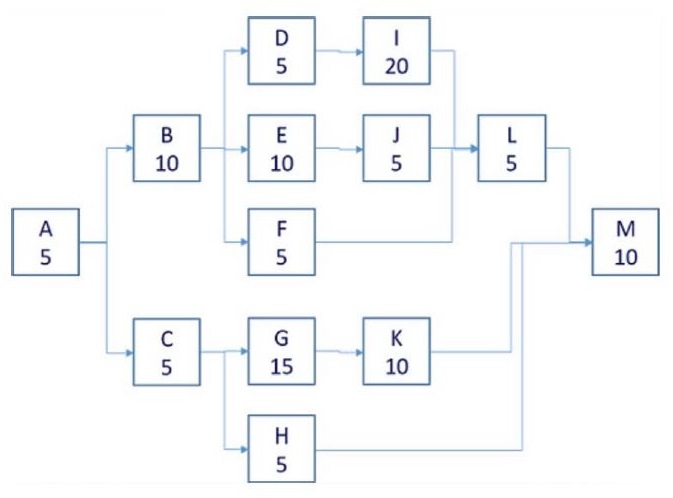
B A-B-D-I-L-M
Question
Key Takeaways
This question tests your ability to calculate total duration across parallel paths, with the common trap being selecting a path with fewer steps or higher individual task weights instead of the highest cumulative time.
The critical path represents the longest sequence of dependent tasks that determines the minimum project duration. Community consensus confirms that calculating and comparing total path durations across parallel routes reveals the correct answer.
Common mistake: Option A is frequently chosen by candidates who misread the diagram or incorrectly sum the durations, overlooking that the critical path is strictly defined by maximum elapsed time rather than task count or visual length.
Expert Analysis
Why the Answer Is Correct
The critical path method (CPM) defines the critical path as the longest continuous sequence of activities from start to finish. By adding the durations of each step along path B, the total equals 50 units, which exceeds all other options. This longest duration dictates the shortest possible project completion time, making it the definitive critical path.Why the Other Options Are Wrong
Paths A, C, and D all yield lower cumulative durations, leaving them with scheduling slack. Selecting them would indicate a fundamental misunderstanding of CPM, as these routes do not constrain the overall project timeline. Candidates often mistakenly prioritize the visually shortest or most direct route, ignoring the mathematical requirement for maximum elapsed time.Community Comment Notes
Users consistently emphasize that identifying the critical path simply requires finding the longest path time-wise. Comment [3] provides a clear breakdown of the path totals (Path A=45, B=50, C=40, D=30), directly validating the calculation approach. Several comments reinforce that memorizing the definition "longest duration wins" is highly effective for this exam type.Official Reference
- https://www.comptia.org/training/books/pk0-005
- https://en.wikipedia.org/wiki/Critical_path_method
- https://projectmanagement.com/critical-path-method-cpm/
These links open the official vendor documentation in a new tab.
Exam Strategy
Always map out every possible path on scratch paper and carefully sum the numerical values before selecting an option. Remember that the critical path never contains scheduling slack, so focus exclusively on finding the highest total duration regardless of how many intermediate nodes the path contains.
Community Votes
75% of anonymous learners picked answer B. Votes are pick records left by other test-takers — they are not the verified answer.
Discussion 4 contributions
Compiled from public community threads and reader submissions, lightly edited for clarity. Handles and vote tallies are shown as recorded, and comments reflect the views of individual contributors.
From public community threads 4
-
nasinec 👍 2The critical path is the longest one. Therefore, B is the correct answer.
-
eXhilarat3d 👍 2 Answered BThe path with the longest duration is the critical path.
-
BlueMan93 👍 1 Answered BCritical path = longest path time wise. Just add up the numbers, highest total wins. A = 45 B = 50 C = 40 D = 30
-
Therealjosh 👍 1 Answered Athe Critcal path in this would be A-C-G-k-M
Reader comments & corrections
No reader corrections yet — spotted an error or have a note? Share it below.
Related Analysis
Practice All PK0-005 Questions
Access 102 questions with complete answers and detailed explanations.
View Full PK0-005 Practice Test →