Teams Shared Channel External Collaboration for Marketing
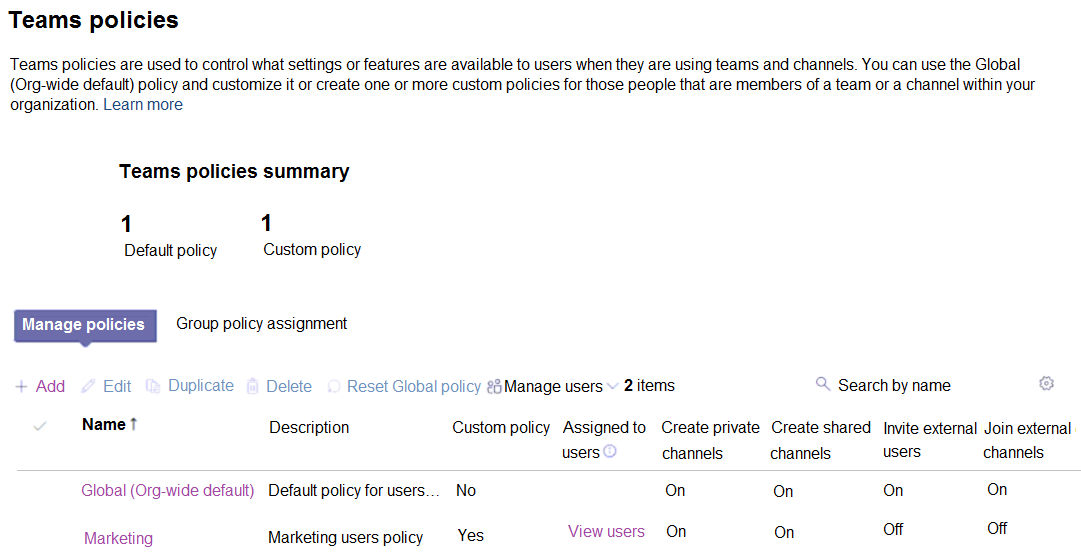
Case study - Overview - Company Information - ADatum Corporation is an energy company that has offices across North America and 3,000 employees. Physical Locations - ADatum has the offices shown in the following table. Existing Environment - Network Infrastructure - The office in Calgary has a 1-Gbps internet circuit. The offices in San Diego and New York have 100-Mbps internet circuits. The field site in Edmonton has a 3-Mbps internet circuit. Departments - ADatum has the following departments: • Information technology (IT) • Project management • Marketing Microsoft 365 and Tenants Environment ADatum recently purchased a Microsoft 365 E5 subscription that has the Microsoft Teams Domestic Calling Plan add-on. All users are assigned Microsoft 365 E5 and Microsoft Teams Domestic Calling Plan licenses and Calling Plans is deployed. Azure AD has the default Cross-tenant access settings configured. The Teams policies settings are configured as shown in the following exhibit. The Teams client is deployed to a non-persistent Virtual Desktop Infrastructure (VDI) used by the project management department. Allow guest access in Teams is set to Off. The Microsoft Viva Connections app is deployed to all users. Problem Statements - ADatum identifies the following issues: • An executive at the San Diego office reports that video drops during Teams meetings. • The Edmonton field site has limited bandwidth, and users report poor audio during Teams calls and meetings. • Users in the project management department report that they cannot give or take control during Teams calls and meetings while sharing their VDI desktop. Planned Changes - ADatum plans to implement the following changes: • Configure the media bit rate settings for the users at the Edmonton field site. The settings must apply only to the user while they are at the site, but NOT when they are at a different office. • Create a Teams channel to enable the project management department to collaborate with the IT department on a device upgrade project. • Implement a pilot rollout of Operator Connect for the users in the New York office. A port re-quest was accepted already. • Create a Teams channel for the marketing department for external collaboration. • Rename the Viva Connections icon as Start portal. Technical Requirements - ADatum identifies the following technical requirements: • The marketing department requires that all the files shared by using Teams remain available for at least three years after deletion. • The marketing department must be able to apply a watermark to content and video shared dur-ing Teams meetings. • All users require indefinite access to training videos recorded in Teams by the IT department. • All access to Teams and shared resources must use the principle of least privilege. • Guest access must remain disabled. You need to implement the planned changes for the marketing department. Which two actions should you perform? Each correct answer presents part of the solution. NOTE: Each correct selection is worth one point. - 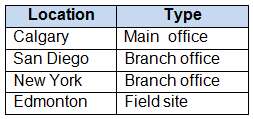 -
- 
Community Votes
100% of anonymous learners picked answer CE. Votes are pick records left by other test-takers — they are not the verified answer.
Community Insight
The question tests the direction of cross-tenant access (inbound vs. outbound) and the scope of Teams policies for shared channels, with the trap being to choose outbound settings or the global default policy.
Teams shared channels for external collaboration require enabling 'Invite external users to shared channels' on the specific department's Teams policy and configuring B2B direct connect inbound access settings in Azure AD. This page confirms that the correct actions for the ADatum marketing department are options C and E, not the outbound or global-default alternatives.
A frequent error is selecting B (outbound B2B direct connect) because learners confuse which direction controls external users accessing your shared channel; outbound applies when your users join external channels, not when you host one.
Community Discussion (3 comments)
Comments & Corrections
No comments yet — spotted an error or have a note? Share it below.
Expert Analysis
Why the Answer Is Correct
The marketing department needs a Teams channel for external collaboration, which in Microsoft Teams means a shared channel. To host a shared channel and invite external participants, the department's Teams policy must have "Invite external users to shared channels" turned On (option E). Scoping this to the marketing department's policy rather than the Global (Org-wide default) policy satisfies the least-privilege requirement. For external users from another Microsoft Entra tenant to actually access the shared channel, ADatum must configure the B2B direct connect inbound access settings in Azure AD to allow those users (option C). Inbound settings control who from other organizations can access your resources, which is exactly the direction needed when you are the host inviting guests into your shared channel.
Why the Other Options Are Wrong
Option A is incorrect because changing the Global (Org-wide default) Teams policy would enable external invitations for all users, not just marketing, violating the least-privilege requirement. Option B is wrong because outbound B2B direct connect settings control whether your users can access shared channels hosted by other organizations—the opposite direction from hosting a channel and inviting external users in. Option D is wrong because "Join external shared channels" only matters when your users need to join a shared channel created by an external tenant; the marketing department is creating its own channel, so this setting is not required.
Community Comment Notes
Community consensus strongly favors CE, with all recorded votes selecting those two options. As Bobalo observed, "The marketing channel is shared, not private," confirming the scenario is about shared channels rather than private channels. kitty73 cited Microsoft documentation noting that B2B direct connect "currently works with Microsoft Teams shared channels," reinforcing the need for cross-tenant access configuration. r2c3po explained that "Join external shared channels" (D) enables joining external channels while "Invite external users to shared channels" (E) enables inviting, correctly pointing out that only the invite setting is needed here. These perspectives align with the analysis above.
Official Reference
Exam Strategy
Focus on the direction of access: when you host a shared channel, you need inbound cross-tenant settings to let external users in; outbound is for when your users join external channels. Also, scope Teams policies to the specific department to meet least privilege.
Frequently Asked Questions
Why is B2B direct connect outbound access not the correct action for external collaboration?
Outbound settings control your users accessing shared channels hosted by other tenants. Here the marketing department hosts the channel and invites external users, so inbound access is required.
Why not set 'Invite external users to shared channels' on the Global org-wide default Teams policy?
The requirement is for the marketing department only, and the least-privilege principle means you should scope the Teams policy to that department rather than enabling it for all users.
Related Analysis
Practice All MS-700 Questions
Access 88 questions with complete answers and detailed explanations.
View Full MS-700 Practice Test →