Which Maintenance Forecast Fits Each Requirement?
Short answer
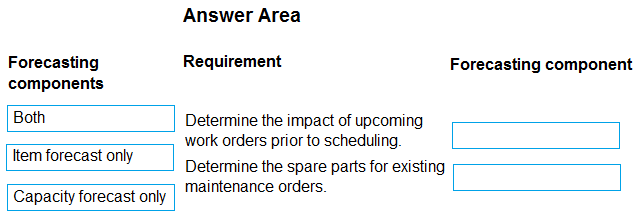
Map capacity forecast to "the impact of upcoming work orders prior to scheduling" and item forecast to "the spare parts required for existing maintenance orders."
Question
A company uses Dynamics 365 Supply Chain Management. A group of machines requires monthly maintenance that includes the replacement of spare parts such as belts and oil.
A subset of the machines also has existing maintenance requests. The service manager is concerned that an insufficient number of technicians and parts are available to complete the requests.
The company must determine the following:
• The impact of upcoming work orders prior to scheduling.
• The spare parts required for existing maintenance orders.
You need to determine the required forecasting.
Which forecasting component should you configure for each requirement? To answer, drag the appropriate forecasting components to the correct requirements. Each forecasting component may be used once, more than once, or not at all. You may need to drag the split bar between panes or scroll to view content.
Key Takeaways
It tests whether you can separate the capacity (technician workload) dimension from the item (spare parts) dimension of maintenance forecasting, and the trap is dragging both components onto each requirement.
This MB-330 drag-and-drop asks you to match Dynamics 365 Supply Chain Management maintenance forecasting components to two requirements: capacity forecast shows the workload impact of upcoming work orders before scheduling, while item forecast lists the spare parts needed for existing maintenance orders.
Common mistake: Assigning both capacity forecast and item forecast to each requirement, or using master planning/demand forecasting instead — capacity forecast only measures technician workload, and item forecast only measures parts consumption, so each requirement needs exactly one component.
Expert Analysis
The governing principle
In Dynamics 365 Supply Chain Management's Maintenance module, the forecasting feature deliberately splits maintenance planning into two forecast types with different subjects of measurement. A capacity forecast answers a workload question: it evaluates the work orders scheduled for a period against the available technician (resource) capacity so you can see the effect of upcoming work before you commit to a schedule. An item forecast answers a material question: it rolls up the spare parts, consumables and BOM lines referenced by maintenance requests and work orders, so you know what must be in stock. The key is that each forecast reports on exactly one of those dimensions — capacity forecast reports people and time, item forecast reports parts and quantity.
Mapping the requirements
- The impact of upcoming work orders prior to scheduling → Capacity forecast. This is a pre-scheduling workload check, precisely what the capacity forecast is designed to show.
- The spare parts required for existing maintenance orders → Item forecast. This is a parts-requirement roll-up, which is the item forecast's sole purpose.
Why the trap exists
Learner commentary on this item argues for capacity forecast alone on the first requirement and item forecast alone on the second, because item forecast measures material consumption rather than scheduling capacity, while capacity forecast measures resource workload rather than material requirements. The tempting wrong move is to drag both components onto each requirement; that blurs the two dimensions the exam is testing. Also resist the urge to reach for master planning or demand forecasting — those live outside the maintenance forecasting feature and are not the tools described here. The correct mapping is therefore a clean one-to-one assignment: capacity forecast → scheduling impact; item forecast → spare parts demand.
Exam Strategy
For requirement-matching drag-and-drop items, strip each requirement down to the noun it asks about: people, time, and schedule impact point to capacity; parts, quantities, and stock point to items. Because a component may be reused or left unused, judge each requirement independently rather than assuming every tile must be placed or that both tiles apply everywhere. Finally, ignore forecasting features from other modules — the scenario names maintenance work orders, so stay inside the Maintenance module's forecast types.
Frequently Asked Questions
What is the difference between capacity forecast and item forecast in D365 SCM maintenance?
When should I run a maintenance forecast in Dynamics 365 Supply Chain Management?
Is maintenance forecasting the same as master planning demand forecasting?
Discussion 1 contributions
Compiled from public community threads and reader submissions, lightly edited for clarity. Handles and vote tallies are shown as recorded, and comments reflect the views of individual contributors.
From public community threads 1
-
Gemami 👍 11. Capacity forecast only - Evaluates expected maintenance workload and technician/resource capacity before scheduling. - Item forecast measures material consumption, not scheduling capacity. 2. Item forecast only - Calculates the spare parts and consumables required for maintenance orders. - Capacity forecast calculates resource workload, not material requirements. Why not Both? The question separates the two forecasting objectives. Each has a dedicated calculation in Asset Management.
Reader comments & corrections
No reader corrections yet — spotted an error or have a note? Share it below.