Lead time and negative days for vendor delay in master planning
Short answer
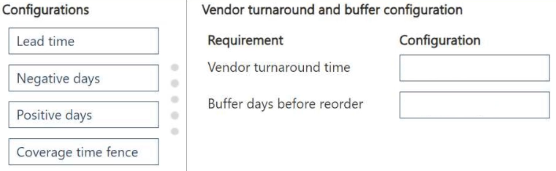
Vendor turnaround time → Lead time; two-day buffer before reordering → Negative days, set to 2. Lead time defines the vendor's delivery duration used to backdate the planned order, while negative days is the late-receipt tolerance before master planning proposes new replenishment.
Question
A company uses Dynamics 365 Supply Chain Management.
A planner observes that an item has last-minute orders placed. These orders drive new demand that is dependent upon POs arriving on schedule.
The planner determines the vendor is inconsistent with turnaround time.
You need to configure the system to adjust for the vendor turnaround and add a buffer of two days prior to reordering product.
What should you configure for each requirement? To answer, move the appropriate configurations to the correct requirements. You may use each configuration once, more than once, or not at all. You may need to move the split bar between panes or scroll to view content.
NOTE: Each correct selection is worth one point.
Key Takeaways
The trap is confusing negative days (late-receipt tolerance before replanning) with positive days or coverage time fence, which govern future-supply coverage and the planning horizon instead.
This MB-330 drag-drop tests how Dynamics 365 Supply Chain master planning handles an unreliable vendor. Configure lead time for the vendor's turnaround and negative days to 2 for the two-day reorder buffer.
Common mistake: Choosing positive days or coverage time fence for the two-day buffer: positive days controls how far ahead existing supply can cover demand, and coverage time fence sets the planning horizon — neither tolerates late receipts.
Expert Analysis
Trace through a master planning run
The planner's symptom starts with last-minute customer orders creating new demand. When master planning runs, it nets that demand against existing and expected supply: open POs, planned receipts, and on-hand inventory. Each netted receipt is evaluated against two things — when it must arrive, and how much lateness is acceptable. Those two evaluations map directly to the two requirements in this scenario.
Requirement 1: vendor turnaround time → Lead time
The lead time is what tells planning how many calendar days elapse between releasing a purchase order and receiving the goods. Planning subtracts that lead time from the requirement date to derive the planned order date. If the lead time on the item (or the purchase lead time supplied by the vendor record) is understated, planning will order too late and the last-minute orders will keep exposing the gap. So the setting that encodes "the vendor is inconsistent with turnaround" is the lead time — it is the baseline delivery duration the whole schedule is built on.
Requirement 2: two-day buffer before reordering → Negative days
Negative days (the receipt tolerance on the coverage settings) is the number of days a receipt is allowed to be late before master planning considers the supply late and proposes fresh replenishment. Setting negative days to 2 gives exactly the requested buffer: a PO arriving up to two days behind schedule still satisfies the demand, and only beyond that tolerance does planning generate a new planned replenishment. This is the trap the scenario sets — learners reach for coverage time fence or positive days instead. Positive days controls how far ahead existing future supply may cover demand, and the coverage time fence controls how far into the future planning looks and how far back it explodes requirements; neither measures lateness tolerance. Learner notes correctly pair lead time with turnaround and negative days with the reorder buffer, while flagging positive days and coverage time fence as the distractors.
The correct mapping is therefore: vendor turnaround → lead time, and two-day buffer → negative days (set to 2).
Official Reference
https://learn.microsoft.com/en-us/dynamics365/supply-chain/master-planning/
This link opens the official vendor documentation in a new tab.
Exam Strategy
For every drag-drop on planning parameters, translate each setting into the question's plain-language symptom before matching: turnaround or delivery duration means lead time, tolerance for lateness means negative days, and future supply coverage means positive days. Then sanity-check by asking what date each setting actually moves — if it moves the order release date it is timing, if it changes when planning declares supply late it is tolerance. Use the wording of the requirement itself as the giveaway; a numeric buffer almost always maps to a day-count tolerance setting.
Frequently Asked Questions
What do negative days do in Dynamics 365 master planning?
How does lead time affect planned purchase order dates?
What is the difference between positive days and coverage time fence?
Discussion 2 contributions
Compiled from public community threads and reader submissions, lightly edited for clarity. Handles and vote tallies are shown as recorded, and comments reflect the views of individual contributors.
From public community threads 2
-
Gemami 👍 1Correct answers: Lead time → Negative days - Lead time: Defines how long the vendor takes to deliver products. - Negative days: Defines how many days a late receipt can be tolerated before master planning suggests new replenishment. Set to 2 days. Why not the others? - Positive days: Determines how far into the future existing supply can cover demand, not late-delivery tolerance. - Coverage time fence: Defines how far ahead master planning considers demand and supply, not the reorder buffer. Note: Negative days provides a delay tolerance, not a buffer for ordering two days earlier.
-
982be89 👍 1Vendor takes X days → LEAD TIME Vendor is late / when should I reorder? → NEGATIVE DAYS Future receipt available → POSITIVE DAYS How far planning looks → COVERAGE TIME FENCE For that reason, Vendor turnaround time → Lead time Buffer days before reorder → Negative days
Reader comments & corrections
No reader corrections yet — spotted an error or have a note? Share it below.