Configuring Trade Agreements for Flash Sales and Standard Prices
Short answer
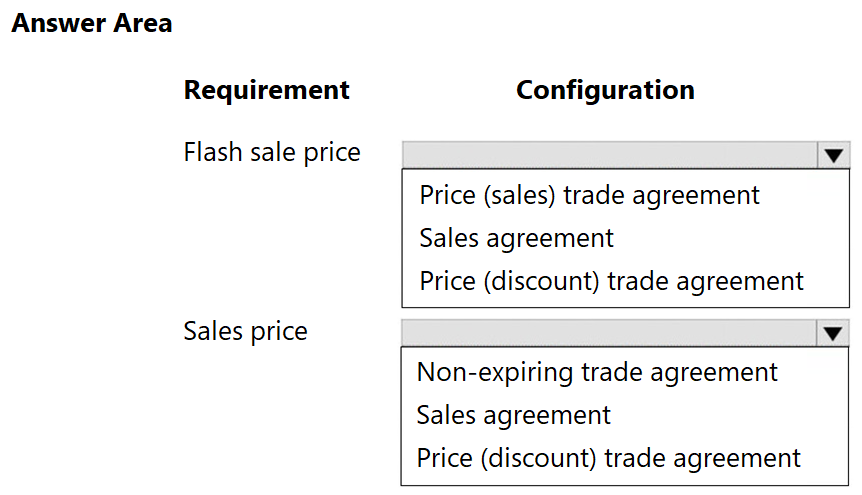
Configure Flash Sale Price using a Price (discount) trade agreement. Configure Sales Price using a Non-expiring trade agreement.
Question
Case study
This is a case study. Case studies are not timed separately. You can use as much exam time as you would like to complete each case. However, there may be additional case studies and sections on this exam. You must manage your time to ensure that you are able to complete all questions included on this exam in the time provided.
To answer the questions included in a case study, you will need to reference information that is provided in the case study. Case studies might contain exhibits and other resources that provide more information about the scenario that is described in the case study. Each question is independent of the other questions in this case study.
At the end of this case study, a review screen will appear. This screen allows you to review your answers and to make changes before you move to the next section of the exam. After you begin a new section, you cannot return to this section.
To start the case study
To display the first question in this case study, click the Next button. Use the buttons in the left pane to explore the content of the case study before you answer the questions. Clicking these buttons displays information such as business requirements, existing environment, and problem statements. If the case study has an All Information tab, note that the information displayed is identical to the information displayed on the subsequent tabs. When you are ready to answer a question, click the Question button to return to the question.
Background
School of Fine Art is a distribution company that sells school supply items to primary and secondary schools. These include items such as pens, pencils, paper, notebooks, chalk, desks, acrylic paints, blackboards, dry erase markers, and whiteboard paint. Due to increased demand for colored pencils, lead times are longer for these pencils. School of Fine Art plans to expand sales into this market.
School of Fine Art plans to implement Dynamics 365 Supply Chain Management to manage the business.
Current environment. Company structure
School of Fine Art consists of two legal entities.
Primary company
• Located in Dublin, Ireland.
• Has a single named warehouse.
• Is the primary distribution center for both companies.
Second company
• Is located in Glasgow, Scotland.
• Includes the following warehouses: Glasgow1, Glasgow2.
○ Glasgow1 is used primarily to supply items regionally.
○ Glasgow2 serves as local storage for vendor-owned inventory and bulk storage for School of Fine Art's inventory.
Current environment. General processes
School of Fine Art uses a combination of spreadsheets and paper forms to manage the business.
• All sales, purchases, and inventory are tracked in spreadsheets that are password protected by managers.
• Managers frequently share spreadsheet passwords so that other users can make edits on their behalf. Inventory quantities and values are unreliable.
• The spreadsheets are often incorrectly updated, have entry errors, and broken formulas for calculations.
• Purchase order receipts, picking lists, packing slips, and invoices are all handwritten on pre-printed, three-part forms.
• Late summer is the company's busiest time. During this time, workers are typically on the warehouse floor or making rush deliveries to schools to meet last-minute needs.
Current environment. Inventory and warehousing
• School of Fine Art values inventory by using FIFO costing methods.
• Inventory in the warehouses cannot be distinguished as available inventory or inventory that is sold to a customer and waiting to be picked. This creates inventory inflation during cycle counts and later shortages because warehouse workers count items that are already promised to customers and waiting to be shipped.
• Glasgow2 space is fully allocated to vendors.
• Due to space constraints, school orders for photocopiers are shipped from the vendor to the school.
• Crayons are stored as separate item numbers depending on whether they are in a box or a case. This creates issues when counting inventory to determine the total number of crayons in stock.
• Lack of inventory controls has led to shortages on sales orders, creating backorders and unhappy schools.
• Inventory is ordered quarterly due to the seasonality of the business.
• Items can change annually based on popular sizes, colors, and styles for each new school season. The creation of the different configurations is a manual process, which creates so much overhead that temporary workers are brought in to do the data entry.
Current environment. Purchasing
• Reordering is manually managed by the buyers looking at the seasonal spikes for the start of the school year, slowing around the end-of-year holidays until the following school year.
• Pens are readily available products that are rarely discounted for sale.
• Photocopiers are only available for sale on the Glasgow region.
• Photocopy paper and construction paper are ordered by the pallet into Dublin1 and must be broken down into smaller sizes. The pallets are typically broken down and then split between what stays in Dublin1 and what is shipped to Glasgow1.
• Chalk and blackboards are slower sellers, so many vendors do not carry these items. School of Fine Art purchases these products from a single vendor. There are no alternative vendors available.
• School of Fine Art agrees to purchase a new line of smartboards from a vendor. The agreed-upon smartboard purchase prices will have a cost price per 55-inch, 75-inch, or 85-inch smartboard.
• The company purchases pencils for the following warehouses:
○ Glasgow1:
• standard pencils from Vendor A
• colored pencils from Vendor B
○ Dublin1:
• standard pencils from Vendor A
• colored pencils from Vendor A
• As whiteboard paint grows in popularity, so does the demand. This causes supply shortages. Whiteboard paint is ordered six months in advance.
Current environment. Customer sales
• The company contractually agrees to prices for some items with schools prior to the start of each school year.
• Schools may order bulk cases of products and choose to distribute further breakdowns, such as a case of crayons, which are then distributed to classrooms by the box.
• Pens do not require contracts with schools because they are low margin and do not have supply chain shortages.
• Painting supplies such as acrylic paint, canvases, and easels do not require a special contract and are sold at regular list price to all schools.
• Schools that offer painting classes are part of a program that provides special pricing on the painting supplies.
• Chalk and blackboards are ordered less frequently than they were in past years. Schools are choosing to use whiteboard paint, which is a lower cost than ordering and installing the whiteboards.
Requirements. Customers and sales
• The system must have the ability to limit product purchase amounts by a single school to prevent stock shortages for other schools.
• Schools are obligated to purchase the agreed amount for specific items per the school year.
• Customer service must be able to easily enter items for sales orders and identify stock shortages.
• Sales of whiteboard paint must be limited so that one school does not buy all the inventory and force backorders for other schools.
• Schools must agree to the amount of whiteboard paint they will purchase for the whole school year.
Requirements. Inventory costing
• Inventory must have associated costs except for the vendor storage in Glasgow2.
• The vendor storage must still contain quantities but not include cost in inventory valuations.
• At the end of each month, the costing manager must be able to identify how many items will not be fully settled.
• Annual configuration changes to items must be automatically created where possible.
• The company must be able to track costs for colored pencils and standard pencils separately.
Requirements. Inventory
• Warehouse workers must be able to use their mobile phones and the mobile app to take calls and create transactions in the warehouse.
• The desks must use a single item number and barcode regardless of year manufactured and the vendor.
• Water-based paints from the vendor must be received in pails.
• Acrylic paint must be managed by batches and expiration dates.
• Pencils must be categorized as colored pencils or standard pencils. The individual colors of each colored pencil (such as red, green, and blue) will not be tracked.
• The creation of unique smartboard items must be kept to a minimum.
Issues
• WarehouseWorker1 works in Glasgow2. The worker receives a request to ship pallets of paper from the warehouse to Glasgow1 and Dublin1. WarehouseWorker1 must create the shipments in the system to transfer the pallets of paper from Glasgow1 to Dublin1.
• The number of backorders for desks has increased. Customer service representatives struggle to select a desk item number that has inventory on hand. The desks are the same item, but the manufacturer vendor and year differ.
• A school calls customer service to report that its photocopier is broken. The school needs expedited shipment of a replacement.
• A school that is part of the special paint program reports that a sale price on canvas last month was a better price than its paint program price. The school requests a price adjustment.
• A school reports that different shipments of acrylic paints are slightly different in color.
• The sales team decides to have a flash sale on pens for one month only. The person entering the Sales order line should be able to communicate the information to the customer on the Sales order line.
• Schools are reporting that chalk and blackboards are broken upon receipt. A worker in Dublin1 opens some cases of these products in the warehouse and finds that they are also broken. You must implement processes to enforce inventory inspection for a percentage of each purchase order line received. You must block all inventory for a purchase order line if the inspection fails.
You must configure pen flash sale prices.
What should you configure? To answer, select the appropriate option in the answer area.
NOTE: Each correct selection is worth one point.
Key Takeaways
The main trap is confusing 'Sales Agreements' with 'Trade Agreements'. Sales Agreements are for binding quantity/price contracts over time, while Trade Agreements handle the actual price calculations, with Discount Trade Agreements being ideal for temporary promotional periods.
Learn how to configure a one-month flash sale using a Price (discount) trade agreement and a standard sales price using a Non-expiring trade agreement in Dynamics 365 SCM.
Common mistake: Learners often select 'Sales Agreement' for any scenario involving a 'special price' or 'school year agreement'. This is incorrect because Sales Agreements enforce volume commitments, whereas a flash sale is merely a temporary price reduction requiring a Discount Trade Agreement.
Expert Analysis
The question asks how to configure pricing for two specific scenarios within Dynamics 365 Supply Chain Management: a one-month flash sale on pens and a permanent sales price. The correct configuration relies on understanding the distinct purposes of trade agreements in D365 SCM.
For the Flash Sale Price, the requirement specifies a special price for pens valid for only one month. In D365 SCM, time-bound discounts or temporary price overrides are handled using a Price (discount) trade agreement. This agreement type allows you to define a discount amount or percentage applicable within a specific date range (From Date and To Date). It is designed exactly for short-term promotions like flash sales where inventory levels might be high or demand needs stimulation temporarily. Using a Sales Agreement here would be incorrect because sales agreements are typically used for long-term commitments or contracts involving quantities over time, not simple short-term price drops.
For the Sales Price (implied as the standard or agreed-upon price for items like those in the paint program or general list prices), the correct tool is a Non-expiring trade agreement (often referred to as a Trade Agreement with no end date or simply a Price Discount/Sales Price agreement depending on the exact UI context, but fundamentally it's a standard price agreement). However, looking at the specific constraint "Pens do not require contracts" and the need for a stable price, a standard Trade Agreement (specifically a Price Discount or Sales Price agreement without an expiration) is used to set the baseline price for customers or items. If the question implies setting a specific agreed price for a customer group that doesn't expire, it falls under standard trade agreements.
Crucially, the comment highlighting "Flash sale price = Price (discount) trade agreement" and "Sales price = Non-expiring trade agreement" aligns with Microsoft's documentation. A Sales Agreement is reserved for scenarios where there is a contractual obligation for quantity and price over a period (like the whiteboard paint commitment mentioned elsewhere in the case study). Since the flash sale is purely a price change for a duration, and the standard sales price is a permanent or long-term setting, these are distinct from Sales Agreements which bind both parties to volume commitments.
Therefore, the first selection (Flash Sale) should be Price (discount) trade agreement and the second (Sales Price/Standard) should be Trade agreement (or specifically the non-expiring variant if presented as such). The key distinction is between temporary price changes (Discount Trade Agreement) and permanent/contractual pricing structures.
Exam Strategy
Always read the duration and nature of the pricing requirement carefully. If the price change is temporary (e.g., 'flash sale', 'one month'), think 'Discount Trade Agreement'. If it involves a contractual obligation for quantity over time (e.g., 'obligated to purchase agreed amount'), think 'Sales Agreement'. For permanent standard prices, use a standard Trade Agreement.
Frequently Asked Questions
What is the difference between a Trade Agreement and a Sales Agreement?
When should I use a Price (discount) trade agreement?
Discussion 4 contributions
Compiled from public community threads and reader submissions, lightly edited for clarity. Handles and vote tallies are shown as recorded, and comments reflect the views of individual contributors.
From public community threads 4
-
Kev_Sharp 👍 9Flash sale price = Price (discount) trade agreement. Sales price = Non-expiring trade agreement. Note that this is not a sales agreement as "Pens do not require contracts with schools"
-
Gemami 👍 1Flash sale price ------> Price (sales) trade agreement Sales price ------> Non-expiring trade agreement Why? 1. Flash sale price → Price (sales) trade agreement The company wants a special price for pens for one month only. A sales-price trade agreement allows you to specify a discounted sales price with a From date and To date. 2. Sales price → Non-expiring trade agreement Pens normally have a regular selling price. A non-expiring trade agreement establishes the ongoing price without an end date. Why not the others? - Sales agreement — Used for contractual commitments between the company and specific customers, not a general flash sale. - Price (discount) trade agreement — Defines a discount percentage or amount rather than the specific promotional sales price requested.
-
globeearth 👍 1For the 2nd requirment, answer is Sales agreement. the following lines indicates it as agreement. • Schools are obligated to purchase the agreed amount for specific items per the school year. • Schools must agree to the amount of whiteboard paint they will purchase for the whole school year.
-
globeearth 👍 1Agreed
Reader comments & corrections
No reader corrections yet — spotted an error or have a note? Share it below.