Choosing the Right Safety Margin in Master Planning
Short answer
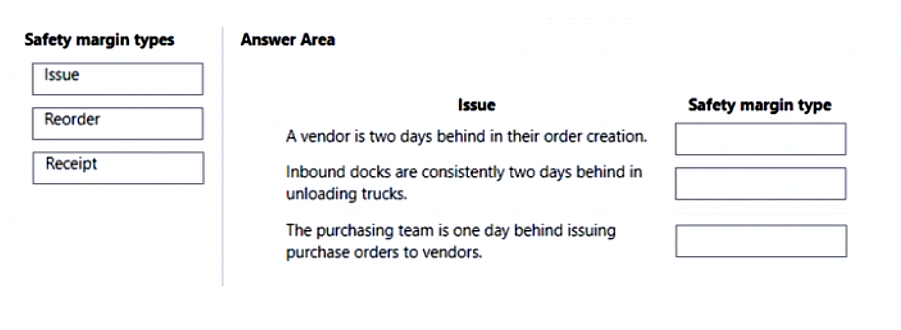
Match by where the delay occurs: vendor or purchasing delay in creating the supply order maps to Reorder margin; unloading or handling incoming goods maps to Receipt margin; outbound sales-order shipment handling maps to Issue margin.
Question
A company uses Dynamics 365 Supply Chain Management. The company implements master planning.
The company identifies several supply chain issues.
You need to configure safety margins for the company.
Which type of safety margin should you use? To answer, drag the appropriate safety margin types to the correct issues. Each safety margin type may be used once, more than once, or not at all. You may need to drag the split bar between panes or scroll to view content.
NOTE: Each correct selection is worth one point.
Key Takeaways
You must locate the delay on the timeline — before the supply order exists, after goods arrive, or on the outbound shipment — because all three margins are just buffers of days and look interchangeable.
This MB-330 drag-drop tests whether you can pair each supply chain delay with the correct master planning safety margin: reorder margin for order-creation delays, receipt margin for inbound handling, and issue margin for outbound shipment handling.
Common mistake: Treating a late vendor or purchasing order as a receipt margin problem, because the goods arrive late; the delay actually occurs before the lead time starts, so reorder margin is correct.
Expert Analysis
Where the delay sits is the whole test
Dynamics 365 master planning offers exactly three safety margins, and each one is tied to a different point on the timeline of a planned order. The confusion in this drag-drop comes from treating them as generic "extra days" buffers rather than locating the delay relative to the supply order itself.
Reorder margin — the delay happens before the supply order exists
Reorder margin is the buffer time for placing the supply order. It is added so that planning accounts for the gap between when the planner decides an order is needed and when the purchasing team actually creates and releases it. Any issue where a vendor or the internal purchasing team is late in creating the purchase order — for example, the buyer is two days behind — falls on this side of the boundary, because the delay precedes the lead time clock, and reorder margin effectively extends planning lead time to absorb it.
Receipt margin — the delay happens after the goods arrive at your dock
Receipt margin is the buffer time for handling incoming supply: unloading, putting away, inspection, and any other inbound handling after the shipment reaches the company. If the stated issue is that incoming goods take longer to be received or unloaded than planned, that is receipt margin, not reorder margin.
Issue margin — the delay happens on the outbound side
Issue margin is the buffer time for handling shipments, that is, outbound sales-order picking, packing and despatch. Comments in the learner records correctly note that "issue margin is for handling shipment (sales order)," so the last issue, shipment handling, is issue margin.
The correct mapping
So the correct answer is the mapping: purchase-order creation or vendor-ordering delay → Reorder margin; receiving/unloading of incoming goods → Receipt margin; outbound sales-order shipment handling → Issue margin. Note the margins may be reused or left unused across the three targets, so decide each pair solely by the location of the delay, not by position in the list. A comment suggesting that a late supplier order is a receipt margin case is wrong precisely because it ignores this boundary — the delay there occurs before receipt, in order creation.
Official Reference
This link opens the official vendor documentation in a new tab.
Exam Strategy
For any safety-margin item, draw a quick timeline in your head: order creation → lead time → arrival → inbound handling → outbound shipment. Ask which segment the described delay belongs to, then pick reorder (before lead time), receipt (inbound) or issue (outbound). Because types may be reused or unused, judge each pairing independently instead of trying to use each margin exactly once.
Frequently Asked Questions
What is the difference between reorder, receipt and issue safety margins?
If our purchasing team always creates purchase orders late, which margin applies?
Can a safety margin type be used for more than one issue in the drag-drop?
Discussion 6 contributions
Compiled from public community threads and reader submissions, lightly edited for clarity. Handles and vote tallies are shown as recorded, and comments reflect the views of individual contributors.
From public community threads 6
-
Vnes80 👍 7Issue margin is for handling shipment (sales order). So the last one should be reorder margin. https://learn.microsoft.com/en-us/dynamics365/supply-chain/master-planning/planning-optimization/safety-margins
-
Blesaf 👍 3Reorder margin – The buffer time for placing the supply order Receipt margin – The buffer time for handling incoming supply Issue margin – The buffer time for handling shipments
-
H_Incandenza 👍 2For point 3: I think either reorder or issue could technically work, but selecting "issue" requires more assumptions. Reorder margin means to add days to the lead time for planning purposes. E.g. if your lead time is 15 days, but your purchasing team is constantly a day behind, it will always be there a day late. Reorder margin fixes that. Issue margin could work too, i.e. we assume we're issuing it on the day it arrives, and the purchasing team is setting us back a day. But for my money I would select reorder.
-
globeearth 👍 2[1] Receipt margin is defined as "the buffer time for handling incoming supply." When a vendor is two days behind in creating an order (e.g., a purchase order), it delays the delivery of goods to the company. [2] Receipt margin also applies here, as it covers "the buffer time for handling incoming supply." [3] Reorder margin is defined as "the buffer time for placing the supply order." When the purchasing team is one day behind in issuing purchase orders, it delays the start of the procurement process.
-
Blesaf 👍 2For me the correct answers would be : 1. Receipt margin- the supplier is late in placing the order, so it has an impact on our expected receipt date 2. Receipt margin 3. Reorder margin
Show 1 more comment
-
Gemami 👍 11. Reorder — the delay occurs before fulfillment/lead time starts. Reorder margin provides buffer between supply-order creation and its start. 2. Receipt — unloading is incoming-goods handling after delivery, exactly what Receipt margin covers. 3. Reorder — purchasing is delayed in creating/placing the supply order, explicitly the purpose of Reorder margin.
Reader comments & corrections
No reader corrections yet — spotted an error or have a note? Share it below.