IS-IS Level-1 Default Route vs Level-2 Specific Routes
Short answer
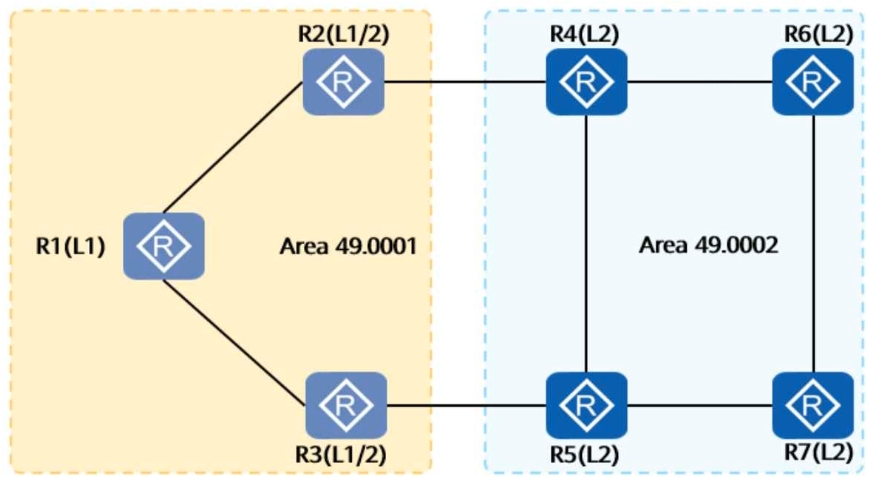
BCD Routers R2, R3, and R7 operate at Level-2 or Level-1-2 and maintain specific routes for the entire IS-IS network, while R1 (Level-1) relies on a default route.
Question
Key Takeaways
The trap is assuming all routers know all routes; the insight is that IS-L1 routers only see intra-area specifics and a default route, while IS-L2 routers see everything.
Determines which routers hold specific routes in an IS-IS multi-area network. Correct answers are B, C, and D because Level-2 routers maintain full routing tables, unlike Level-1 routers which use default routes.
Common mistake: Selecting A (R1) because it appears central or connected to many links. It is wrong because L1 routers suppress inter-area detail to keep databases small, using only a default route instead.
Expert Analysis
The scenario describes an IS-IS network with multiple areas. In IS-IS, routers are classified into Level-1 (L1), Level-2 (L2), or Level-1-2 (L1-2). The key behavior governing this question is the default routing advertisement between levels.
Level-1 Routers (Intra-area): By default, L1 routers do not know about specific routes in other areas. To ensure connectivity to destinations outside their area, they automatically generate and send a default route (0.0.0.0/0) to all L1 routers within the same area. This default route is originated by the L1/L2 router that has the ATT (Attached) bit set in its Level-1 LSUs. Therefore, an L1-only router like R1 will only have a default route pointing to its Area Border Router (ABR) and will not possess specific detailed routes for the entire network. As noted in community comments, "R1 es un router de nivel Level-1... NO recibe las rutas detalladas/específicas".
Level-2 Routers (Inter-area/Backbone): L2 routers form the backbone and exchange full link-state database information across areas. They maintain a complete view of the topology and thus hold specific routes for all networks in the IS-IS domain. Routers that act as L2 routers (or L1-2 routers acting as L2 speakers) will have these specific routes. In typical campus designs depicted in such diagrams, routers connecting different areas or forming the core backbone (like R2, R3, R7) operate at Level-2. Consequently, they learn and store specific routes for all subnets.
Therefore, the routers that have specific routes on the entire network are those operating at Level-2 or Level-1-2 (excluding the L1-only router). Based on standard topology conventions where R2, R3, and R7 serve as inter-area bridges or backbone nodes, they will contain the full routing table.
Exam Strategy
When analyzing IS-IS topology questions, first identify the Level of each router. If a router is L1-only, it never has specific inter-area routes—only a default route generated by an L1/L2 neighbor. If a router is L2 or L1/L2, it participates in the backbone and maintains full specific routes. Eliminate L1-only options immediately when asked for 'specific routes'.
Frequently Asked Questions
Why does R1 not have specific routes?
What is the role of the ATT bit?
Community Votes
34% of anonymous learners picked answer B. Votes are pick records left by other test-takers — they are not the verified answer.
Discussion 1 contributions
Compiled from public community threads and reader submissions, lightly edited for clarity. Handles and vote tallies are shown as recorded, and comments reflect the views of individual contributors.
From public community threads 1
-
HCIP Resolutor 👍 1R1 es un router de nivel Level-1 (L1) puro. Por defecto, los routers L1 NO reciben las rutas detalladas/específicas de otras áreas (L2/L1-2); en su lugar, aprenden una ruta por defecto (0.0.0.0/0) generada por los routers L1/L2 que tienen fijado el bit ATT (Attached Bit). Por ende, R1 NO tiene rutas específicas de toda la red. Los routers R2, R3, R4, R5, R6 y R7 forman parte del Backbone L2 o son routers L1/L2. Por defecto, las rutas de la zona L1 (Area 49.0001) se filtran/inyectan automáticamente hacia el dominio L2 en LSPs de Nivel 2. Por lo tanto, los routers L2 y L1/L2 (R2, R3 y R7) SÍ poseen rutas específicas completas de toda la red.
Reader comments & corrections
No reader corrections yet — spotted an error or have a note? Share it below.
Related Analysis
Practice All H12-821 Questions
Access 168 questions with complete answers and detailed explanations.
View Full H12-821 Practice Test →