BGP Incremental Updates and Mandatory Attributes
Short answer
BD BGP sends incremental updates and includes the mandatory Origin attribute in every route advertisement.
Question
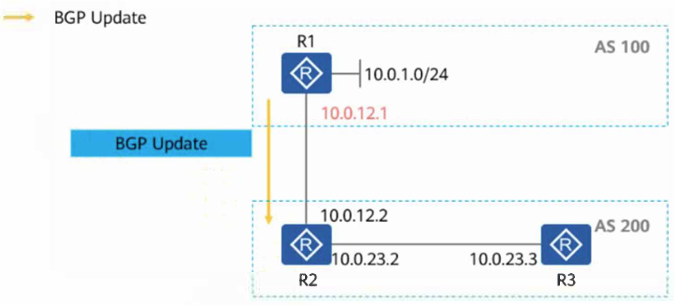
Key Takeaways
BGP relies on TCP port 179 and mandatory attributes like Origin; it also optimizes traffic by sending only incremental updates after the initial exchange.
Learn why BGP advertisements use incremental updates and always include the Origin attribute. Understand EBGP next-hop behavior and TCP connectivity.
Common mistake: Candidates often mistake BGP for using UDP (like OSPF or RIP) or assume Next_Hop is never changed. Remember BGP uses TCP and modifies Next_Hop for EBGP peers.
Expert Analysis
This question tests the mechanics of BGP route advertisement and attribute handling between EBGP peers. The correct options are B and D.
Option B is correct because BGP uses incremental updates. After the initial full table exchange, BGP peers only send updates for new routes or withdrawn routes when changes occur, rather than sending periodic full table dumps. This is a fundamental characteristic of BGP designed to reduce bandwidth usage.
Option D is correct because every BGP update message (specifically UPDATE messages) must carry an Origin attribute. This attribute indicates how the route was injected into BGP: IGP (i), EGP (e), or Incomplete (?). It is a mandatory well-known attribute.
Why A is incorrect: When advertising to an EBGP peer, R2 must modify the Next_Hop attribute. By default, BGP sets the Next_Hop to the IP address of the interface used to communicate with the neighbor. Since R1 and R2 are EBGP peers, R1 likely set the Next_Hop to its own interface. When R2 advertises this to R3 (assuming R2-R3 is also EBGP or even if it's IBGP but R2 is the ASBR), R2 typically updates the Next_Hop to its own address to ensure reachability. Specifically, for EBGP advertisements, the Next_Hop is almost always changed to the sender's interface IP. Even if R2-R3 were IBGP, the Next_Hop from R1 would be preserved only if R2 does not perform next-hop-self or similar actions, but in standard EBGP-to-EBGP scenarios, the hop changes. More critically, the statement says "R2 retains..." which implies no change. In EBGP, the next-hop is usually the advertising router's IP. If R1 advertised to R2, R2 sees R1's IP as next-hop. When R2 advertises to R3 (EBGP), R2 changes the next-hop to R2's IP. Thus, R2 does not retain R1's next-hop.
Why C is incorrect: BGP runs over TCP, specifically port 179, not UDP. Therefore, there is no UDP connection source address involved.
Exam Strategy
When analyzing BGP questions, immediately identify the transport protocol (TCP 179) and check for mandatory well-known attributes (ORIGIN, AS_PATH, NEXT_HOP, LOCAL_PREF). For multi-select questions about 'process', look for behavioral characteristics like 'incremental updates' vs 'periodic full updates'. Always verify if the link is EBGP or IBGP to determine if Next_Hop changes.
Frequently Asked Questions
Does BGP send full routing tables periodically?
What happens to the Next_Hop attribute in EBGP?
Community Votes
34% of anonymous learners picked answer A. Votes are pick records left by other test-takers — they are not the verified answer.
Discussion 1 contributions
Compiled from public community threads and reader submissions, lightly edited for clarity. Handles and vote tallies are shown as recorded, and comments reflect the views of individual contributors.
From public community threads 1
-
HCIP Resolutor 👍 1B. R1 sends only incrementally updated routes: Es una característica fundamental de BGP. BGP no envía actualizaciones periódicas completas de la tabla de enrutamiento; tras el intercambio inicial, solo envía actualizaciones incrementales cuando ocurren cambios.
Reader comments & corrections
No reader corrections yet — spotted an error or have a note? Share it below.
Related Analysis
Practice All H12-821 Questions
Access 168 questions with complete answers and detailed explanations.
View Full H12-821 Practice Test →