VRRP and BFD Integration Failover Behavior
Short answer
B When VRRP is associated with BFD, the backup device transitions to Master upon BFD failure detection, without waiting for the Master_Down_Timer to expire.
Question
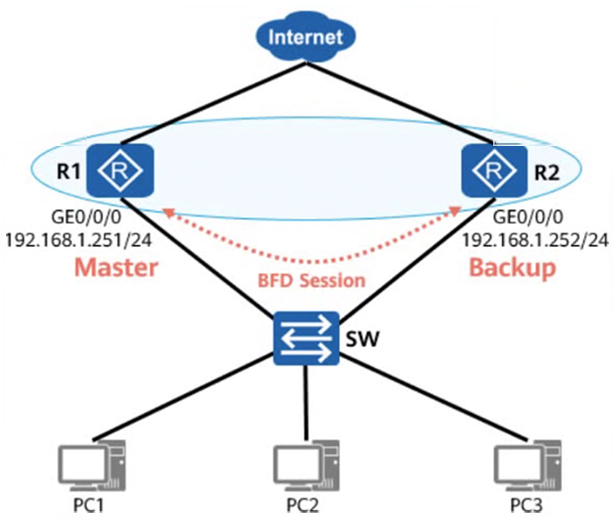
Key Takeaways
The main trap is assuming VRRP timers still govern the timing; BFD overrides this by triggering immediate state changes upon link failure detection.
This question tests understanding of how BFD accelerates VRRP failover. The correct answer is False because BFD allows immediate role transition, bypassing the Master_Down_Timer delay.
Common mistake: Candidates often choose True, mistakenly believing that VRRP always waits for its own timers regardless of external monitoring protocols like BFD.
Expert Analysis
BFD Integration Accelerates VRRP Failover
When VRRP is linked to a Bidirectional Forwarding Detection (BFD) session, the protocol relies on BFD's sub-second detection capabilities rather than standard VRRP hello timers for fault identification. In a normal scenario without BFD, a backup router must wait for the Master_Down_Timer to expire before transitioning to the Master state, which can take several seconds.
Immediate State Transition Mechanism
The core mechanism here is that BFD acts as an external trigger. When the backup device detects a failure in the master via BFD, it immediately triggers a state change. It does not wait for the Master_Down_Timer to expire. Instead, it preemptively assumes the Master role (if configured with preemption) or transitions based on the BFD session loss event. This significantly reduces convergence time compared to relying solely on VRRP hello packets.
Verifying the Statement
The question states that the backup device "immediately assumes the master role after the Master_Down_Timer timer expires." This phrasing implies that the transition still depends on the expiration of the VRRP-specific timer, which contradicts the purpose of integrating BFD. The integration is specifically designed to bypass the delay associated with the Master_Down_Timer. Therefore, the statement is false because the assumption of the master role happens upon BFD failure detection, not after waiting for the VRRP timer.
Conclusion
The correct answer is FALSE. The integration of BFD allows for faster failover by eliminating the need to wait for the Master_Down_Timer.
Exam Strategy
For questions involving high-availability protocols like VRRP or VSTP, look for keywords like 'BFD', 'NQA', or 'Track'. These features are almost always included to reduce convergence time. If the option suggests waiting for standard timers (like Hello or Dead intervals) when these tracking mechanisms are active, the statement is likely incorrect.
Frequently Asked Questions
Why use BFD with VRRP?
What triggers the backup router to become Master in VRRP+BFD?
Community Votes
100% of anonymous learners picked answer B. Votes are pick records left by other test-takers — they are not the verified answer.
Discussion 2 contributions
Compiled from public community threads and reader submissions, lightly edited for clarity. Handles and vote tallies are shown as recorded, and comments reflect the views of individual contributors.
From public community threads 2
-
alissonloyola 👍 1 Answered BWhen VRRP is associated with a BFD session, and a backup device detects a failure in the master through BFD, it does not need to wait for the Master_Down_Timer to expire to assume the master role.
-
lazizz 👍 1 Answered BB /
Reader comments & corrections
No reader corrections yet — spotted an error or have a note? Share it below.
Related Analysis
Practice All H12-821 Questions
Access 168 questions with complete answers and detailed explanations.
View Full H12-821 Practice Test →