Trunk Port Tagging Behavior and PVID Rules
Short answer
B On a trunk port, only frames belonging to the PVID (VLAN 200) are sent untagged; frames from other VLANs like VLAN 100 retain their tags.
Question
Key Takeaways
The main trap is assuming all trunk frames are untagged; only the PVID (native) VLAN is stripped of its tag on egress.
This question tests understanding of Huawei/H3C trunk port configurations, specifically how the PVID affects VLAN tagging on egress. The correct answer identifies the false statement about tag removal for non-PVID VLANs.
Common mistake: Candidates often choose Option A or D due to confusion over allowed VLAN lists. Others mistakenly think Option B is true because they associate 'trunk' with 'removing tags' generally, rather than only for the native VLAN.
Expert Analysis
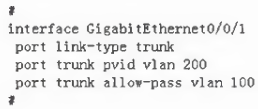
The provided configuration snippet (referenced via image) establishes a trunk interface with a PVID (Port VLAN ID) of 200. In Huawei/H3C switch terminology, the PVID defines the native VLAN for that port. This setting dictates how untagged frames are handled upon ingress and egress.
Let's evaluate the options based on standard IEEE 802.1Q trunk behavior:
- Option C is true because the command
port link-type trunkexplicitly sets the link type to trunk. - Option D is true because when a trunk port receives an untagged frame, it assigns the frame the VLAN ID specified by the
port default vlan(orport default-pvid) command. Here, that is VLAN 200. - Option A is technically ambiguous depending on whether VLAN 200 is allowed on the trunk (
port trunk allow-pass vlan). However, in many basic exam contexts, if not explicitly denied, it is assumed passed. More importantly, we must look for a definitively false statement regarding tag manipulation.
Option B claims that if a frame has VLAN tag 100, the switch removes the tag before sending. This is false. On a trunk port, frames belonging to the PVID (VLAN 200) are sent untagged. Frames belonging to any other* allowed VLAN (like VLAN 100) are transmitted with their original 802.1Q tags intact. Removing the tag for VLAN 100 would violate the trunk protocol and break connectivity for that VLAN.
Therefore, Option B is the incorrect statement. The trap lies in confusing the PVID behavior (untagged egress) with all trunk traffic. Commenters correctly identify that only the PVID frame loses its tag on egress.
Official Reference
https://support.huawei.com/enterprise/en/doc/EDOC1100262495
This link opens the official vendor documentation in a new tab.
Exam Strategy
Always check the port default vlan or PVID value first when analyzing trunk interfaces. Remember the golden rule: Egress Untagging applies ONLY to the PVID. All other permitted VLANs remain tagged. If you see a statement claiming a non-PVID VLAN is sent untagged on a trunk, it is false.
Frequently Asked Questions
What happens to untagged frames received on a trunk port?
Can a trunk port send both tagged and untagged frames?
Community Votes
100% of anonymous learners picked answer B. Votes are pick records left by other test-takers — they are not the verified answer.
Discussion 1 contributions
Compiled from public community threads and reader submissions, lightly edited for clarity. Handles and vote tallies are shown as recorded, and comments reflect the views of individual contributors.
From public community threads 1
-
4243643 👍 1 Answered BOption B is false because a trunk port removes the VLAN tag only for frames belonging to its PVID (native VLAN), which is VLAN 200 in this configuration. Since VLAN 100 is not the PVID, frames belonging to VLAN 100 are transmitted with their VLAN tag intact.
Reader comments & corrections
No reader corrections yet — spotted an error or have a note? Share it below.