Inter-VLAN Routing and ARP Limitations
Short answer
B Inter-VLAN communication requires a Layer 3 device for routing, making direct ARP-based pinging between hosts in different VLANs impossible regardless of cache entries.
Question
Key Takeaways
The main trap is assuming that having an ARP entry guarantees reachability; however, ARP only works within the same broadcast domain (VLAN), while inter-VLAN traffic requires a router.
This H12-811 question tests understanding of ARP behavior across VLANs. The correct answer is FALSE because Layer 3 routing is mandatory for communication between hosts in different VLANs.
Common mistake: Choosing TRUE by focusing only on the existence of the ARP cache. This ignores the fundamental network topology constraint that different VLANs cannot communicate directly at Layer 2.
Expert Analysis
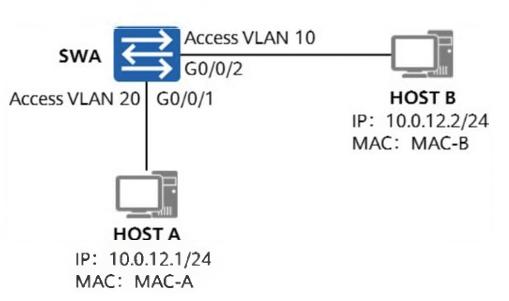
The question presents a scenario where Host A and Host B are connected via a switch, but the context implies they reside in different VLANs. The provided comment explicitly states that "A layer 3 device is required for inter vlan routing," which confirms that Host A and Host B are in separate broadcast domains (different subnets).
For Host A to ping Host B across different subnets, it must send packets to its default gateway (a Layer 3 router or L3 switch). The ARP protocol operates at Layer 2 and resolves IP addresses to MAC addresses within the same local network segment. If Host A has an ARP entry for Host B's IP address, it means Host A believes Host B is directly reachable on the local link.
However, this belief is incorrect if they are in different VLANs. Host A should not have an ARP cache entry for a remote host; instead, it should have an ARP entry for its default gateway. Even if such an incorrect ARP entry existed due to misconfiguration or caching errors, the packet would be sent to the wrong MAC address (Host B's actual MAC) rather than the gateway's MAC. Since switches forward frames based on VLAN membership and MAC tables, and routers filter based on subnet boundaries, sending a frame directly to Host B's MAC from a different VLAN will fail because the switch ports belong to different VLANs. Inter-VLAN communication strictly requires Layer 3 routing.
Therefore, the statement that Host A can ping Host B simply because it has an ARP cache of Host B is false. The ARP cache presence does not overcome the Layer 3 separation imposed by VLANs.
Exam Strategy
When analyzing network diagrams with multiple VLANs, always check if the source and destination are in the same subnet first. If they are not, assume Layer 3 intervention is required. Do not rely solely on the presence of an ARP table; verify if the target IP belongs to the local interface or a remote network requiring a gateway.
Frequently Asked Questions
Why doesn't ARP work across VLANs?
What should Host A's ARP cache contain for Host B?
Community Votes
100% of anonymous learners picked answer B. Votes are pick records left by other test-takers — they are not the verified answer.
Discussion 2 contributions
Compiled from public community threads and reader submissions, lightly edited for clarity. Handles and vote tallies are shown as recorded, and comments reflect the views of individual contributors.
From public community threads 2
-
MichelleComsoft 👍 1 Answered BA layer 3 device is required for inter vlan routing
-
konyuz 👍 1 Answered Bdifferent VLANs
Reader comments & corrections
No reader corrections yet — spotted an error or have a note? Share it below.