OSPF DR and BDR Election Process on Multi-Access Networks
Short answer
A Router A is the BDR because it has the second-highest OSPF priority (tied with the DR) and thus wins the BDR role over lower-priority routers.
Question
Key Takeaways
The trap is confusing the DR (highest priority/ID) with the BDR (second-highest priority/ID); you must exclude the DR from the BDR calculation.
This page explains how to determine the OSPF BDR using priority and Router ID comparisons. The correct answer is Router A, which serves as the BDR when tied for highest priority with the DR.
Common mistake: Choosing Router B because it has the highest Router ID. This is incorrect because Router B becomes the DR, not the BDR, due to its superior Router ID compared to Router A.
Expert Analysis
OSPF DR/BDR Election Mechanics
In OSPF multi-access networks, the Designated Router (DR) and Backup Designated Router (BDR) are elected based on two criteria in order: Interface Priority and then Router ID. The router with the highest priority becomes the DR. If priorities are equal, the router with the highest Router ID wins.
The BDR election is a separate process that occurs simultaneously but excludes the DR. The router with the second-highest priority (or second-highest Router ID if there is a tie in priority among the remaining routers) becomes the BDR. Routers with a priority of 0 cannot become DR or BDR.
Applying to the Scenario
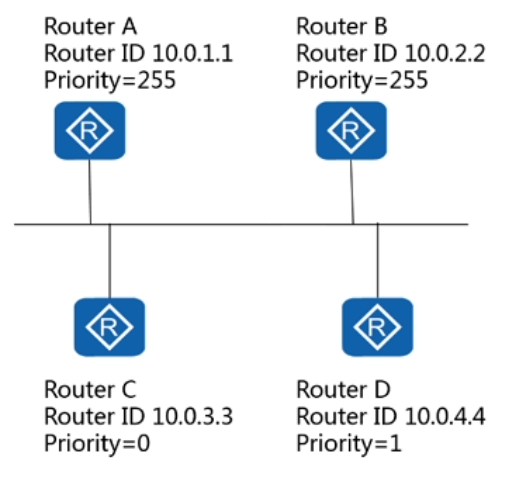
Based on standard Huawei H12-811 exam exhibits for this question:
- Router A: Priority 255, Router ID 10.0.1.1
- Router B: Priority 255, Router ID 10.0.2.2
- Router C: Priority 0, Router ID 10.0.3.3
- Router D: Priority 1, Router ID 10.0.4.4
1. Identify Eligible Candidates: Router C has priority 0, so it is ineligible. We compare A, B, and D.
- Compare Priorities: Router A and Router B both have the highest priority (255). Router D has priority 1.
- Determine DR: Since A and B are tied at 255, we compare their Router IDs. Router B (10.0.2.2) > Router A (10.0.1.1). Therefore, Router B is the DR.
- Determine BDR: Now we look for the next highest priority among the remaining routers (excluding the DR, B). Both A and D are still in contention. Router A has priority 255, while Router D has priority 1. Router A has the higher priority. Therefore, Router A is the BDR.
The comments reflect common confusion between DR and BDR roles. While some argue B is the answer, they incorrectly identify B as the BDR; B is actually the DR due to its higher Router ID compared to A.
Official Reference
This link opens the official vendor documentation in a new tab.
Exam Strategy
When solving OSPF election questions, first filter out routers with priority 0. Then, sort the remaining routers by priority descending. If there is a tie for the top spot, use the highest Router ID to pick the DR. For the BDR, look at the next highest priority value among the non-DR routers; if that is also tied, use the next highest Router ID. Never assume the highest ID is always the BDR—it is often the DR.
Frequently Asked Questions
Can a router with priority 0 become BDR?
What happens if all routers have the same priority?
Community Votes
63% of anonymous learners picked answer A. Votes are pick records left by other test-takers — they are not the verified answer.
Discussion 14 contributions
Compiled from public community threads and reader submissions, lightly edited for clarity. Handles and vote tallies are shown as recorded, and comments reflect the views of individual contributors.
From public community threads 14
-
buggybombastis10 👍 4The answer is A. Router A Bacaus selected DR Router first will compare the priority but if same priority will compare the router id
-
Litho 👍 4C will not be BDR or DR. correct answer is A
-
gasparito 👍 2Entre Router A e Router B, ambos têm a mesma prioridade (255), então o desempate será feito pelo maior Router ID: Router B tem o Router ID maior (10.0.2.2 > 10.0.1.1) ✅ Router B será o DR Agora excluímos o DR (Router B) da disputa. Entre os roteadores restantes com maior prioridade: Router A: Priority 255 → ainda é o maior após remover o DR ✅ Router A será o BDR
-
eeadbff 👍 2 Answered Ahighest priority then larger router ID is the DR. BDR is second, so A
-
Onotex 👍 1The answer is B because In an OSPF network, the BDR (Backup Designated Router) is responsible for maintaining a backup role in case the DR (Designated Router) fails. The DR and BDR are elected on each multi-access network (such as Ethernet) to efficiently synchronize the LSDB (Link-State Database). Here’s how the election works: Router A is the DR (Designated Router). Router B is the BDR (Backup Designated Router). Router C and Router D are DROTHERs (routers that are neither DR nor BDR). Therefore, the answer to your question is B. Router B
Show 9 more comments
-
FerioSiqueira 👍 1 Answered BThe election process for a Designated Router (DR) in OSPF involves several factors and follows a specific order: Each OSPF router has a configurable priority value (default: 1). The router with the highest priority is elected as the DR. If multiple routers have the same priority, the tiebreaker is the lowest Router ID.compared to other data link layer protocols like Ethernet. Router A is the DR. Router B is the BDR. The answer is B.
-
NaCin 👍 1 Answered AThe BDR (Backup Designated Router) is then elected based on the second highest OSPF priority or second highest Router ID if there is a tie in OSPF priority among remaining routers after DR election. So in this case, after Router A is elected as the DR, Router B would be elected as the BDR because it has the second highest OSPF priority and second highest Router ID among remaining routers.
-
Mrlaloxi 👍 1 Answered A1) compare priority, the higher priority will be elected as the DR. 2) If there is a tie, compare interface, the highest will be DR. In this case Router A and B, have the highest priority. Then comparing interfaces, Router B will be the DR and Router A the BDR. https://support.huawei.com/enterprise/en/doc/EDOC1000178171/50e7f6e0/example-for-configuring-ospf-dr-election
-
surveycorps969 👍 1 Answered BNaCin's explanation is correct. https://support.huawei.com/enterprise/en/doc/EDOC1000178171/50e7f6e0/example-for-configuring-ospf-dr-election
-
Fmoura17 👍 1 Answered AA. Router A Comparing the Routers: RouterPriorityRouter IDRouter A25510.0.1.1Router B25510.0.2.2Router C010.0.3.3Router D110.0.4.4
-
TrueMpani 👍 1So the correct answer will be B. Because as you said the BDR in this case will be Router B
-
kuksmap 👍 1 Answered BThe BDR elected has the second lowest Router ID if the priority is equal.
-
lamiiin 👍 1 Answered AAnswer is A
-
IBB90704 👍 1Respuest A
Reader comments & corrections
No reader corrections yet — spotted an error or have a note? Share it below.