RSTP Port Roles on the Root and Non-Root Bridge
Short answer
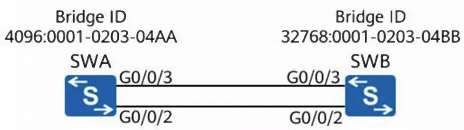
BCD SWA is the root bridge so both its ports are designated, while SWB G0/0/3 is the alternate port to the root.
Question
Key Takeaways
It tests the four RSTP port roles, and the trap is confusing an alternate port (second-best path to the root) with a backup port (parallel path to the same segment).
This RSTP multi-select asks which port-role statements hold for SWA and SWB. Because SWA is the root bridge, both its ports are designated, and SWB G0/0/3 is an alternate port — making B, C and D correct.
Common mistake: Choosing A: SWB G0/0/3 looks like a standby link, but a backup port must share the same LAN segment as another port on the same switch — G0/0/3 instead offers a redundant route to the root, so it is an alternate port.
Expert Analysis
Governing principle RSTP assigns exactly four port roles — root, designated, alternate and backup — and the assignment follows two rules from the spanning tree specification: every port on the root bridge is a designated port, and on a non-root bridge the single best path to the root becomes the root port while every remaining redundant path becomes an alternate port. A backup port is different: it is a blocked port on the same switch that reaches the same LAN segment as the forwarding port, i.e. a parallel attachment to one segment, not a second route toward the root.
Applying it to the topology Here SWA is the root bridge (the bridge whose ports are all designated). Therefore B is true — G0/0/3 of SWA is a designated port — and C is true — G0/0/2 of SWA is also a designated port. The comments confirm this logic: all ports on the root switch are designated ports, so SWA's two ports cannot be root or blocked roles.
On SWB, the two paths toward the root are compared; G0/0/2 wins the root-port election (via the PID/path-cost tiebreaker noted in the discussion) and forwards, while G0/0/3 is the losing redundant path to the root. A redundant path to the root that is not a parallel path to the same segment is an alternate port, so D is true.
Why A fails A is false because G0/0/3 of SWB leads toward the root bridge, not toward the same broadcast segment as another SWB port. That is precisely the alternate-port definition; the backup-port definition requires two ports on one switch sharing one segment.
Verdict B, C and D are correct; only A is false.
Exam Strategy
For any STP/RSTP role question, first identify the root bridge, because every root-bridge port is automatically designated — that alone settles most options in seconds. Then, on each non-root switch, mark the single best path to the root as the root port and label every other blocked path an alternate; only claim "backup" when two ports on the same switch attach to the same segment.
Frequently Asked Questions
Why is G0/0/3 of SWB an alternate port instead of a backup port?
Are all ports on the root bridge designated ports in RSTP?
How do I decide between B, C and D in a multi-select STP question?
Community Votes
50% of anonymous learners picked answer B. Votes are pick records left by other test-takers — they are not the verified answer.
Discussion 3 contributions
Compiled from public community threads and reader submissions, lightly edited for clarity. Handles and vote tallies are shown as recorded, and comments reflect the views of individual contributors.
From public community threads 3
-
Fmoura17 👍 1The correct answers are B, C, and D. A. G0/0/3 of SWB is a backup port ❌ This is false. A Backup Port in RSTP is a port that provides a redundant path to the same segment as another port on the same switch. G0/0/3 of SWB provides an alternate path to the root bridge, making it an Alternate Port, not a Backup Port.
-
Heidorn 👍 1SWA Ports are designated port as he is the Bridge, For SWB GE0/0/2 Should be the root port, and the other port the alternate port, based on the PID tiebreaker
-
ButcherCapybara 👍 1All ports are designated ports on the root switch, even if they connect to another switch
Reader comments & corrections
No reader corrections yet — spotted an error or have a note? Share it below.