Huawei Switch ARP Table Interface vs Host Entry Analysis
Short answer
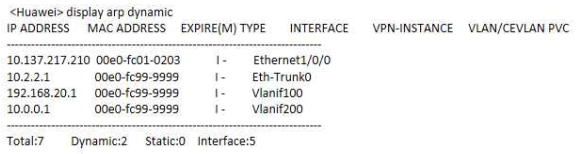
B The statement is False because the ARP entries with MAC 00e0-fc99-9999 are Interface ('I-') types, indicating they belong to the switch's own logical interfaces, not an external host whose IP changed.
Question
Key Takeaways
The trap is assuming all ARP entries with the same MAC represent a single changing host. Recognizing 'I-' as Interface (local device) rather than Dynamic (learned host) is the key.
This H12-811 question tests understanding of ARP table entry types. The correct answer is False because the MAC address appears in Interface-type entries, meaning it belongs to the switch itself, not an external host.
Common mistake: Candidates often choose True (A) by focusing only on the fact that one MAC has three IPs, concluding the host must have changed IPs. They fail to notice the 'I-' type code which signifies these are local interface addresses, not learned neighbor entries.
Expert Analysis
Interface vs. Learned ARP Entries The question hinges on the distinction between an ARP entry learned from an external host and one associated with the device's own interfaces. In Huawei VRP (and most networking OS), an ARP table distinguishes between entries learned via ARP requests/replies from other devices and entries representing the local router/switch itself.
Analyzing the 'I-' Type
The comment correctly identifies that the entries marked with "I-" are Interface addresses. These represent the IP addresses configured directly on the switch's logical interfaces (e.g., Vlanif100, Vlanif200). The MAC address 00e0-fc99-9999 is likely the system MAC or a specific interface MAC used by the switch itself for these VLANs. Therefore, these are not entries "learned by a switch through ARP" from an external host; they are locally generated static-like mappings for the device's own IPs.
Conclusion
Since the three entries with MAC 00e0-fc99-9999 are of type "I-" (Interface), they do not prove that an external host changed its IP three times. They simply show the switch has three different IP addresses assigned to its own interfaces, all resolving to its own MAC. Thus, the statement that the host changed its IP three times is false because the premise (that these are learned host entries) is incorrect.
Exam Strategy
Always check the ARP entry type code (Dynamic, Static, Interface, etc.) before concluding anything about host movement or changes. In Huawei exams, 'I-' specifically denotes the device's own interface IP-MAC mapping. Do not assume a MAC appearing multiple times always indicates a single external host moving between subnets.
Frequently Asked Questions
What does 'I-' mean in a Huawei ARP table?
How can I tell if an ARP entry is learned from a host?
Community Votes
50% of anonymous learners picked answer B. Votes are pick records left by other test-takers — they are not the verified answer.
Discussion 2 contributions
Compiled from public community threads and reader submissions, lightly edited for clarity. Handles and vote tallies are shown as recorded, and comments reflect the views of individual contributors.
From public community threads 2
-
Fmoura17 👍 1 Answered BThe statement is False because: The "I-" type in the ARP table means these are the device's own Interface addresses, not entries learned from an external host. The summary confirms only Dynamic: 2 entries exist, while the three entries with 00e0-fc99-9999 are all Interface type, belonging to different logical interfaces (Eth-Trunk0, Vlanif100, Vlanif200) on the device itself — not a host that changed its IP three times.
-
Heidorn 👍 1 Answered AEither there are 3 devices with the same Mac Address or the same device has changed its IP 3 times, which is more likely, so this is true.
Reader comments & corrections
No reader corrections yet — spotted an error or have a note? Share it below.