Risk-Based Vulnerability Prioritization by Network Exposure
Short answer
C Remediate 12.21.34.114 first because its publicly routable address makes it internet-reachable, unlike the private-range hosts in options A, B and D.
Question
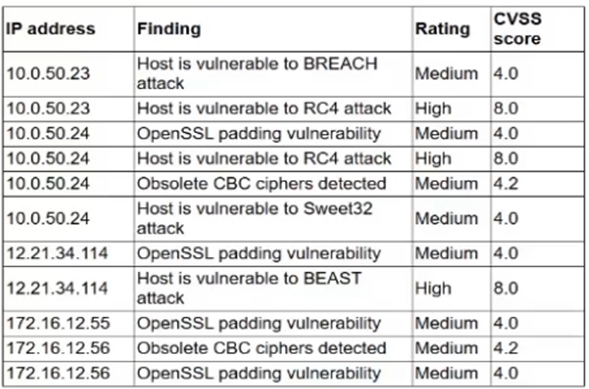
Which of the following devices should the analyst address first using a risk-based approach?
Key Takeaways
The exam tests whether you rank findings by external exposure and business risk rather than by severity output alone; the trap is picking an internal host because of a familiar-looking final octet.
This CS0-003 scenario tests risk-based vulnerability prioritization across a scan report: the host with the publicly routable IP 12.21.34.114 (option C) must be addressed first because it is internet-exposed, while 10.0.50.23, 10.0.50.24 and 172.16.12.56 sit on private ranges.
Common mistake: Choosing option B (10.0.50.24) by focusing on the last octet of the IP address instead of the address range — it is a private 10.x.x.x host with no direct internet exposure, so it ranks below the public host.
Expert Analysis
The boundary being tested: exposure vs. internal reachability
A risk-based approach to vulnerability prioritization is not about which host shows the most findings or which IP happens to end in a memorable octet. It is about which asset sits closest to an untrusted network and therefore gives an attacker the shortest path from the internet into your environment. In this report, three of the listed hosts — 10.0.50.23 (option A), 10.0.50.24 (option B) and 172.16.12.56 (option D) — carry RFC 1918 private addresses, meaning they are reachable only from inside the corporate network. A vulnerability on those hosts still matters, but exploitation requires an existing foothold, so they sit on the internal side of the boundary.
Why option C wins
Option C, 12.21.34.114, falls inside 12.0.0.0/8, a publicly routable block (historically assigned to AT&T). A host holding a routable address is potentially directly reachable from the internet, so any high-severity or unpatched finding on it can be weaponized by an external attacker with no prior access. Community commentary makes exactly this point: the correct host is 12.21.34.114 because it is a public IP while the rest are on private ranges, and that exposure "takes priority." One comment also warns against the trap of being distracted by the last octet and guessing option B.
The rule to carry forward When a scan report mixes address ranges, first split hosts by internet exposure, then rank by severity and exploitability within each group. Externally reachable assets are remediated before internal-only assets, all else being equal. Here, that ordering makes option C the device to address first.
Exam Strategy
When a vulnerability question lists IP addresses, immediately classify each one as public (routable) or private (RFC 1918: 10.x, 172.16-31.x, 192.168.x) before reading any other data. Publicly routable hosts imply internet exposure and therefore a higher risk score, so they are remediated first under a risk-based approach. Ignore distracting details such as the final octet, host count, or raw severity totals — they are common distractors in these prioritization questions.
Frequently Asked Questions
How do I quickly tell if an IP in a scan report is internet-exposed?
Does a higher CVSS score always mean I patch that host first?
Community Votes
100% of anonymous learners picked answer C. Votes are pick records left by other test-takers — they are not the verified answer.
Discussion 3 contributions
Compiled from public community threads and reader submissions, lightly edited for clarity. Handles and vote tallies are shown as recorded, and comments reflect the views of individual contributors.
From public community threads 3
-
rf18 👍 1i was looking at the end of the IP and thought it was B :) but then i ready your comment and was like oh lol. agree with option C
-
agfencer 👍 1 Answered CC: 12.21.34.114 (its a public IP, rest are private network, this takes priority)
-
tailogdavid1987 👍 1 Answered CPublic IP with two vulnerabilities
Reader comments & corrections
No reader corrections yet — spotted an error or have a note? Share it below.