Prioritizing Arachni Findings for a PII-Backed Web App
Short answer
A Remediate SQL injection first because it gives attackers a direct path to read the PII stored in the web application's database.
Question
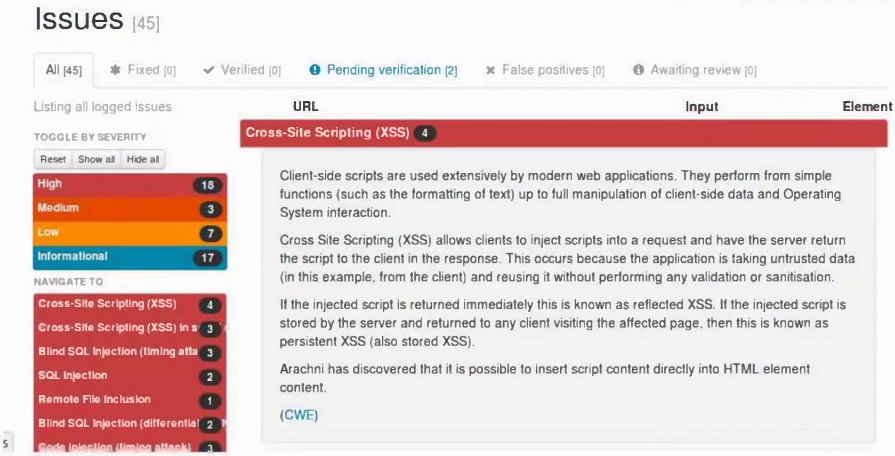
Which of the following should be remediated first?
Key Takeaways
It tests ranking vulnerability findings by business impact, and the trap is picking a high-severity issue like XSS or code injection instead of the one with the most direct path to the PII data.
This CS0-003 question tests vulnerability prioritization from Arachni scan output for a PII-storing web app; SQL injection (A) ranks first because it directly exposes the database records.
Common mistake: Choosing D (code injection) because full server compromise sounds worse; it is an indirect, condition-dependent path, while SQL injection reads the PII database directly in a single request.
Expert Analysis
Trace the remediation decision The Arachni crawler first discovers application endpoints, then replays payloads against each one and reports findings tagged by type and severity. The analyst's job in this step is not to re-verify the findings but to rank them: which finding, if left open, yields the worst outcome for an application that stores PII.
Rank by direct data exposure Option A, SQL injection, sits on the query path between the web tier and the database where the PII actually lives. A successful SQLi lets the attacker read, dump, or exfiltrate the full dataset in one request — no further interaction required. That is a direct, single-step path to the crown-jewel data, so it is the first remediation target.
Compare the remaining options Option C, XSS, compromises browsers or sessions; an attacker must first plant script, then wait for a privileged user to load the page, and only then pivot toward data — an indirect, multi-step chain. Option B, RFI, requires the server to fetch and execute attacker-controlled remote files, which depends on file-handling conditions that may not exist here. Option D, code injection, is a genuine contender because it can yield full server control and thus reach the database indirectly, but it still requires the injection point to reach an interpreter and execute arbitrary code, whereas SQLi retrieves the stored records immediately through the application's own legitimate query channel.
Apply the PII tie-breaker When severity labels look similar, CompTIA's vulnerability-prioritization doctrine says to weigh business impact and data sensitivity. Because the asset stores PII, the vulnerability offering the most direct route to that data wins the queue. Comments in the discussion converge on this reasoning: one notes that "SQLi poses the biggest risk amongst the given options to PII," and another explains that "SQL Injection should be remediated first because it poses the highest risk, potentially allowing attackers to access or manipulate the PII data directly in the database." A dissenting comment argues code injection "compromises the entire server," but that path is longer and less certain than direct database extraction.
Verdict Option A, SQL injection, is remediated first.
Official Reference
https://www.comptia.org/certifications/cybersecurity-analyst
This link opens the official vendor documentation in a new tab.
Exam Strategy
In prioritization questions, ignore severity labels first and map each option to its distance from the sensitive data: ask how many attacker steps separate the vulnerability from the PII. The option with the shortest direct path wins, even if another looks technically more severe. When two options both reach the data, apply the stated business context (here, PII storage) as the tie-breaker.
Frequently Asked Questions
Why is SQL injection ranked above code injection for a PII application?
Does XSS not matter because the app stores PII?
How does CompTIA suggest prioritizing vulnerability scan findings?
Community Votes
75% of anonymous learners picked answer A. Votes are pick records left by other test-takers — they are not the verified answer.
Discussion 5 contributions
Compiled from public community threads and reader submissions, lightly edited for clarity. Handles and vote tallies are shown as recorded, and comments reflect the views of individual contributors.
From public community threads 5
-
FT000 👍 15 Answered ASQLi poses the biggest risk amongst the given options to PII. Hence my vote is for A
-
Omo_Mushin 👍 9The image shows a scan result indicating various security issues for a web application. The issues are categorized by severity, with Cross-Site Scripting (XSS) identified as one of the high-severity issues. Given the options and the context of storing Personally Identifiable Information (PII), the issue that should be remediated first is: A. SQL injection SQL injection vulnerabilities are critical because they can allow attackers to access and manipulate sensitive data, including PII, directly from the database. This type of vulnerability often poses a higher risk than others, including XSS, as it can lead to data breaches and potentially complete compromise of the application and its data.
-
cy_analyst 👍 3 Answered ASince the application stores PII, SQL Injection (option A) should be remediated first because it poses the highest risk, potentially allowing attackers to access or manipulate the PII data directly in the database.
-
magmadiver1937 👍 2 Answered AA because SQLi can retrieve data directly from the database whereas XSS cannot do that directly. For XSS to get the data, the attacker would have to store some XSS attack on the site (e.g., document.cookie), wait for an administrator of the site to access that page, steal the cookie, and then log in as the administrator in the hopes that the administrator for the front-end can somehow access the backend database data and exfiltrate it.
-
agfencer 👍 1 Answered DCode injection compromises the entire server (including the database and filesystem), making it a higher tactical priority.
Reader comments & corrections
No reader corrections yet — spotted an error or have a note? Share it below.