Identifying CSRF Vulnerability from Missing Request Protections
Short answer
B The absence of anti-CSRF tokens or headers in a state-changing POST request indicates a Cross-Site Request Forgery vulnerability.
Question
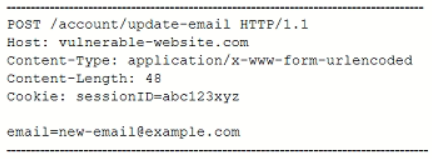
After inspecting the request, the security analyst notices that it does not include any additional protections or validation mechanisms. Which of the following vulnerabilities is most likely present in the web application?
Key Takeaways
The trap is confusing input-based attacks (XSS/SQLi) with trust-based attacks (CSRF); the key is recognizing that 'missing protections' in a state-changing context refers to anti-CSRF measures.
This question tests the ability to identify Cross-Site Request Forgery (CSRF) based on the lack of specific request validations in an HTTP POST payload.
Common mistake: Candidates often select XSS because it is common, but XSS requires script injection flaws, whereas the prompt emphasizes the lack of request-level validation for a legitimate-looking action.
Expert Analysis
The scenario describes a security analyst examining an HTTP request used to update a user's account email address. The request is a POST method targeting /account/update-email, carrying a session cookie and the new email parameter. The critical clue is that the request "does not include any additional protections or validation mechanisms" beyond standard authentication (the session cookie).
Cross-Site Request Forgery (CSRF) exploits the trust a web application has in a user's browser by forcing an authenticated user to submit a malicious request without their knowledge. Because the request relies solely on the session cookie for identity, it lacks specific anti-CSRF controls such as synchronizer tokens (unique per-session values included in forms), custom headers (e.g., X-CSRF-Token), or SameSite cookie attributes. Without these mechanisms, an attacker can trick a victim into executing this state-changing action.
While IDOR (Insecure Direct Object Reference) involves accessing unauthorized data via manipulated identifiers, the focus here is on the lack of request-level protection for a state change. SQLi and XSS involve injecting malicious code into inputs or scripts; however, the prompt specifically highlights the absence of structural protections against unauthorized commands rather than input sanitization issues. Therefore, the missing validation mechanisms refer to CSRF defenses.
Exam Strategy
When you see keywords like 'state-changing', 'POST', 'session cookie', and 'no additional validation', immediately think CSRF. Look for options involving tokens, headers, or SameSite attributes as the solution, or CSRF as the vulnerability itself.
Frequently Asked Questions
Why isn't this an IDOR issue?
What are 'additional protections' in this context?
Discussion 3 contributions
Compiled from public community threads and reader submissions, lightly edited for clarity. Handles and vote tallies are shown as recorded, and comments reflect the views of individual contributors.
From public community threads 3
-
HeatSquad77 👍 2 Answered BThe lack of additional protections or validation mechanisms in the HTTP request is most likely indicative of a Cross-Site Request Forgery (CSRF) vulnerability.
-
Berro_b 👍 1 Answered BPOST --> Sends data to the server /account/update-email ---> Requests a change to the account's email address Cookie: sessionID=... ---> Identifies the user's logged-in session [email protected] ---> The new email address being submitted
-
NaquelePique 👍 1 Answered AThe attacker can easily change de sessionID
Reader comments & corrections
No reader corrections yet — spotted an error or have a note? Share it below.