Azure NAT Gateway Minimum Subnets for VM1/VM2
Short answer
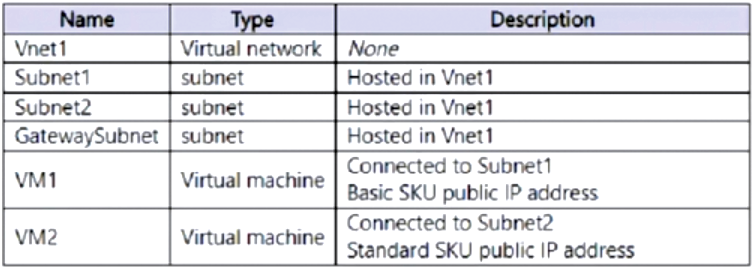
C Deploying the NAT Gateway requires a fourth dedicated subnet because it cannot be associated with Subnet1, Subnet2, or GatewaySubnet.
Question
Key Takeaways
Tests the constraint that Azure NAT Gateways require a dedicated subnet devoid of other resources, creating a trap where candidates forget that existing subnets (Subnet1, Subnet2, GatewaySubnet) are ineligible for association.
Determines the minimum subnet count required to deploy an Azure Virtual Network NAT gateway while preserving existing public IP configurations for VMs. Establishes that a dedicated subnet is mandatory because NAT Gateways cannot be associated with subnets containing basic resources or gateway subnets.
Common mistake: Choosing B (3) by assuming the NAT Gateway can share an existing subnet or does not require its own subnet at all, ignoring the requirement for a dedicated subnet for outbound traffic management.
Expert Analysis
Why the Answer Is Correct
The correct answer is C (4). To meet the requirements, you must retain VM1 and VM2 in their current subnets (Subnet1 and Subnet2) so they continue using their individual Public IPs. You also have an existing GatewaySubnet. The NAT Gateway itself is a regional resource but requires association with a specific subnet to manage egress traffic. Crucially, Azure documentation states that a NAT Gateway cannot be deployed in or associated with a subnet that contains basic resources (like VMs with Basic Public IPs) or a GatewaySubnet. Therefore, you need a fourth, dedicated subnet solely for the NAT Gateway association.Why the Other Options Are Wrong
Option A (2) and Option D (5) are incorrect because they do not align with the minimum necessary infrastructure. Option B (3) is the most common distractor; it assumes that one of the existing three subnets can host the NAT Gateway. However, since Subnet1 and Subnet2 contain VMs, and GatewaySubnet is reserved for gateways, none can be used. Without a fourth subnet, there is no valid place to associate the NAT Gateway without violating the requirement to minimize administrative effort (i.e., moving VMs).Community Comment Notes
As Jor466077 noted, "Cannot deploy in GatewaySugnet, and if deployed in Subnet1 or Subnet2 VM1 or VM2 will start accessing the Internet by using the NAT GW IP address," highlighting the conflict between existing configurations and NAT behavior. Gaz_ reinforced this by citing Microsoft docs: "NAT gateway can't be used with subnets where basic resources exist." Conversely, users like mohsim argued for B, mistakenly believing the NAT Gateway doesn't strictly require a new subnet, but this ignores the association constraints.Official Reference
https://learn.microsoft.com/en-us/azure/virtual-network/nat-gateway/nat-overview
This link opens the official vendor documentation in a new tab.
Exam Strategy
Always check if existing subnets are 'polluted' with resources that prevent NAT Gateway association. If VMs have Basic Public IPs or a subnet is a GatewaySubnet, you cannot associate a NAT Gateway there; you must provision a new, clean subnet.
Frequently Asked Questions
Why can't I associate the NAT Gateway with Subnet1?
Does the NAT Gateway itself consume a subnet?
Community Votes
63% of anonymous learners picked answer C. Votes are pick records left by other test-takers — they are not the verified answer.
Discussion 7 contributions
Compiled from public community threads and reader submissions, lightly edited for clarity. Handles and vote tallies are shown as recorded, and comments reflect the views of individual contributors.
From public community threads 7
-
Jor466077 👍 7 Answered CCannot deploy in GatewaySugnet, and if deployed in Subnet1 or Subnet2 VM1 or VM2 will start accessing the Internet by using the NAT GW IP address. Thus, a new subnet (4th) is needed.
-
mohsim 👍 3 Answered CActually since we can't associate the NAT Gateway to any of the other three subnets, then a fourth subnet is required.
-
mohsim 👍 3 Answered BNAT gateway doesn't require a subnet itself, only require a subne to be associated with. So the answer is 3
-
GabiBT 👍 2 Answered BYo solo veo que necesitemos 3 subredes no entiendo porque necesitaríamos una 4a Subnet1 y Subnet2 son necesarias para hospedar VM1 y VM2, respectivamente, cada una con su propia dirección IP pública. GatewaySubnet es necesaria para implementar la puerta de enlace NAT. Cual seria la 4 ???
-
bobothewiseman 👍 2 Answered B• Since VM1 and VM2 will retain their public IPs, NAT Gateway will not manage their outbound traffic. • No additional subnets are required to deploy the NAT Gateway. • Therefore, VNet1 only needs 3 subnets: Subnet1, Subnet2, and the existing GatewaySubnet.
Show 2 more comments
-
Gaz_ 👍 1 Answered CNAT gateway can't be used with subnets where basic resources exist. A NAT gateway can’t be deployed in a gateway subnet. https://learn.microsoft.com/en-us/azure/nat-gateway/nat-overview
-
Diounaidou 👍 1 Answered CCannont deploy Nat gatway in GatewaySubnet and in subnet where basic resource exists. therefore we need another subnet
Reader comments & corrections
No reader corrections yet — spotted an error or have a note? Share it below.
Related Analysis
Practice All AZ-700 Questions
Access 100 questions with complete answers and detailed explanations.
View Full AZ-700 Practice Test →