Azure DNS Private Resolver Minimum Deployment
Short answer
B Deploy 2 resolvers, one in each region, to enable bidirectional resolution between on-premises and Azure VNets.
Question
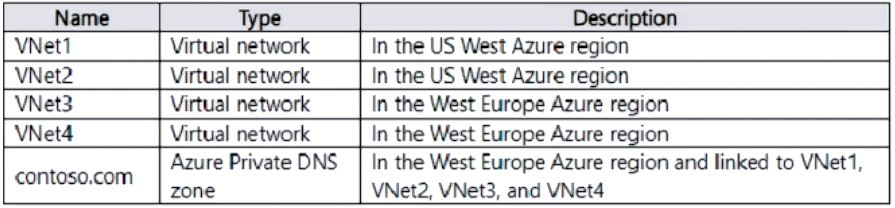
Key Takeaways
The core trap is assuming a single global resolver can handle all queries; in reality, resolvers are regional services that must reside in the same region as the VNets they resolve or query.
This question addresses the regional constraints of Azure DNS Private Resolvers and determines the minimum deployment required to facilitate bidirectional name resolution between on-premises and multi-region Azure environments.
Common mistake: Candidates often select '1' (Option A), mistakenly believing that a Private DNS Zone's global scope allows a single resolver in one region to service VNets in other regions via S2S VPN.
Expert Analysis
Why the Answer Is Correct
The correct answer is B (2). Azure DNS Private Resolver is a regional resource, meaning an inbound or outbound endpoint must be located in the same Azure region as the virtual network it connects to. To satisfy the requirements, you need at least two resolvers: one in Region 1 to allow on-premises users to resolve fabrikam.com (via an Outbound Endpoint linked to VNet1) and one in Region 2 to allow Server1 to resolve contoso.com resources (via an Inbound Endpoint linked to VNet2). While technically a single resolver could be used if both VNets were peered to it, the requirement for Server1 to resolve resources implies a need for connectivity from the on-premises side which typically necessitates specific endpoint placement per region to minimize latency and administrative overhead across the disconnected VNets.Why the Other Options Are Wrong
Option A (1) is incorrect because a single resolver cannot natively serve as an Inbound Endpoint for one region and an Outbound Endpoint for another if those VNets are not connected to that specific resolver's region. Since the VNets are distinct and likely in different regions (implied by the need for separate resolution paths), deploying only one would fail to meet the requirement for Server1 to resolve Azure resources unless complex cross-region routing was established, which violates the 'minimize effort' constraint. Options C (3) and D (4) represent unnecessary deployments that increase cost without adding functional value for this specific topology.Community Comment Notes
Community consensus leans towards B, with several users citing the regional limitation documentation. As Gambito11 noted, "A DNS resolver can only refer to a virtual network that's in the same region as the DNS resolver." This confirms that you need a resolver instance in each relevant region to bridge the gap between on-premises and Azure resources effectively.Official Reference
https://learn.microsoft.com/en-us/azure/dns/private-dns-overview
This link opens the official vendor documentation in a new tab.
Exam Strategy
Always check the regionality of Azure networking components. If a component is regional, count the number of regions involved in the solution to determine the minimum number of instances required.
Frequently Asked Questions
Can one Azure DNS Private Resolver serve multiple regions?
Why not use just 1 resolver for fabrikam.com resolution?
Community Votes
62% of anonymous learners picked answer B. Votes are pick records left by other test-takers — they are not the verified answer.
Discussion 5 contributions
Compiled from public community threads and reader submissions, lightly edited for clarity. Handles and vote tallies are shown as recorded, and comments reflect the views of individual contributors.
From public community threads 5
-
Gambito11 👍 10 Answered BAzure Dns private resolver is a regional service. "A DNS resolver can only refer to a virtual network that's in the same region as the DNS resolver" https://learn.microsoft.com/en-us/azure/architecture/networking/architecture/azure-dns-private-resolver
-
prekair0 👍 4 Answered APrivate DNS zone is global. private DNS resolver is restricted to the location of the VNET, but it can lookup any address in the private DNS zone as long as it's linked. So 1 private DNS resolver should be sufficient.
-
maciek8131 👍 3 Answered AI think that is should be A. Only One
-
xRiot007 👍 1 Answered Bhttps://learn.microsoft.com/en-us/azure/architecture/networking/architecture/azure-dns-private-resolver An Azure DNS Private Resolver has REGIONAL AVAILABILITY, so no, it will not work across multiple regions. Without VNet peering or vWAN, this resolver is bound to its VNet.
-
bobothewiseman 👍 1 Answered AI go for A! You can deploy the resolver in the US West region (e.g., VNet1 or VNet2) because it can handle DNS queries for all Azure VNets connected via VPN or peering.
Reader comments & corrections
No reader corrections yet — spotted an error or have a note? Share it below.
Related Analysis
Practice All AZ-700 Questions
Access 100 questions with complete answers and detailed explanations.
View Full AZ-700 Practice Test →