Minimum Azure Service Endpoints for Peered VNets
Short answer
A Create 2 service endpoints (one for Microsoft.Storage and one for Microsoft.Sql) to cover all resources across the peered VNets.
Question
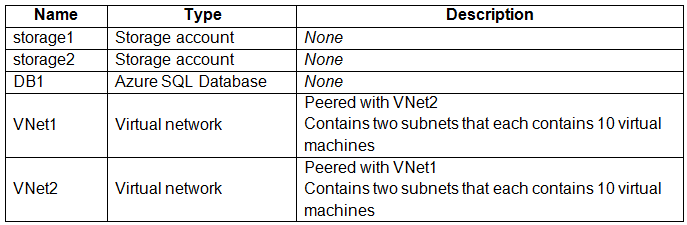
Key Takeaways
Tests understanding that a single service endpoint per resource type applies across all subnets within a VNet and its peers, avoiding redundant configurations.
Determines the minimum number of service endpoints needed to connect peered virtual networks to Azure storage and SQL resources, establishing that two endpoints are sufficient.
Common mistake: Most learners select C (4) because they incorrectly assume that each Virtual Network requires separate service endpoint configurations for every resource type.
Expert Analysis
Why the Answer Is Correct
The correct answer is A because service endpoints are configured at the subnet level to secure traffic to specific Azure services. Since the two Virtual Networks (VNet1 and VNet2) are peered, they share network identity and reachability. You only need one service endpoint for 'Microsoft.Storage' on a subnet in VNet1 and one for 'Microsoft.Sql' on a subnet in VNet1 (or VNet2). These endpoints allow all subnets in both VNets to access the respective resources securely without needing individual endpoints for each VNet or each storage account.Why the Other Options Are Wrong
Option B (3) is incorrect because it implies a third distinct endpoint type is needed, but there are only two resource types (Storage and SQL). Option C (4) is the most common distractor; it assumes you must create one endpoint per VNet per resource type (2 VNets × 2 Resources = 4), which ignores the scope of service endpoints across peering. Option D (12) likely results from counting every subnet individually, which is unnecessary as endpoints apply to the subnet's traffic to the service.Community Comment Notes
User alinuxguru70 correctly identifies that both storage accounts require a single endpoint for 'Microsoft.Storage' and the database requires one for 'Microsoft.Sql'. User bobothewiseman reinforces this by noting that peering allows subnets in one VNet to access resources in the other via the same endpoint. Conversely, user Abilash2605 argues for 4 endpoints, stating "We have Two Vnets. we can only link one service endpoint per Vnet," which reflects the common misconception that endpoints do not traverse peering boundaries.Official Reference
https://learn.microsoft.com/en-us/azure/virtual-network/virtual-network-service-endpoints-overview
This link opens the official vendor documentation in a new tab.
Exam Strategy
When configuring service endpoints for peered VNets, always count unique Azure service types (e.g., Storage, SQL) rather than the number of VNets or subnets. One endpoint per service type is sufficient for all connected VNets.
Frequently Asked Questions
Do I need separate service endpoints for each storage account?
Does peering automatically enable service endpoints?
Community Votes
53% of anonymous learners picked answer A. Votes are pick records left by other test-takers — they are not the verified answer.
Discussion 5 contributions
Compiled from public community threads and reader submissions, lightly edited for clarity. Handles and vote tallies are shown as recorded, and comments reflect the views of individual contributors.
From public community threads 5
-
alinuxguru70 👍 6 Answered A2 Both storage accounts require a single service endpoint for "Microsoft.Storage." The Azure SQL Database requires a service endpoint for "Microsoft.Sql."
-
Abilash2605 👍 5 Answered CWe have Two Vnets. we can only link one service endpoint per Vnet. we need one service endpoint for storage and one service endpoint for Microsoft.SQL. for two vnets we deploy 4 Service endpoint.
-
juancarlosdlar 👍 2 Answered Chttps://learn.microsoft.com/en-us/azure/virtual-network/vnet-integration-for-azure-services#compare-private-endpoints-and-service-endpoints
-
bobothewiseman 👍 1 Answered AVNet1 and VNet2 are peered, subnets in one VNet can access resources in the other VNet via the same service endpoint, single service endpoint for Azure Storage is sufficient to allow all subnets in both VNets to access storage1 and storage2. single service endpoint for Azure SQL is sufficient to allow all subnets in both VNets to access DB1.
-
Saba53 👍 1 Answered A2 Should be correct
Reader comments & corrections
No reader corrections yet — spotted an error or have a note? Share it below.
Related Analysis
Practice All AZ-700 Questions
Access 100 questions with complete answers and detailed explanations.
View Full AZ-700 Practice Test →