Retrieving Analysis Results in Azure Content Understanding
HOTSPOT
You are developing an application that analyze invoices by using Azure Content Understanding in Foundry Tools.
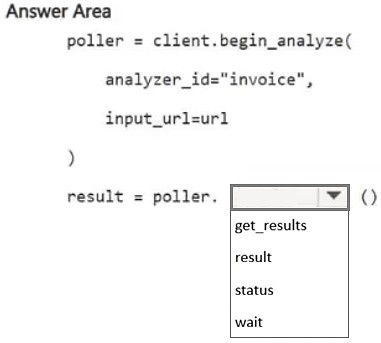
You need to ensure that the application retrieves the analysis results after processing completes.
How should you complete the Python code? To answer, select the appropriate option in the answer area.
NOTE: Each correct selection is worth one point.
Community Insight
The question tests knowledge of async operations in Foundry; the common trap is trying to access results immediately without waiting, which leads to null or incomplete data.
This scenario tests the correct method for retrieving asynchronous analysis results from Azure Content Understanding. The solution requires using the polling mechanism to wait for the operation to complete before accessing the final data.
Learners often select methods that return immediate status without blocking, or they confuse the result retrieval method with the initiation method, failing to recognize that 'poller.result()' is the synchronous call to get the outcome.
Community Discussion (1 comments)
Comments & Corrections
No comments yet — spotted an error or have a note? Share it below.
Expert Analysis
Why the Answer Is Correct
In Azure Content Understanding (part of Foundry Tools), long-running tasks like invoice analysis are processed asynchronously. To retrieve the actual analysis results, you must use a poller object. The correct Python code pattern involves callingpoller.result, which blocks execution until the operation succeeds or fails, ensuring the returned data is complete and valid.Why Other Candidate Answers Are Wrong
Alternative options likely include methods that only check status (like.status) or methods intended for initiating the job rather than retrieving its output. Accessing results before the operation completes would yield empty or intermediate data, defeating the purpose of the analysis step.Community Comment Notes
Community consensus strongly supports the use ofpoller.result. As one commenter noted, this method "keeps waiting for success or fail," accurately describing the blocking behavior necessary for reliable data retrieval in async workflows. Exam Strategy
When working with AI services in Foundry that process documents or images, always look for async/poller patterns. Remember that heavy processing jobs require you to explicitly wait for completion using the appropriate result retrieval method.
Frequently Asked Questions
Why can't I access results immediately after starting the analysis?
Because invoice analysis is an asynchronous background task. You must use a poller to wait for the server-side processing to finish before the data is available.
What does poller.result() do in Foundry Tools?
It synchronously waits for the long-running operation to complete and then returns the final result object containing the extracted information.
Related Analysis
Practice All AI-901 Questions
Access 105 questions with complete answers and detailed explanations.
View Full AI-901 Practice Test →