Which Responsible AI Principle Covers Human Oversight of AI Decisions?
HOTSPOT
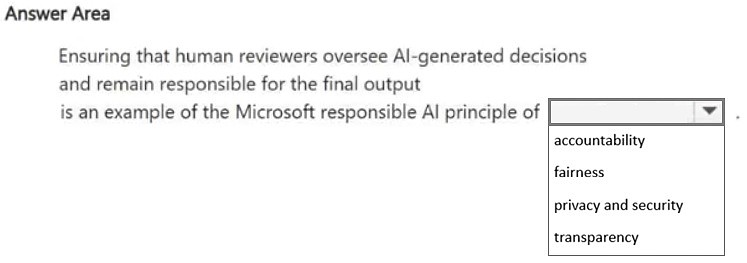
Select the answer that correctly completes the sentence.
Community Insight
The item tests whether you can match a described governance behavior — humans remaining answerable for AI-driven outcomes — to the single correct responsible AI principle, and the trap is choosing Transparency because both principles involve explaining or overseeing AI output.
This AI-901 hotspot asks you to complete a sentence about Microsoft's responsible AI principles, where human reviewers oversee AI-generated decisions and stay answerable for the final output. The page establishes that the correct completion is Accountability, not transparency, fairness, or reliability and safety.
The most common wrong approach is picking Transparency or Reliability and safety because the scenario mentions reviewing AI decisions; learners forget that Transparency is about disclosing how a system works and its limitations, while Accountability is specifically about people owning the outcome.
Community Discussion (1 comments)
Comments & Corrections
No comments yet — spotted an error or have a note? Share it below.
Expert Analysis
Why the Answer Is Correct
Microsoft's six responsible AI principles are Fairness, Reliability and safety, Privacy and security, Inclusiveness, Transparency, and Accountability. The Accountability principle states that people, not the AI system, remain answerable for how AI operates and for the decisions it informs, which is exactly what the sentence in the exhibit describes: human reviewers oversee AI-generated decisions and carry ultimate responsibility. A community member (buianhthang) reached the same conclusion, writing that "people must remain accountable and responsible for how AI systems operate." Governance mechanisms such as human-in-the-loop review boards, sign-off workflows, and escalation paths exist precisely to make that accountability real. Because the sentence pairs human oversight with ultimate ownership of the final output, Accountability is the only principle that completes it without contradicting the wording.Why Other Candidate Answers Are Wrong
Transparency is the most tempting distractor, but it requires only that AI systems be understandable and that their capabilities and limitations be communicated — it does not assign responsibility to a person. Fairness concerns equitable treatment across groups, and nothing in the sentence mentions bias, demographics, or disparate impact. Reliability and safety addresses consistent, dependable, and harm-free operation, which describes system behavior rather than human ownership of decisions. Privacy and security governs data handling and protection, and Inclusiveness is about empowering and engaging all people; neither maps onto the phrase about reviewers taking responsibility for the final output.Community Comment Notes
Only one substantive comment is recorded here, and it votes Accountability with reasoning that aligns with Microsoft's published principle, so it does not conflict with the verdict on this page. The comment's key phrase, "take ultimate responsibility for the final output", is the same signal a test taker should key on in the exhibit image. Because the hotspot image is the only place the exact sentence appears, the safest technique is to read the sentence stem for the ownership verb (reviewers, responsible, answerable) before scanning the principle list. No commenter raised a competing principle, so community consensus and the official principle definition agree in this case.Official Reference
Exam Strategy
Before looking at the principle list, underline the ownership words in the hotspot sentence — reviewers, responsibility, answerable for the output — because AI-901 responsible AI items are almost always decided by a single responsibility verb. If the sentence instead described disclosing limitations or explaining model behavior, Transparency would win; keep those two principles sharply separated in your notes.
Frequently Asked Questions
Why is human oversight of AI decisions an Accountability issue and not Transparency?
Accountability assigns ownership of outcomes to people, while Transparency only requires disclosing how a system works and its limits. The sentence stresses reviewers taking responsibility, which is Accountability.
Which responsible AI principles could appear as the other choices in this AI-901 hotspot?
Expect Fairness, Reliability and safety, Privacy and security, Inclusiveness, and Transparency alongside Accountability. Only Accountability describes people staying answerable for AI-driven decisions.
Related Analysis
Practice All AI-901 Questions
Access 105 questions with complete answers and detailed explanations.
View Full AI-901 Practice Test →