Responsible AI: Accountability, Transparency, and Fairness
HOTSPOT
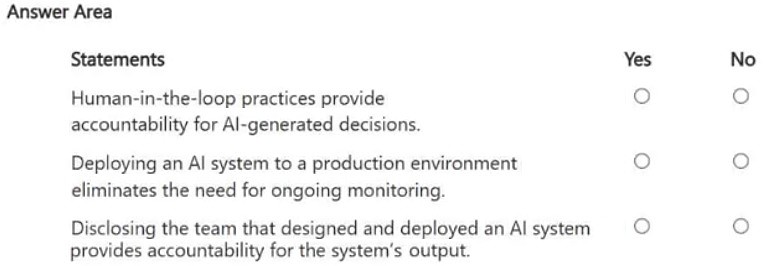
For each of the following statements, select Yes if the statement is true. Otherwise, select No.
NOTE: Each correct selection is worth one point.
Community Insight
The common trap is conflating Accountability with Transparency; while related, Accountability requires governance and audit trails, whereas Naming provides visibility (Transparency).
This question tests the precise definitions of Responsible AI principles, specifically distinguishing between Accountability and Transparency. The correct evaluation identifies that naming a team ensures transparency, not accountability.
Learners often assume that because a named team is responsible, this action constitutes 'Accountability' in the strict sense, ignoring that Accountability is a broader framework of governance rather than just an identification step.
Community Discussion (2 comments)
Comments & Corrections
No comments yet — spotted an error or have a note? Share it below.
Expert Analysis
Why the Answer Is Correct
The first statement is Yes because explicitly naming the team or individuals responsible for an AI system enhances Transparency by making it clear who is behind the model's decisions. The second statement is No because Accountability is defined as the obligation to explain, justify, and take responsibility for outcomes, which involves governance frameworks, documentation, and monitoring, not merely being named. The third statement is Yes because Transparency mechanisms, such as explaining how decisions are made, directly help build Trust by reducing the 'black box' perception of AI.Why Other Candidate Answers Are Wrong
Selecting 'Yes' for the second statement incorrectly equates 'Naming' with 'Accountability'. While naming is a component of transparency, true accountability requires a structured approach to oversight and liability, which goes beyond simple attribution. Selecting 'No' for the third statement would misunderstand the fundamental relationship between transparency and user trust.Community Comment Notes
User Er_01 correctly identified that naming provides transparency but noted that accountability requires governance and audit trails. User Sr18 also highlighted that accountability means being responsible if something goes wrong and does not solely account for transparency, reinforcing the distinction between these two principles.Exam Strategy
When answering questions on Responsible AI principles, carefully distinguish between the core definition of each pillar. Transparency is about openness and visibility (e.g., naming teams, explaining decisions), while Accountability is about ownership and governance (e.g., audits, liability).
Frequently Asked Questions
What is the difference between Accountability and Transparency in Responsible AI?
Transparency focuses on openness and visibility, such as naming teams and explaining decisions. Accountability focuses on governance, taking responsibility for outcomes, and having mechanisms for audit and redress.
Does naming the AI team ensure Accountability?
No. Naming the team primarily ensures Transparency by identifying who is involved. Accountability requires a broader framework including governance, documentation, and monitoring to ensure the team can be held responsible.
Related Analysis
Practice All AI-901 Questions
Access 105 questions with complete answers and detailed explanations.
View Full AI-901 Practice Test →