AI-901 System Prompt Capabilities and Limitations

Identify AI model components and configurations
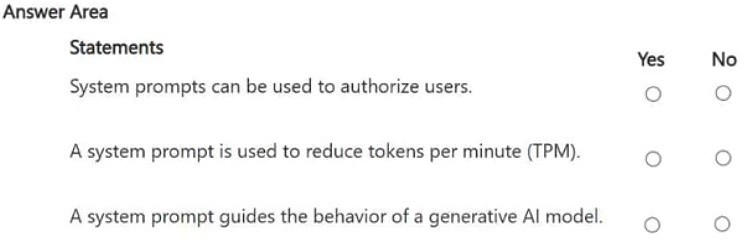
Answer Statement 1 is No. Statement 2 is No. Statement 3 is Yes.

HOTSPOT For each of the following statements, select Yes if the statement is true. Otherwise, select No. NOTE: Each correct selection is worth one point. exhibit
Community Insight

The common trap is confusing the functional role of a system prompt (guiding output) with infrastructure roles like authentication/authorization or service quotas (TPM).

This AI-901 question tests the understanding of system prompts, clarifying that they guide model behavior but do not handle security authorization or rate limiting. The page establishes that system prompts are purely instructional text for the AI model.

Learners often incorrectly assume system prompts can authorize users because they define 'who' the AI is acting as, or believe they reduce TPM by making responses concise, ignoring that TPM is a hard infrastructure limit.

Community Discussion (9 comments)

Trinayana 👍 1
1: No 2: No 3: Yes
imvelez 👍 1
System prompts can be used to authorize users. - No A system prompt is used to reduce tokens per minute (TPM). - No A system prompt guides the behavior of a generative AI model. - Yes
Jedi_Jeremy 👍 1
The second option is poorly worked. You can not DIRECTLY reduce tokens per minute with a system prompt. However, you can indirectly influence by instructing it to reduce the length of the response. Concise responses mean fewer tokens. My gut tells me for the test this is NO. Thoughts?
Mary_Matic 👍 2
System prompts can be used to authorize users (No): Authorization and authentication are handled by platform security, identity providers (like Microsoft Entra ID), or API keys, not by model system prompts. A system prompt is used to reduce tokens per minute (TPM) (No): TPM is a capacity and rate-limiting metric managed by the service infrastructure, unrelated to system prompts. A system prompt guides the behavior of a generative AI model (Yes): System prompts define the persona, rules, role, and guidelines that steer how the model responds to users.
nap61 👍 7
1. System prompts can be used to authorize users. → NO A system prompt cannot authorize anyone. Authorization requires: identity verification tokens roles permissions authentication flows A system prompt is just text that guides the model’s behavior. It has zero security authority. So the correct answer is NO. 2. A system prompt is used to reduce tokens per minute (TPM). → NO A system prompt does not reduce TPM. TPM is controlled by: rate limits model usage request size API quotas A system prompt does not influence billing or throughput. It only influences behavior, not performance. So the correct answer is NO. 3. A system prompt guides the behavior of a generative AI model. → YES This is the true statement. A system prompt: sets tone defines rules establishes constraints guides how the model responds This is exactly what system prompts are designed for. So the correct answer is YES.
Shifin 👍 3
System prompts can be used to authorize users - No (Authorization is handled through authentication and access control mechanisms, not system prompts.) A system prompt is used to reduce tokens per minute (TPM) - No (TPM is a service quota/rate-limit metric. System prompts do not exist to reduce TPM usage.) A system prompt guides the behavior of a generative AI model - Yes (System prompts provide instructions that define the model's role, tone, constraints, and behavior, guiding how it responds to users.)
Avbud 👍 2
1. No -> system prompts can't authorize users, either Entra ID or api key does 2. No -> TPM is configured in deployment settings not via system prompts! 3. Yes
RRandell 👍 4
1. Yes 2. No 3. No A system prompt guides model behaviour, improves response quality, and can reduce harmful outputs. It's core purpose isn't managing TPM
MichaelinX 👍 2
2. A system prompt is used to reduce tokens per minute (TPM). -> No. I think the answer is No? TPM / rate limit / throughput / quota / capacity

Comments & Corrections

No comments yet — spotted an error or have a note? Share it below.

Log in to comment, report an error, or add a note about this question.

Submitted for moderation before publishing. Keep it helpful and respectful.

Expert Analysis

Why the Answer Is Correct

A system prompt provides instructions to the generative AI model to shape its tone, style, and response logic; therefore, it guides behavior (Statement 3 is Yes). It has no authority to verify user identity or grant permissions, which are handled by Entra ID or API keys (Statement 1 is No). Additionally, Tokens Per Minute (TPM) is a service-level quota managed by the platform, not a metric controlled by the prompt content itself (Statement 2 is No).

Why Other Candidate Answers Are Wrong

Some candidates argue that prompting for concise answers reduces token usage, thereby indirectly affecting TPM. However, TPM is a maximum throughput limit enforced by the service provider; while shorter responses use fewer tokens, the prompt does not 'reduce TPM' as a configuration setting. Similarly, confusing 'acting as an admin' in a prompt with actual security authorization is a fundamental error in AI security concepts.

Community Comment Notes

Community consensus strongly supports NO, NO, YES. Users like nap61 and Shifin emphasize that authorization requires identity verification tokens and authentication flows, not text prompts. Several commenters note that TPM is a capacity metric unrelated to prompt engineering strategies.

Exam Strategy

Distinguish clearly between model-level configurations (prompts, temperature) and infrastructure-level constraints (quotas, authentication). Remember that system prompts are for instruction, not security or resource management.

Frequently Asked Questions

Can a system prompt be used for user authentication?

No. Authentication and authorization are handled by external identity providers like Microsoft Entra ID or via API keys, not by the text within a system prompt.

Do system prompts control Tokens Per Minute (TPM)?

No. TPM is a service quota defined by the cloud provider to manage load. While prompts can influence response length, they do not configure or reduce the TPM limit itself.

More AI-901 FAQ →

Related Analysis

Practice All AI-901 Questions

Access 105 questions with complete answers and detailed explanations.

View Full AI-901 Practice Test →

← Back to AI-901 Study Guide