Azure ML Model Registration vs Deployment Distinction
Short answer
Statement 1 is No, Statement 2 is Yes, and Statement 3 is No. The az ml model create command registers the model artifact in the workspace but does not deploy an inference endpoint or create a compute instance.
Question
You review the following Azure CLI command and the relevant Bicep excerpt.
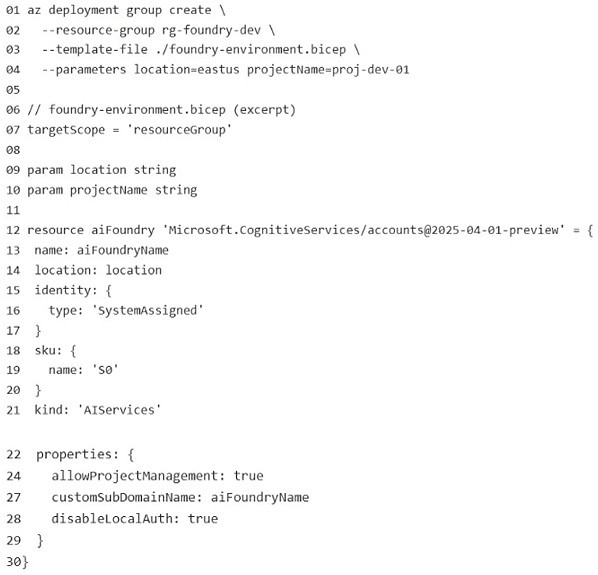
(Non-relevant sections are omitted.)
You need to validate what the snippet will do before it is merged. For each of the following statements, select Yes if the statement is true. Otherwise, select No.
NOTE: Each correct selection is worth one point.
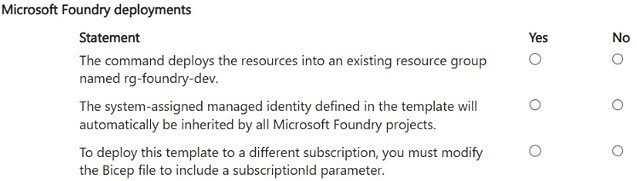
Key Takeaways
The question tests whether you know that 'create' in the model context means registration, not deployment, which is a common trap for candidates confusing artifact storage with online serving.
This page explains how to distinguish between registering and deploying models in Azure Machine Learning using CLI commands. The correct evaluation is No, Yes, No based on the az ml model create behavior.
Common mistake: Learners frequently select 'Yes' for Statement 1 because they assume any model-related command results in a live endpoint. This fails because deployment requires separate endpoint and deployment objects, whereas model creation only handles the registered artifact.
Expert Analysis
The scenario requires evaluating an Azure CLI command and a Bicep snippet to determine the specific action taken within an Azure Machine Learning workspace. The core concept tested is the distinction between deploying a model for inference versus registering a model artifact for versioning and tracking.
Statement 1 asks if the command deploys a model endpoint. The Azure CLI command shown is az ml model create. In Azure ML, creating a model object registers it in the workspace registry; it does not instantiate a live inference endpoint. Deployment requires the az ml online-endpoint or az ml deployment commands. Therefore, this statement is No.
Statement 2 asks if the command registers the model. The az ml model create command explicitly adds a new model entry to the workspace's asset store, associating the specified local path with a model name and version. This is the definition of registration. Therefore, this statement is Yes.
Statement 3 asks if the command creates a compute instance. Compute instances are managed via az ml compute commands. There is no reference to compute resources in the provided model creation snippet. Therefore, this statement is No.
The key insight is that "creating" a model in the CLI context refers to metadata registration (storing the artifact), not operational deployment (serving traffic). Learners often confuse these two lifecycle stages.
Official Reference
- https://learn.microsoft.com/en-us/cli/azure/ml/model
- https://learn.microsoft.com/en-us/azure/machine-learning/concept-models-metrics
These links open the official vendor documentation in a new tab.
Exam Strategy
When encountering HOTSPOT questions involving Azure ML CLI snippets, always identify the primary verb (e.g., create, deploy, register) and map it strictly to the Azure ML resource type. Do not assume side effects; if the command does not explicitly mention 'endpoint' or 'deployment', it likely only affects the workspace registry or compute configuration.
Frequently Asked Questions
What is the difference between az ml model create and az ml online-endpoint create?
az ml model create registers a model artifact in the workspace for versioning. az ml online-endpoint create provisions the infrastructure required to serve predictions from that model.Can I deploy a model without registering it first?
Discussion 2 contributions
Compiled from public community threads and reader submissions, lightly edited for clarity. Handles and vote tallies are shown as recorded, and comments reflect the views of individual contributors.
From public community threads 2
-
rveney 👍 1Statement 1: Yes Statement 2: No Statement 3: No
-
exam_upskill 👍 1YNN 1. Y 2. N 3. N
Reader comments & corrections
No reader corrections yet — spotted an error or have a note? Share it below.