Assessing and Improving RAG Retrieval Quality Sequence
Short answer
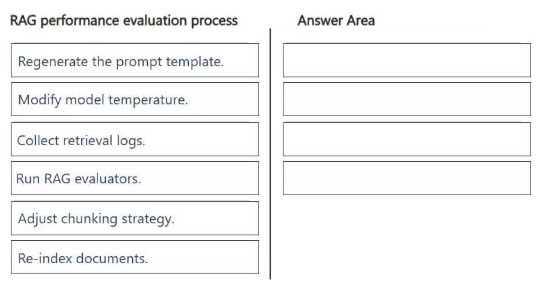
1. Collect retrieval logs, 2. Run RAG evaluators, 3. Adjust chunking strategy, 4. Re-index documents.
Question
A team is developing a Retrieval-Augmented Generation (RAG) system.
The team requires improvements to the system's retrieval quality to ensure accurate, grounded responses.
You need to assess RAG performance before you can suggest an improvement strategy.
Which four actions should you perform in sequence? To answer, move the appropriate actions from the list of actions to the answer area and arrange them in the correct order.
Key Takeaways
The question tests the logical workflow of RAG optimization: diagnosis before action, and implementation after configuration. The common trap is attempting to re-index before adjusting the strategy or running evaluators without data.
This guide explains the correct sequence for assessing and improving Retrieval-Augmented Generation (RAG) systems, specifically focusing on retrieval quality. It establishes that one must collect logs, run evaluators, adjust chunking, and then re-index to implement changes.
Common mistake: Learners often skip the evaluation step, jumping straight to adjusting chunking strategies, or they attempt to re-index documents before changing the chunking logic, which renders the re-indexing useless.
Expert Analysis
Why the Answer Is Correct
The correct sequence begins with Collect retrieval logs to gather empirical evidence of what the system is actually doing. Next, Run RAG evaluators allows you to quantify the quality of these retrievals using metrics like groundedness and relevance. Based on these insights, you Adjust chunking strategy to improve how documents are segmented for better retrieval. Finally, Re-index documents applies the new chunking strategy to the vector store, making the improvement live.Why Other Candidate Answers Are Wrong
Actions like 'Regenerate the prompt template' address generation quality, not retrieval quality, and should be considered only if retrieval issues are ruled out. 'Fine-tune the model' is a more drastic measure typically reserved for when prompt engineering and retrieval optimization fail. Starting with re-indexing is illogical because there is no new strategy to apply yet.Community Comment Notes
Community consensus strongly supports the log-evaluate-adjust-reindex flow. As wwowow noted, "Collect retrieval logs... Run RAG evaluators... Adjust chunking strategy... Re-index documents" represents the standard diagnostic loop. Another user, DAgoGi, confirmed this order aligns with official guidance on optimizing RAG performance.Exam Strategy
When asked about RAG optimization, always separate 'retrieval' improvements from 'generation' improvements. For retrieval, think: Measure -> Analyze -> Change Structure -> Apply. Never change the structure (chunking) without first measuring the current state.
Frequently Asked Questions
Why do I need to collect logs before running evaluators?
Can I skip re-indexing after adjusting chunking?
Discussion 2 contributions
Compiled from public community threads and reader submissions, lightly edited for clarity. Handles and vote tallies are shown as recorded, and comments reflect the views of individual contributors.
From public community threads 2
-
wwowow 👍 4
- Collect retrieval logs (gather the data on what the system actually retrieved) - Run RAG evaluators (score retrieval quality: groundedness, relevance, and so on, that's the assessment) - Adjust chunking strategy (act on the findings, since chunking drives retrieval quality) - Re-index documents (a new chunking strategy only takes effect after re-indexing) Unused: Regenerate the prompt template and modify model temperature, both tweak the generation side, not retrieval quality, which is what the requirement targets. Logic: measure first (logs → evaluators), then improve (chunking → re-index).
-
DAgoGi 👍 1According to GPT 5.6: Step Action Why 1 Collect retrieval logs Gather evidence about retrieved documents and identify retrieval issues. 2 Run RAG evaluators Measure retrieval quality and assess whether the retrieved context is relevant and accurate. 3 Adjust chunking strategy Improve document segmentation based on the evaluation results. 4 Re-index documents Rebuild the index so the updated chunking strategy takes effect. Why not the other options? Regenerate the prompt template: Changes generation instructions rather than directly improving retrieval quality. Modify model temperature: Affects response randomness, not document retrieval quality.
Reader comments & corrections
No reader corrections yet — spotted an error or have a note? Share it below.